8 Ways to Improve Your Captive Rail Rates
Many rail shippers believe that if they are captive to a railroad at a location, they have little leverage to negotiate better rates.
The graph below shows why this isn’t a good way to look at your rail traffic. The graph contains rail rates for Iron or Steel Products (STCC 33123) going into the captive rail market of Nashville, TN.
The question to answer with this graph is:
Why Are Rates So Different at a Destination Market Like Nashville, TN that Is Completely Captive To CSXT?
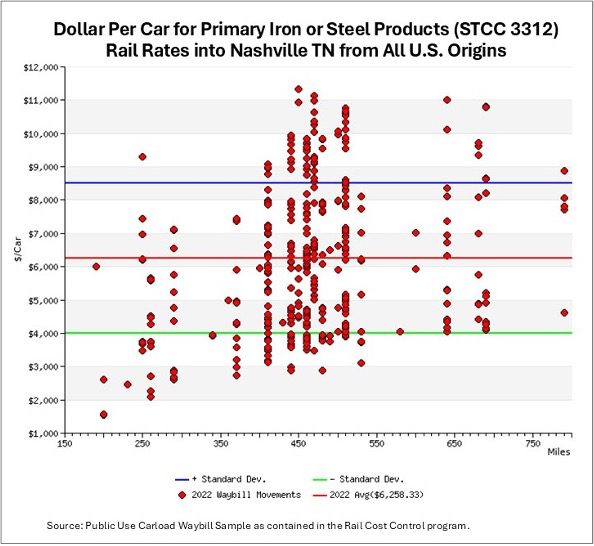
The graph shows that some rates are below $4,000, while other rates going the same distance, are above $9,000. The question is: If Nashville is a captive market, then why aren’t all rail rates above $9,000?
There are many reasons why rates for specific movements vary, but the big picture answer is very simple, Effective Strategic Planning. Shippers that make railroads look at their traffic differently get better rates from their railroads.
Strategic Planning causes captive moves to have different rate levels. Significant downward pressure on rail rates can be generated when the following issues are addressed by shippers in strategic planning.
Eight Ways to Get Better Rail Rates at Captive Locations:
-
Railroads need to compete for your business when you have multiple plants that produce the same product.
- Even when a location is captive to a railroad, a shipper can use geographic competition to obtain lower rates from railroads.
-
Large shippers that bundle all their rail traffic in an RFP can get better rates at captive locations.
- In order for a railroad to get more of a shipper’s competitive traffic it must reduce its rates on captive traffic. More traffic is always better than less traffic in rail rate negotiations. RFP’s that take advantage of a shipper’s entire book of potential business increase negotiation leverage.
-
Forward storage of products at captive locations.
- To avoid bottle necks at captive destinations, explore forward storage options at sites with rail competition, then truck to captive locations. You don’t have to bypass railroads at captive locations forever. Railroads get the message.
-
Take freight costs out of the system with commodity swaps or buy/sell agreements
- Commodity swaps or buy/sell agreements work best when you have a competitor serve your customer when its facility is closer to your customer and you serve a competitor’s customer that is closer to your plant. The higher your rail expenses, the greater the cost savings are for you and your competitor from this type of agreement. Commodity swaps or buy/sell agreements are normally a short-term action as a railroad gets the message pretty quickly that you have competitive options.
-
High rates create the economic incentive to invest capital to increase your logistics options.
- The railroad needs to make it uneconomical for a shipper to take traffic off its system. If your rates are too high, then other logistic and capital investment options become more attractive. A railroad must provide rates that discourage a shipper from investing capital to increase its competitive options. Otherwise, a railroads high rate structure could become a big problem for the railroad.
-
Railroads need to compete against trucking on short and mid distance moves.
- Large rail rate increases allow trucks to compete with rail for longer distance moves. The cost of trucking needs to become the ceiling price for short and mid distance rail moves.
-
Political pressure!
- One of the best and easiest sources of leverage to create is political pressure. Politicians want to talk to you as your company is a great source for tax revenue, political contributions, and you employ many voters. Politicians can be a great benefit because if you have the ear of someone that is important to the railroad, then you become more important to the railroad. There is a right way and a wrong way to address politicians, and all politicians are not equal, which should be considered in your strategic planning.
-
Foreign Imports:
-
- It doesn’t matter if a railroad’s moves are captive, if imports are reducing your domestic production. The shipper and railroads have the same goal with imports – STOP THE BLEEDING. (Additional information on this topic will be contained in an upcoming Blog Article.)
Rail Negotiation Seminar
If you are interested in ways to effectively reduce the rates for your captive rail movements, you should attend Escalation Consultants Rail Negotiation Seminar. For the last forty years, Escalation Consultants, Inc. has conducted the most highly recommended Rail Negotiation Seminar for shippers. The Rail Negotiation seminar changes how shippers negotiate with their railroads. The next seminar is on March 19th and 20th in Tampa, FL. Click the following link for more information:
Rail Cost Control Program (RCC)
Escalation Consultants’ Rail Cost Control program and consulting services are used extensively by shippers to help reduce the rate structure for their movements by managing costs and empowering negotiations. For more information about RCC and other related articles on effective methods to reduce rail freight expenses, visit the RCC Blog.