• RCC Solutions
    • AXIS
    • Rail Rate Checker
    • Cost Optimizer
    • DMS
  • Resources
    • News & Events
    • Seminars & Training
  • Company
    • About Us
    • Contact Us
  • Login
  • Menu Menu

Tag Archive for: RVC

Posts

RCC Blog - Improving Rail Rates on Captive Movements

A Regulatory Perspective: Improving Rail Rates on Captive Movements

July 11, 2023

Improving Rail Rates on Captive Movements

Large increases in railroad’s profitability are improving shipper’s leverage in rate negotiations on captive movements. This is happening because high levels of railroad profit are factored into the RSAM[1] data that the STB uses to determine the outcome of a 3-Benchmark Rate Challenge. Higher railroad profits result in the RSAM data improving the ability for a shipper to win a 3-Benchmark Rate Challenge. This strengthens negotiation leverage on captive movements. 

As an example, based upon the latest RSAM data, a rail shipper’s captive rates could be similar to competitor. However, they would be considered more than 25% above competitors’ rates in a 3-Benchmark Rate Challenge. This will be a big deal for many rail shippers.  

This blog is not intended to make you an expert on the calculation of the STB RSAM data or on everything that goes into a 3-Benchmark Rate Challenger. The intent of this blog is to provide: 

  1. A general understanding of how the 3-Benchmarks are calculated; 
  1. The impact high railroad profits can have on a shipper’s chance of success in a rate challenge; and, 
  1. The potential change in a shipper’s negotiation leverage on captive rail movements is due to the large increase in railroad profitability.  

Calculating the 3-Benchmarks 

The following benchmarks are used in a 3-Benchmark Rate Challenge. The STB calculates the values for Benchmarks 1 and 2. Shippers and railroads each calculate the 3rd Benchmark. 

Benchmark 1 – RSAM (Revenue Shortfall Allocation Mark-up Ratio) 

  • RSAM represents the average Revenue to Variable Cost Ratio (RVC) a railroad would need to generate from its rates on all captive traffic (traffic with RVC’s above 180%) to be revenue adequate. 

Benchmark 2 – RVC>180% 

  • RVC>180% represents the average RVC a railroad obtains from the rates for all of its captive traffic (traffic with RVC’s above 180%) 

Benchmark 3 – RVC-Comp 

  • RVC-Comp is the average RVC for movement rates that are comparable to the rate for the contested movement.[2]  

Importance of Recent Change in RSAM Values on Shippers Chance of Success in a Rate Challenge  

The latest RSAM data substantially improves a shipper’s ability to win a 3-Benchmark Rate Challenge. This is because the recent increases in railroad profitability put significant downward pressure on railroads’ RSAM values and significant upward pressure on its RVC  > 180% value. Thus, your rates could be comparable to competitors, but be considered 25% above these rates in a 3-Benchmark Rate Challenge. 


To be clear, shippers don’t necessarily need to initiate a 3-Benchmark Rate Challenge at the STB. However, shippers do need to understand that a railroad now has more to lose by not listening to a shipper’s concerns about rates and service on moves where there is a lack of rail competition. 

Schedule a quick discovery call to learn how to best navigate these recent increases in railroad profitability & changes in RSAM Values.


[1] RSAM is Revenue Shortfall Allocation Markup Ratio calculated each year by the STB.

[2] Comparable movement rates must have RVC’s above 180%.

https://www.railcostcontrol.com/wp-content/uploads/Rail-Negotiation-Seminar-Survey-Tile-39.png 540 540 Keith Nestman https://www.railcostcontrol.com/wp-content/uploads/new-logo-2.svg Keith Nestman2023-07-11 09:00:292024-12-05 14:53:11A Regulatory Perspective: Improving Rail Rates on Captive Movements
Rail Cost Control Cost Optimizer

Optimizing to Reduce Shippers Rail Expenses

March 31, 2021

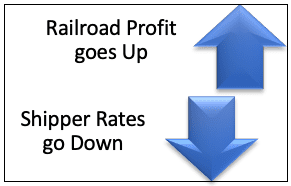
The most productive rail negotiations are win/win negotiations where a shipper gets lower rates and the railroad makes greater profit. These type of win/win negotiations are easier to develop than many shippers realize. The best way to create this type of win/win outcome is by a shipper optimizing railroads rates when performing the bid evaluation.

Optimize Your Rail Spend

Millions of dollars in value are created for shippers and railroads through the optimizing process: 

        • The benefit to shippers is cost reductions of 5% to 15%; while, 
        • Railroads benefit from a substantial increase in revenue and profits.

This optimizing process starts by a shipper calculating the railroad’s long term Variable Cost (Cost). This Cost is calculated for ALL rates in a railroad’s bid. Shippers frequently calculate the railroad’s cost for a movement to show that a railroad is making too much profit from the movement. Unfortunately, this is frequently not very effective.

A more productive use of railroad costs is to better understand how a shipper can increase or decrease railroad’s profits with volumes it can add or takeaway in negotiations.

Calculating railroad’s cost for all of a shipper’s moves, opens opportunities to create greater value for both shippers and railroads. It is best for a shipper to use a macro processing program like the Rail Cost Control Program  (RCC) to calculate the cost of all rail moves at one time. Calculations are effortless, as rail costs are automatically calculated and maintained for use in RCC’s bid evaluation optimizing program.  

Once a shipper knows the railroad’s costs for moves, it has a much better understanding of the economic impact of adding, or taking away, moves from railroads in the bid evaluation. When a railroad’s rates are reduced it becomes the low bidder on more competitive traffic in the bid evaluation. As a railroad wins more competitive traffic, its carloads increase as well as the profit it makes from the shipper’s business.  

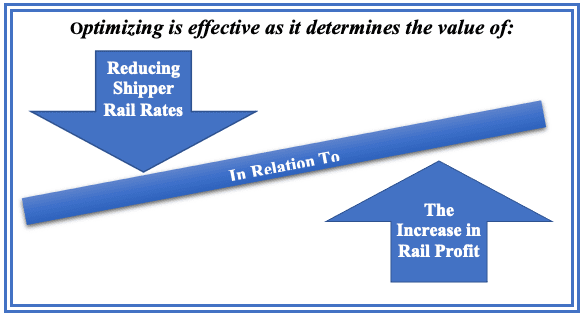
It is important to find win/win opportunities with your railroads. These opportunities come from understanding the relationship between reductions in spend a shipper receives from reduced rates versus the increase in profit the railroad receives from obtaining additional volumes. 

As an example, if competitive rates are reduced by 11% on a railroad resulting in $6 million in savings this looks like a great deal for the shipper. But is this a good deal for the railroad? The shipper needs to know the economic impact on the railroad. If the railroad is awarded an additional 3,100 carloads, because it is now the low bidder on more competitive carloads, the shipper needs to know how this impacts railroad profit. Table 1 provides a summary of the results for the 11% rate decrease.  

Table 1 

 Example of Summary Results for a 11% Rate Reduction on a Railroads Competitive Moves   

Shipper Savings
$6.0 million
Increase in Railroad Profit
$7.3 million
Increase in Railroad Revenue
$13.4 million
Increase in Railroad Carloads
3,100

Railroad Profit vs Shippers Rates

Table 1 shows that the 3,100 additional carloads represent a $7.3 million increase in the railroad’s profit. This is $7.3 million in profit and $13.4 million in revenue the railroad would not get with the rates in its original bid. Table 1 shows that the railroad makes out better than the shipper from the 11% rate decrease. The value to the railroad is $1.3 million greater ($7.3 million versus $6.0 million) than the value to the shipper. By optimizing, you then equalize the benefits from strategic decisions on rates and volumes.

Optimizing created $6 to $7 million in value for both the shipper and the railroad. 

Though the value created by the 11% rate decrease is significant, it may not be the best rate decrease for either the shipper or the railroad. The question that needs to be answered, is how do you know the rate decrease that creates the most value for the shipper and railroad? Would a larger 15% rate decrease generate greater value or would a lower 7% rate decrease work best. Answering this question, you’ll need to know the optimizing Pivot Point for rates in each railroad’s bids for competitive traffic.

Understanding each railroads Pivot Point is important as it: 

  1. Generates greater value from the optimizing process; and, 
  2. Brings captive rail movements rates into the optimizing process. 

Understanding the Pivot Point increases the value created from optimizing. As an example, the Pivot Point for the rail traffic used in this article increases the value created by optimizing by an additional 71% (more than a $5 million increase) . This is not an unusual Pivot Point optimizing result for mid to large rail shippers. Optimizing the rates in railroads bids creates a significant increase in value for the shipper and the railroad. 

It should be noted that though the calculations for optimizing are complex the process has become very easy to perform. For example, the Pivot Point is automatically calculated for the rates in each railroad’s bids in RCC’s: Cost Optimizer.   

Our next blog will address determining the Pivot Point for each railroad and bringing captive rates into the optimizing process. 


 Escalation Consultants, Inc. developed Rail Cost Control (“RCC”)  to help shippers reduce rail expenses by managing costs and empowering negotiations. Furthermore, for more information about RCC and other related articles, visit the RCC Blog.


Rail Cost Optimizer

https://www.railcostcontrol.com/wp-content/uploads/hero_cost_optimizer-scaled.jpg 916 2560 Keith Nestman https://www.railcostcontrol.com/wp-content/uploads/new-logo-2.svg Keith Nestman2021-03-31 08:00:282021-06-01 13:49:34Optimizing to Reduce Shippers Rail Expenses

Pages

  • About Us
  • AXIS
  • Contact Us
  • Cost Optimizer
  • Database Management System
  • Evaluation Exercise Calendly
  • Evaluation Exercise Contact Form
  • Home
  • Landing Page – 2025
  • Movement Evaluation Exercise
  • News & Events
  • PopUp Testing 05172021
  • Privacy Policy
  • Rail Cost Control Demo
  • Rail Rate Checker
  • Seminars and Training
  • YT

Categories

  • Uncategorized

Archive

  • January 2026
  • December 2025
  • November 2025
  • October 2025
  • September 2025
  • June 2025
  • November 2024
  • October 2024
  • June 2024
  • February 2024
  • September 2023
  • August 2023
  • July 2023
  • June 2023
  • February 2023
  • January 2023
  • June 2022
  • February 2022
  • January 2022
  • December 2021
  • October 2021
  • August 2021
  • July 2021
  • June 2021
  • May 2021
  • April 2021
  • March 2021
  • February 2021
  • January 2021
  • December 2020

Escalation Consultants has been serving railroad customers since 1979.

The Rail Cost Control Program is an Escalation Consultants Inc. product. For the last 40 years Escalation Consultants has assisted companies in reducing the delivered cost of their products. We are normally involved with large and small rail shippers in reducing rail expenses on more than a billion dollars in rail spend annually.

Escalation Consultants has spent decades developing tools that automatically seek out and quantify opportunities for reducing rail expenses. The RCC contains these tools and they allow you to look at your movements differently in order to create more cost-effective negotiations with railroads.

To learn about Escalation Consultants Inc, more visit www.EscalationConsultants.com

Quick Links

  • AXIS
  • Rail Rate Checker
  • Cost Optimizer
  • Database Management System
  • News & Events
  • Seminars & Training
  • About Us
  • Contact Us
  • Login

Contact Info

4 Professional Drive, Suite 129
Gaithersburg, MD 20879

info@railcostcontrol.com
301-977-7459 

linkedinfacebook

© 2025 Rail Cost Control. All Rights Reserved.

Scroll to top