• RCC Solutions
    • AXIS
    • Rail Rate Checker
    • Cost Optimizer
    • DMS
  • Resources
    • News & Events
    • Seminars & Training
  • Company
    • About Us
    • Contact Us
  • Login
  • Menu Menu

Archive for category: Uncategorized

Benefits of The Public Use Waybill for Rail Shippers

Benefits of The Public Use Waybill for Rail Shippers

June 17, 2025

Maximizing Negotiations: The Benefits of The Public Use Waybill Sample for Rail Shippers

Negotiating with railroads can be a complex process filled with intricacies that rail shippers must navigate to secure favorable rates and terms. One powerful tool that can aid in these negotiations is the use of the Public Use The Public Use Waybill Sample. Understanding how this sample can benefit shippers not only strengthens their position but also streamlines the entire shipping process.

Understanding the Public Use Waybill Sample

Before delving into the benefits, it’s crucial to comprehend what the Public Use Waybill Sample is. A waybill is a document issued by a rail carrier that provides important details such as the consignor, consignee, the shipment’s destination, route, type, and quantity of goods. It’s an essential piece of paper that acts as a receipt for the goods.

The Public Use Waybill Sample is a 20% sample of all movements that touch US soil and is compiled by the Surface Transportation Board.  The Public Use Waybill offers valuable insights regarding shipping patterns, pricing models, and volumes, effectively transforming raw data into strategic analysis.

Benefits for Rail Shippers

  1. Informed Decision-Making

The Public Use Waybill Sample equips rail shippers with data-driven insights. By analyzing this information, shippers can determine prevalent pricing trends. This understanding enables shippers to make informed choices when selecting routes and carriers to optimize cost-effectiveness and efficiency.

  1. Strengthened Negotiation Position

Access to comprehensive traffic data empowers shippers during rate negotiations. By having a clear grasp of existing market rates and transaction volumes reflected in the Public Use Waybill Sample, shippers can counter with data-backed requests for reductions or improved service terms. Knowledge from these samples provides leverage during conversations with railroad representatives.

  1. Competitive Benchmarking

The Public Use Waybill Sample allows shippers to compare their current operations against industry standards. By examining data on competitors’ shipping patterns and costs, rail shippers can identify areas where they need improvement or adjust strategies to gain a competitive edge. This benchmarking fosters more assertive negotiation stances and aids in aligning business strategies.

  1. Long-term Strategic Planning

Besides facilitating immediate negotiation tactics, the Public Use Waybill Sample offer insights crucial for strategic planning. They help shippers forecast future needs based on historical trends, paving the way for more effective long-term rate agreements and partnership evolutions with railroads.

Conclusion

Public the Public Use Waybill Sample serve as a powerful resource for rail shippers in negotiations with railroads. By offering data-driven insights, they amplify the shipper’s ability to make informed decisions, strengthen bargaining positions, offer competitive benchmarking, identify optimization opportunities, and pave the way for strategic long-term planning. Through effectively utilizing these samples, rail shippers can transform negotiations from mere discussions to strategic, data-supported engagements that yield mutually beneficial outcomes.

Empowered with this information, rail shippers stand a better chance to optimize both pricing and service standards—delivering improved efficiency and profitability in their shipping operations.

How the RCC uses the Public Use Waybill Sample

Rail Cost Control (RCC) leverages the Surface Transportation Board’s Public Use Waybill Sample — a stratified, anonymized snapshot of freight rail movements — to empower shippers in rail-rate negotiations. RCC feeds Waybill data into its proprietary tools, enabling shippers to benchmark existing and proposed rates against anonymized averages and standard deviations for similar commodities and lanes.

For example, RCC might reveal that a shipper’s $4,000 rate for a 450‑mile plastic shipment is significantly above the $2,430 average for similar moves and is above one standard deviation — a powerful argument in pushing for more competitive pricing. By translating large-scale Waybill benchmarks into actionable intelligence, RCC helps identify overpriced lanes and support clients in negotiating or challenging rail rates based on robust, market-based evidence.
 

Click to schedule your introduction to Rail Cost Control

https://www.railcostcontrol.com/wp-content/uploads/Rail-Negotiation-Seminar-Survey-Tile-1.jpg 675 675 Keith Nestman https://www.railcostcontrol.com/wp-content/uploads/RCC-Logo-2026.svg Keith Nestman2025-06-17 14:42:022025-09-04 15:01:15Benefits of The Public Use Waybill for Rail Shippers
RCC Blog: Use Competitor Rates to Reduce Your Rail Rates

Use Competitor Rates to Reduce Your Rates

November 13, 2024

Railroads do not mind shippers saying they have high rates. What does have an impact is showing that a railroad’s rates are putting you at a competitive disadvantage in your markets.

What this means is, in order for a shipper to have reasonable rates, it needs to know something about its competitors’ rates.

Fortunately, obtaining information on competitors’ rail rates is easier than many shippers realize. Railroads are required to submit a large amount of data on their moves to the Surface Transportation Board (STB). This data contains costs, rates, volumes, and profit, which helps shippers become more knowledgeable about the rates they compete against in their markets.

Two primary methods are used for benchmarking a shipper’s rates against competitors:

1) Public Use Carload Waybill Statistics (Waybill)

The Waybill is a large database, containing information on over one million annual rail movements with detail down to the five-digit STCC. The Waybill provides valuable intelligence on rates and carloads:

  1. For specific origin and destination pairs, as well as,

  2. For all origins that serve specific destination markets.

The following scatter graph provides an example of the rate information available for a specific origin/destination pair. The graph contains Waybill rate information for moves between the Houston, TX and St. Louis market areas for Plastic Materials, STCC 28211.

Plastic Rates for moves between Houston and St. Louis

The graph organizes rates by mileage range and our hypothetical shipper’s rate of $6,000 is shown by the purple diamond for this 850-mile move.

The average of all Waybill rates is $4,424 which is shown by the red line.

The blue line shown at $5,400 represents the rate, which is 1 Standard Deviation above average. All moves above $5,400 are therefore in the top 15% of all Houston Plastic rates into this market.

The green line shown at $3,450 represents the rate which is 1 Standard Deviation below average. All moves below $3,450 are in the bottom 15% of all Houston rates into this market.

Some Intelligence Learned from the Graph
  1. There is a wide range of rates for Plastic rail movements between Houston, TX and St. Louis
  2. Rates going shorter distances are priced similar to longer distance moves and, in many cases, are higher than longer distance rates.
  3. The range of rates varies by more than $4,000.
  4. The average rate is $4,424
  5. The shipper’s rate of $6,000 is:
    1. One of the highest rates from Houston into the St. Louis market area
    2. In the top 15% of all rates between Houston and the St. Louis market area.

2) Cost and Profit Benchmark Rates

Cost and profit Benchmarking provides the rate that gives the railroad the average profit received from all movements of your commodity on the whole rail system. No shipper wants to have above average rates, which makes this an important benchmark to understand. This benchmark rate is calculated using data railroads submit to the STB and is determined separately for captive and competitive moves as they have different levels of rail profit.

To demonstrate, Table 1 below contains:

  1. The railroads long term variable cost and Revenue to Variable Cost Ratio (RVC) for the Houston to St. Louis plastic movement

  2. The average Captive, Competitive and Overall Average RVC for all Plastic movements on the whole railroad system (Benchmark RVCs).

  3. Based on the Benchmark RVCs and the specific details for this movement, the table contains rates that would provide the railroad with the average profit being made from all plastic movements. These rate benchmarks are different for Captive and Competitive movements as they have different levels of profit (Benchmark Rates).

Table 1 Railroad Variable Cost for Move – $2,008

 
Cost and Profit Benchmark Rates
Movement RVC/Rate
Captive
Average
Competitive
RVC Ratio
298.8% 275.9% 200.9% 122.8%
Per Car Rail Rates
$6,000 $5,541 $4,034 $2,467


Summary of Waybill and Rail Profit Rate Benchmark Analysis

Table 2 shows the cost and profit benchmark rates that would provide the railroad with no more and no less profit than what railroads make from all plastic movements versus the Waybill market rates and the shipper’s rate:

Table 2: Summary Table for Rate Benchmark Analysis

Cost/Profit Benchmark Rates
Waybill Market Rates

Captive moves (little or no competition)

$5,541

$5,400 (1 STD Above Avg)

Competitive Moves (Direct competition)

$2,467

$3,450 (1 STD Below Avg)

Average of all moves (Partial competition)

$4,034

$4,424 (Average Rate)

Rate for Shipper’s Movement     

$6,000

All benchmark rates are lower than the shipper’s $6,000 rate and the highest benchmark rate is $459 less than the shipper’s rate ($6,000 – $5,541). However, most rates the shipper is competing against are in the $4,000 range. In addition, many movements with Direct competition have much lower rates in the two and three thousand dollar ranges.

To get reasonable rates you first need to know what reasonable rates are.

Railroads thrive on a lack of rate transparency which means it is up to the shipper to provide that transparency. Rate benchmarking provides ammunition that helps protect rail shippers from excessive rates from railroads that hold monopoly power over their traffic.

Railroads react differently to you saying you have high rates than they do to you showing that their rates are putting you at a competitive disadvantage in markets. If you can show railroads where their rates are putting you at a competitive disadvantage you will have much better success in rail negotiations. In addition, if you can show that high rates are causing both you and your railroad to lose volume in markets, you can accomplish a lot with your railroads. This all starts with rate benchmarking.  For information on benchmarking your rates against all competitor origins that serve your destination markets click here to read the “Benchmark to Reduce Rail Expenses” blog article.


The types of rate benchmarks described above are automatically calculated for individual moves or on a macro basis in the Rail Cost Control program (RCC). Click on the link to learn more about the RCC.

The process for determining and negotiating more competitive rates for rail movements is an important part of Escalation Consultants Rail Negotiation Seminar. This seminar changes how shippers negotiate rates with railroads. The next Rail Negotiation Seminar is in Tampa, FL. on March 19th and 20th. Click the link below for more information.  

Rail Negotiation Seminar

Rail Cost Control (“RCC”) is a program developed by Escalation Consultants, Inc. to help shippers reduce rail expenses by managing costs and empowering negotiations. For more information about RCC and other related articles, visit the RCC Blog.”

https://www.railcostcontrol.com/wp-content/uploads/4-2.png 540 540 Keith Nestman https://www.railcostcontrol.com/wp-content/uploads/RCC-Logo-2026.svg Keith Nestman2024-11-13 16:42:462024-12-04 18:22:21Use Competitor Rates to Reduce Your Rates
RCC Blog: Benchmark to Reduce Rail Expenses

Benchmark to Reduce Rail Expenses

November 13, 2024

To reduce rail expenses and consistently improve performance, companies need to consistently benchmark. The reason for benchmarking is simple. If you do not benchmark, you will likely do things the same way next year as you did this year. This means the problems you have this year will not get corrected.

When negotiating with railroads that have monopoly power over your traffic it needs to be recognized that:

You will always tend to receive rate increases

IF

You do not know what reasonable rates are for your movements.

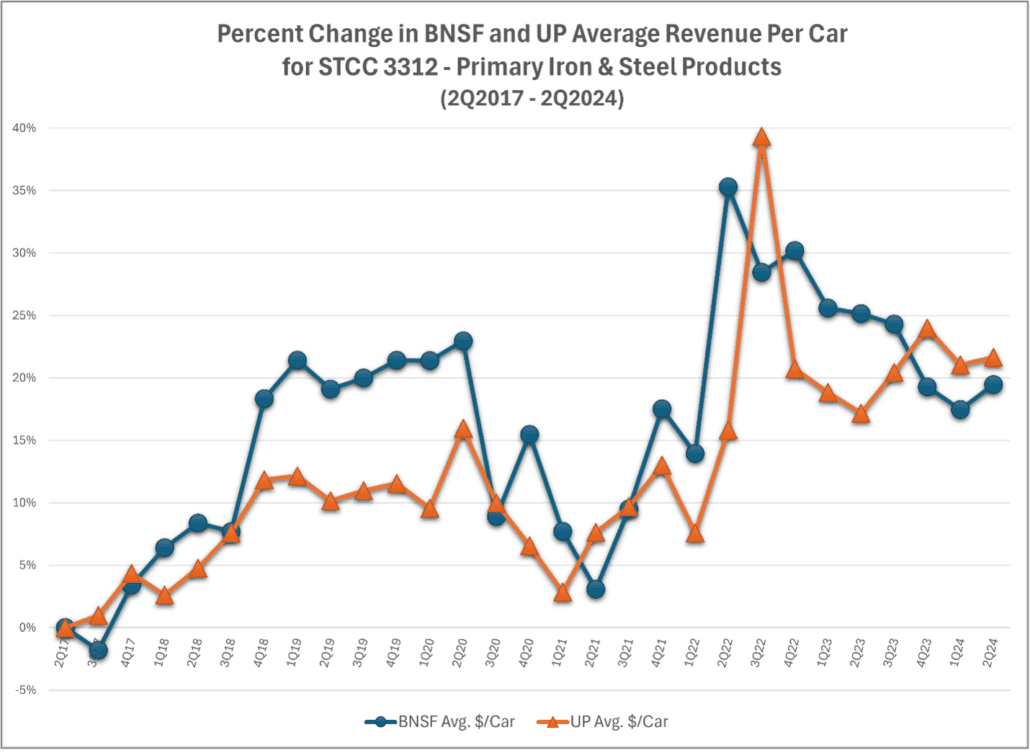
A comparison of railroad’s historical rate changes indicates that railroads are very active with rate benchmarking. The graph below provides an example of the results from railroad benchmarking. It shows the percentage change in average rate per car for all Primary Iron & Steel Products (STCC 3312) BNSF movements, versus UP.

% Change in BNSF & UP Avg Revenue per Car

Source of data: Railroad’s Freight Commodity Statistics as contained in Rail Cost Control

The illustration shows that over the last seven years the percentage change in the average rate per car for all Primary Iron and Steel product moves on BNSF are similar to those of UP. The percentage change in the average rate per car for BNSF and UP frequently separate, but they normally tend to come back to the same type of rate change. The overall average rate change is similar for both railroads during most periods with the railroads exchanging places as to who has the highest rate increases from time to time.

Rail shippers should learn from the practices of railroads and use the data available to them to benchmark their rates against the rates of their competitors.

This is valuable information that will show whether a shipper is being put at a competitive disadvantage in its markets. This market intelligence helps shippers improve their competitive position in markets.

Benchmarking is just common sense. It is always important to find out how well you are doing in the market compared to other companies. To demonstrate, the chart below tracks Grain Mill Products (STCC 204) rates, for movements into the Dallas TX market from major origin locations. Rates are organized on the vertical axis and distance shipped on the horizontal axis.

Waybill Rates for Grain Mill Products

Source of data: Public Use Waybill as contained in Rail Cost Control

The first thing to notice in this illustration is, that the miles for a movement do not necessarily determine the level of the rate for a movement.

For example, movements from Wichita, KS go the shortest distance to Dallas, TX (370 miles) and movements from Des Moines, IA go the longest distance to Dallas, TX (950 miles). However, many of the rates for both of these origins are similar even though Des Moines, IA moves go almost three times the distance. A similar relationship happens with moves from Kansas City, MO. Many of the rates from Kansas City, MO are similar to rates from Des Moines, IA even though Kansas City, MO moves go half the distance to Dallas, TX. This shows that just because you have a geographic advantage in a market does not mean you have a competitive advantage in a market. This is important information for shippers’ marketing and sales departments to know.

When looking at this graph, assume you are a supplier located in Davenport, IA with shipments that travel 950 miles at a rate of $6,701 per car, which is the average rate for all shippers from Davenport, IA into Dallas, TX. Some may say this shipper is getting the average rate from Davenport, IA and has nothing to complain about. But, from the Davenport Shipper’s point of view:

  • Many competitors ship into Dallas, TX with considerably lower rates;
  • Most shippers from Des Moines, IA have significantly lower rates, while shipping a similar distance; and,
  • The average rate into the Dallas, TX market for all movements is $4,589 which is $2,112 less than the average rate from Davenport to Dallas.

If you are a Davenport, IA shipper with a $6,701 rate you would have important issues to discuss with your railroad as you are being put at a competitive disadvantage to shippers from other market areas.

If you are an Omaha NE shipper with a $6,000 rate into Dallas, then the $3000 and $4000 rates of other Omaha shippers are important to discuss with railroads as they are likely hurting your business. Rate benchmarking yields significant savings as it increases your negotiation leverage to obtain better rates for your rail traffic.

Once you know how your rates stack up against competitors in a market, you have a different negotiation with railroads. Your preparation for negotiations will also be different, especially in your important high-volume markets. There are several questions the benchmarking exercise raises:

  1. Are there opportunities to reduce transportation costs through a forward storage site, or transload?

  2. Can a commodity swap or buy/sell agreement with another supplier be negotiated to reduce freight expenses for both companies? (Note- these agreements tend to be short term until a railroad gets the message that you have options)

  3. Can your competitive carloads be bundled with captive carloads in negotiations to obtain better rates from railroads on your captive traffic?

  4. What is the impact on a railroad if you don’t serve specific markets? Will the railroad also lose this business?

Benchmarking rates into a market leads shippers to explore other alternatives for reducing and evaluating rates. The carrier will always say your rate is a market rate; but the carrier’s interpretation of a market rate will include the highest rate any other shipper pays, not necessarily the average rate and certainly not the lowest rate. As long as there is one other shipper with a higher rate, then your carrier’s interpretation will likely be that you have good rates.

Benchmarking helps you educate railroads on:

  • The rates you need;

  • Why you need them; and,

  • The reasons a railroad should give these rates to you.

It is important to benchmark rates with railroads that have monopoly or duopoly power over your traffic. It is important because this is how you determine what rates are reasonable for your traffic. Without the knowledge obtained from benchmarking you will always tend to get rate increases. Companies benchmark to cut costs and improve performance. Railroads do this and so should shippers!

For more information on rail rate benchmarking between specific origins and destinations click the following link to the blog:

Using Competitor Rates to Reduce Your Rates

The process for determining and negotiating more competitive rates for rail movements is an important part of Escalation Consultants’ Rail Negotiation Seminar. This seminar changes how shippers negotiate rates with railroads. The next Rail Negotiation Seminar is in Tampa, FL on March 19th and 20th. Click image below for more information.

Rail Negotiation Seminar

The types of rate benchmarks described in this article are automatically calculated for individual moves or on a macro basis in the Rail Cost Control program (RCC). Click here to learn more about the RCC.

https://www.railcostcontrol.com/wp-content/uploads/7-2.png 540 540 Keith Nestman https://www.railcostcontrol.com/wp-content/uploads/RCC-Logo-2026.svg Keith Nestman2024-11-13 16:39:122024-12-04 18:26:47Benchmark to Reduce Rail Expenses
RCC Blog: 8 Ways to Improve Your Captive Rail Rates

8 Ways to Improve Your Captive Rail Rates

November 13, 2024

Many rail shippers believe that if they are captive to a railroad at a location, they have little leverage to negotiate better rates.

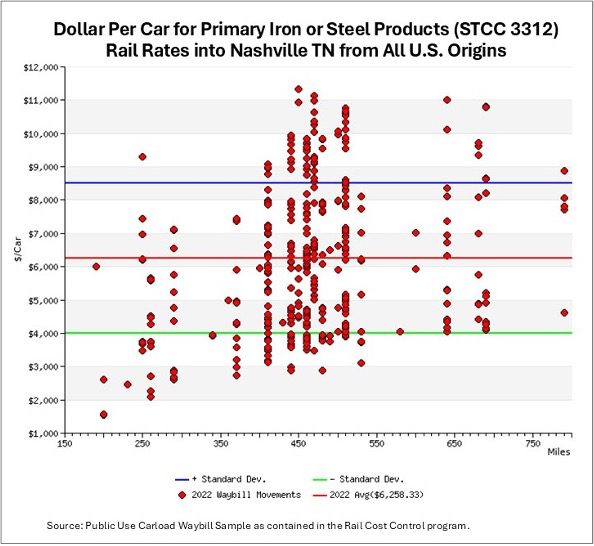
The graph below shows why this isn’t a good way to look at your rail traffic. The graph contains rail rates for Iron or Steel Products (STCC 33123) going into the captive rail market of Nashville, TN.

The question to answer with this graph is:

Why Are Rates So Different at a Destination Market Like Nashville, TN that Is Completely Captive To CSXT?

Dollar Per Car for Primary Iron or Steel Products Rail Rates into Nashville from All US Origins

The graph shows that some rates are below $4,000, while other rates going the same distance, are above $9,000. The question is: If Nashville is a captive market, then why aren’t all rail rates above $9,000?

There are many reasons why rates for specific movements vary, but the big picture answer is very simple, Effective Strategic Planning. Shippers that make railroads look at their traffic differently get better rates from their railroads.

Strategic Planning causes captive moves to have different rate levels. Significant downward pressure on rail rates can be generated when the following issues are addressed by shippers in strategic planning.

Eight Ways to Get Better Rail Rates at Captive Locations:

  1. Railroads need to compete for your business when you have multiple plants that produce the same product.

    • Even when a location is captive to a railroad, a shipper can use geographic competition to obtain lower rates from railroads.
  2. Large shippers that bundle all their rail traffic in an RFP can get better rates at captive locations.

    • In order for a railroad to get more of a shipper’s competitive traffic it must reduce its rates on captive traffic. More traffic is always better than less traffic in rail rate negotiations. RFP’s that take advantage of a shipper’s entire book of potential business increase negotiation leverage.
  3. Forward storage of products at captive locations.

    • To avoid bottle necks at captive destinations, explore forward storage options at sites with rail competition, then truck to captive locations. You don’t have to bypass railroads at captive locations forever. Railroads get the message.
  4. Take freight costs out of the system with commodity swaps or buy/sell agreements

    • Commodity swaps or buy/sell agreements work best when you have a competitor serve your customer when its facility is closer to your customer and you serve a competitor’s customer that is closer to your plant. The higher your rail expenses, the greater the cost savings are for you and your competitor from this type of agreement. Commodity swaps or buy/sell agreements are normally a short-term action as a railroad gets the message pretty quickly that you have competitive options.
  5. High rates create the economic incentive to invest capital to increase your logistics options.

    • The railroad needs to make it uneconomical for a shipper to take traffic off its system. If your rates are too high, then other logistic and capital investment options become more attractive. A railroad must provide rates that discourage a shipper from investing capital to increase its competitive options. Otherwise, a railroads high rate structure could become a big problem for the railroad.
  6. Railroads need to compete against trucking on short and mid distance moves.

    • Large rail rate increases allow trucks to compete with rail for longer distance moves. The cost of trucking needs to become the ceiling price for short and mid distance rail moves.
  7. Political pressure!

    • One of the best and easiest sources of leverage to create is political pressure. Politicians want to talk to you as your company is a great source for tax revenue, political contributions, and you employ many voters. Politicians can be a great benefit because if you have the ear of someone that is important to the railroad, then you become more important to the railroad. There is a right way and a wrong way to address politicians, and all politicians are not equal, which should be considered in your strategic planning.
  8. Foreign Imports: 

    • It doesn’t matter if a railroad’s moves are captive, if imports are reducing your domestic production. The shipper and railroads have the same goal with imports – STOP THE BLEEDING. (Additional information on this topic will be contained in an upcoming Blog Article.)

Rail Negotiation Seminar

If you are interested in ways to effectively reduce the rates for your captive rail movements, you should attend Escalation Consultants Rail Negotiation Seminar. For the last forty years, Escalation Consultants, Inc. has conducted the most highly recommended Rail Negotiation Seminar for shippers. The Rail Negotiation seminar changes how shippers negotiate with their railroads. The next seminar is on March 19th and 20th in Tampa, FL. Click the following link for more information:

Rail Negotiation Seminar

Rail Cost Control Program (RCC)

Escalation Consultants’ Rail Cost Control program and consulting services are used extensively by shippers to help reduce the rate structure for their movements by managing costs and empowering negotiations. For more information about RCC and other related articles on effective methods to reduce rail freight expenses, visit the RCC Blog.

https://www.railcostcontrol.com/wp-content/uploads/8-2.png 540 540 Keith Nestman https://www.railcostcontrol.com/wp-content/uploads/RCC-Logo-2026.svg Keith Nestman2024-11-13 16:23:572024-12-04 18:28:258 Ways to Improve Your Captive Rail Rates
Rail Negotiation Seminar

2025 Rail Negotiation Seminar – Registration Now Open

October 29, 2024

REGISTRATION FOR THE 2025 RAIL NEGOTIATION SEMINAR IS NOW OPEN 

We are happy to announce that registration is now open for the #1 recommended seminar, designed specifically for rail shippers looking to reduce their rail expenses. This highly anticipated event covers proven strategies that increase negotiation leverage with railroads, determining reasonable rates for your rail movements, ways to increase your competitive rail traffic and much more. The Rail Negotiation Seminar changes how shippers negotiate with railroads. The Rail Negotiation Seminar has been the industry standard for shippers looking to reduce rail expenses for more than 25 years. 

Rail Negotiation Seminar

Over the years, this seminar has been attended by thousands of individuals from hundreds of companies that ship by rail.  

We are excited to be able to host this event, once again in Tampa, Florida, and look forward to seeing you all at the Seminar! 

Rail Negotiation Seminar Referrals

https://www.railcostcontrol.com/wp-content/uploads/Rail-Negotiation-Seminar-Survey-Tile-32.png 945 945 Keith Nestman https://www.railcostcontrol.com/wp-content/uploads/RCC-Logo-2026.svg Keith Nestman2024-10-29 17:30:312024-12-05 15:54:112025 Rail Negotiation Seminar – Registration Now Open

Changes in Railroads and Shippers Contracting Practices

June 20, 2024

Rail markets have changed dramatically in recent years.

Shippers must adapt to properly navigate these changes. The results of Escalation Consultants’ annual rail shipper surveys demonstrate how shippers are dealing with the changes being experienced in the rail industry. The survey results highlight critical issues that shippers need to be aware of.

The following results are taken from annual shipper surveys from 2018 through 2023. For reference: the results reflect responses from individuals from over 115 different companies. These companies span all industries that ship by rail. The updated 2024 rail shipper survey results will be released at the September Rail Negotiation Seminar in Washington DC.

Issue 1: Shippers Being Forced to use Tariff Rates

An increasing number of carriers are refusing to renegotiate contracts and forcing shippers to use tariffs or public pricing. 50% of participating shippers said they were experiencing this, and the primary railroads referenced as forcing shippers to tariffs were KCS, NS, and UP. Survey responses indicate a significant increase in the number of shippers being forced into tariffs between 2018 and 2023.

Issue 2: Rate Increases in new contracts

The average rate increase in new contracts in 2023 increased substantially from prior years. In 2023, increases of 5% became the norm for both captive and competitive shipper movements.

Issue 3: Railroads Level of Interest in Shipper’s Competitive Traffic

Almost all shippers (91%) responded that railroads were aggressively going after their competitive traffic.  This was a big change from prior surveys, as back in 2018 less than 10% of shippers were experiencing an aggressive push from railroads to capture all their competitive movements.

Issue 4: Contract Escalation Issues

  1. In 2023 the number of shippers escalating contracts by the All-Inclusive Index Excluding Fuel (AII-LF) more than doubled from prior years. Past surveys showed that pre-established set rates of annual increase were the predominate method being used to escalate contracts. In 2023 the All-LF Index was being used just as much as pre-established set rates of increase.
  1. When the All-LF Index is Used more than 50% of the shippers negotiated an Escalation Collar (Minimum and Maximum rate of change).
  1. The set rate of increase primarily used to escalate contracts went from 3% in past years to 4% in 2023. With a lower rate of annual inflation in the economy this will likely change in the 2024 survey results.

Issue 6: Through Rates Versus Rule 11 Rates

Over time, there has been a steady increase in the number of shippers using Rule 11 rates when more than one Class I Carrier is used in a movement. In 2023, Rule 11 rates were used by 82% of the shippers in the survey. The surveys indicate that through movement rates for multi carrier movements are being used much less frequently.

Issue 7: Pre-Bid Meetings with Railroads

The percentage of shippers that always hold pre-bid meetings with railroads has increased steadily over time. This went from 8% of shippers in 2018 to 22% of shippers in 2022. Shippers that always hold pre-bid meetings then jumped to 62% in 2023. The only shippers that did not always have pre-bid meetings in 2023 answered that they sometimes hold pre-bid meetings.  It appears that pre-bid meetings have become standard practice for rail shippers.


We anxiously await the results of the 2024 rail shipper survey, as the economy has changed dramatically between 2023 and 2024. The 2024 survey results will be released during Escalation Consultants’ Rail Negotiation Seminar.

For over 25 years, Escalation Consultants has hosted the Rail Negotiation Seminar. This seminar has become the most highly anticipated event of the year for rail shippers, as it focuses specifically on improving rail negotiations. Over the years, the seminar has been attended by thousands of people from hundreds of companies across all industries.

The seminar is being held in Washington DC, September 11th- 12th, at the Hyatt Regency, and registration is open!

For more information, or to register for the 2024 Rail Negotiation Seminar, click the image below.

https://www.railcostcontrol.com/wp-content/uploads/Rail-Negotiation-Seminar-Survey-Tile-33.png 540 540 Keith Nestman https://www.railcostcontrol.com/wp-content/uploads/RCC-Logo-2026.svg Keith Nestman2024-06-20 07:00:002024-12-04 18:37:00Changes in Railroads and Shippers Contracting Practices
RCC Blog: The Big Issue with Rail Contract Escalation

The Big Issue with Rail Contract Escalation

February 12, 2024

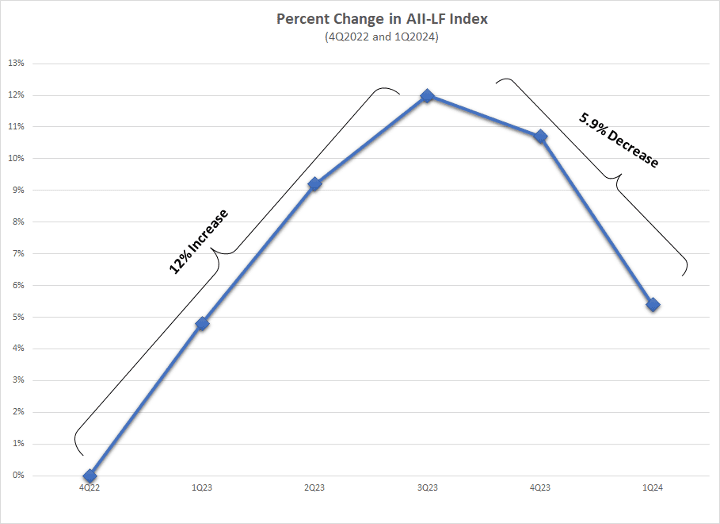
The index most commonly used to escalate rates in rail contracts is the All-Inclusive Index Less Fuel (AII-LF) so the changes in this index have a big impact on the rates most shippers pay for moving rail freight. As a result, the dramatic upward and downward changes that have occurred in the AII-LF index over the last 5 quarters are a big concern to many rail shippers.

Illustration 1 shows that the AII-LF index:

  1. Increased 12% Over the first 3 quarters of 2023, and then

  2. Decreased 5.9% over the next two quarters (Q4 2023 and Q1 2024).

(Illustration 1)

To understand the rate of change to expect from an index it is important to understand what is included in the content of an index and what is driving changes in components of an index. By way of background the AII-LF index is assembled by the Association of American Railroads (AAR), but half of the cost changes that go into the index are tied into changes in BLS Producer Price indexes. However, the most volatile component of the AII-LF index is the Labor component which is assembled by the AAR and currently has a weight of 37% in calculating the overall change in the AII-LF index.

Labor is by far the largest component of the AII-LF index and it is also the major component developed from internal railroad costs. The big swings in the AII-LF index between Q4 2022 and Q1 2024 are directly related to big changes in the values of the Labor component.

These changes were driven by:

  1. The railroads new union wage agreement signed in December 2022, as well as

  2. The 3-year delay in finalizing a new wage agreement with the unions.

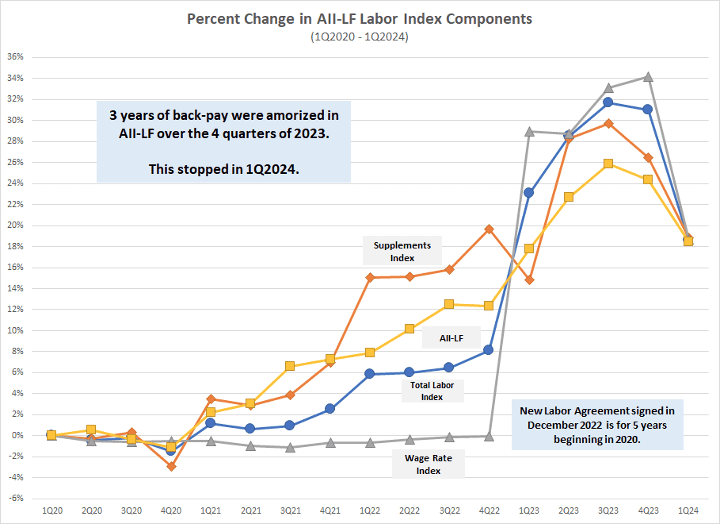
To show the impact that the Labor index has had on the AII-LF index, Illustration 2 tracks percent changes from Q1 of 2020 through Q1 2024.  The illustration includes the percent change in the Labor Index along with its subcomponents of Wages and Wage Supplements, as well as the change in the AII-LF index.

(Illustration 2)

Illustration 2 shows that wages did not change over the 3-years between Q1 2020 and Q4 2022. This is because the old union agreement ended at the end of 2019, but a new agreement was not signed until December of 2022. The Labor index increased over this 3-year period because Wage Supplements increased 20%. However, wages did not change because there was no new agreement with the unions. The overall Labor index increased 8% which was well below the 12% increase in the AII-LF index.

The new Labor Agreement, signed in December 2022 results in the Wage index increasing 29% in one quarter. The large wage increase in Q1 2023 occurred for multiple reasons:

  1. Current Wage Increases

  2. Current $1,000 service recognition bonus

  3. Back pay for prior 3 years of wage increases

  4. Back pay for 3 years of annual $1,000 service recognition bonuses.

There was an immediate lump sum payout of approximately $16,000 per employee for retroactive back pay and annual service recognition bonuses. This $16,000 amount was amortized into the Wage index over the four quarters of 2023. This was a major contributor to the 29% increase in the Wage index between Q4 2022 and Q1 2023. Illustration 2 shows that in 2023 the large increase in wages had a big impact on Wage Supplements, the Labor index and the AII-LF index.

In 2024 most of the amortization of wage costs resulting from the 3-year delay in finalizing a new Wage Agreement went away. For example, back pay amortization in the Wage index went from $7 per hour in Q4 2023 to $0 per hour in Q1 2024. This is the major reason for the big decreases in Q1 2024 in the:

  1. Wage Index

  2. Wage Supplements Index

  3. Labor Index

  4. AII-LF Index

There is an important takeaway from what has happened to the AII-LF index over the last five-quarters. This is that shippers need to do their homework before using this index to escalate rail rates in contracts. Determining whether to escalate contracts by a set rate of annual increase or use the AII-LF index, you need to understand:

  1. The composition of the index

  2. Changes that can be foreseen which will positively or negatively impact the rate of change in the AII-LF index

Rail shippers must prioritize this task as the current Union Wage Agreement expires at the end of 2024. In case of anticipated negotiation delays between unions and railroads, using the AII-LF index for short-term agreements can be advantageous as wage rates won’t increase immediately. However, shippers should expect significant increases in the AII-LF index when there are delays in reaching agreements between unions and railroads.

The uncertainty and volatility in the AII-LF index in recent years is a major reason for using escalation collars when using this index to escalate rates in rail contracts.

https://www.railcostcontrol.com/wp-content/uploads/Rail-Negotiation-Seminar-Survey-Tile-34.png 540 540 Keith Nestman https://www.railcostcontrol.com/wp-content/uploads/RCC-Logo-2026.svg Keith Nestman2024-02-12 23:00:272024-12-04 18:38:40The Big Issue with Rail Contract Escalation
STB Proposes Rule to Improve Poor Service for Captive Rail Movements

STB Proposes Rule to Improve Poor Service for Captive Rail Movements

September 18, 2023

STB Proposes Rule to Improve Poor Service for Captive Rail Movements (Docket EP 711)

The STB has issued a Notice of Proposed Rulemaking to provide rail customers with access to reciprocal switching as a remedy for poor service. The proposed regulations provide a streamlined path for obtaining a reciprocal switching agreement when service to a terminal area  shipper fails to meet any of three performance standards.

The proposed standards reflect a minimal level of rail service below which a shipper would be entitled to relief. Each standard provides an independent path for a petition to obtain a reciprocal switching agreement. The standards employ Board-defined terms which can be applied across all Class I rail carriers and their affiliated companies. To readily monitor and measure rail service the rule would require all Class I railroads to provide their customers with the historical data for these service metrics within seven days of a customer’s request. All three Service metrics would be standardized across all Class I railroads.

The three proposed service standards are:

  1. Service Reliability:

    • The measure of a Class I railroad’s success in delivering a shipment by the Original Estimated Time of Arrival (OETA) provided to the shipper. Actual performance would be compared to railroads OETA provided to the shipper over a lane for 12 consecutive weeks. One proposed approach would be that at least 60% of the shipments for a movement must arrive within 24 hours of the OETA for minimum service reliability during the first year after the rules effective date. This would increase to 70% during the second year after the rules effective date.

  2. Service Consistency:

    • The measure of a railroad’s success in maintaining, over time, the railroad’s efficiency in moving a shipment through the rail system. This standard is based on the transit time for a shipment. For loaded cars, unit trains and empties, a petitioner would be eligible for relief if the average transit time for a shipment increased by a certain percentage (potentially 20% to 25%) as compared to the average transit time for the same 12-week period during the previous year.

  3. Inadequate Local Service:

    • This service metric provides rail customers with information on all important first mile/last mile service. Local service would be deemed inadequate if the railroad had an Industry Spot and Pull (ISP) success rate of less than 80% over a period of twelve consecutive weeks in performing local deliveries and pick-ups. The ISP success rate measures whether the railroad provides service within its customary operating window for the affected shipper, which in no case can exceed 12 hours.   


Under the proposed rule a reciprocal switching agreement would be for a minimum period of two years and up to a maximum of four years.

The STB is to be commended for developing this process for assisting rail shippers with inadequate service. There are, however, several issues that need to be addressed and finalized in the proposed rulemaking:

  1. The percentages that are used to determine what is acceptable service in each of the three-service metrics.

  2. The reciprocal switching fee that the incumbent railroad is allowed to charge an alternate railroad. Setting switch fees based on the cost of service is being considered along with other options. Having pre-determined switch fees is a major part of the inter-switching regulations in Canada but pre-determined switch fees are not being considered in the STB’s proposed ruling.

  3. The STB has no authority over contract movements, and it needs to be determined if the proposed ruling would apply to traffic that is provided under rail transportation contracts.

  4. It needs to be determined whether the service metrics can consider performance data of railroads under rail contracts or are limited to service for tariff movements.

Comments on the proposed rulemaking are due by October 23, 2023. Rail shippers are encouraged to review the Proposed Rulemaking and submit comments to influence the final outcome of the regulation as this will likely have a big impact on a very large number of shippers.

Rail Cost Control Discovery Call

https://www.railcostcontrol.com/wp-content/uploads/Rail-Negotiation-Seminar-Survey-Tile-14.png 1080 1080 Keith Nestman https://www.railcostcontrol.com/wp-content/uploads/RCC-Logo-2026.svg Keith Nestman2023-09-18 18:41:142023-09-25 20:16:03STB Proposes Rule to Improve Poor Service for Captive Rail Movements
RCC Blog - Reducing Rates on Captive Rail Movements - Part 2

Reducing Rates on Captive Rail Movements – Part 2

September 15, 2023

Information on Your Railroad that Helps Reduce Rates on Captive Rail Moves

Most shippers agree there are certain things they must know about the railroads with which they do business. Shippers tend to agree they need to know what is happening with costs and rates at their railroads. Even if this type of information does not result in any type of benefit to their rates or services, it is simply required knowledge for a professional in rail transportation. Shippers have found the following railroad data to be very valuable in negotiations.

The Cost of Specific Movements

Shippers need to know the margin railroads make on their movements. This data can be valuable in answering the following types of questions.

  • How low could a rate go if a shipper had competitive alternatives?
  • What is the profitability of individual movements for a railroad?
  • How much combined profit do all of a shipper’s movements provide to individual railroads? (How important are you to a railroad?)
  • How much profit will a railroad lose if you take certain movements away and how much profit will it gain if you add movements?
  • How will the railroad’s costs change if you change the parameters of your movement?
  • And, frequently most important:
    • What the railroads RVC’s for your major movements are in relation to benchmark RVC’s for your commodities.

How Much of a Shipper’s Commodity is Carried by a Railroad

Do you represent 80% of the shipments of a commodity on a railroad, or only 1% of all its shipments? You need to know whether you are the railroad’s only opportunity for carrying a commodity to certain markets. If that is the case, you need to partner with the railroad to penetrate certain areas and that needs to set the tone for negotiations. If a shipper is captive to a railroad but is the only opportunity for that railroad to obtain market share in a region, then it makes no sense for the railroad to give the shipper monopoly level rates. Shippers need to point these opportunities out to their railroads and demonstrate that rate increases are not beneficial to either of their volume and profit objectives.

The Political Impact You Can Have on a Railroad

One of the best and least frequently used methods of increasing negotiation leverage with railroads is political pressure. Railroads frequently interact with state and local officials in areas where shipper’s offices are located. Understanding what a railroad needs from local officials and how your company can help or hurt the railroad’s efforts is a good source of leverage, which frequently goes unused.

On the national level, involvement with congressional representatives in Washington, as well as with the STB can make a shipper much more important to a railroad. The government regulates railroads, and the greater a shipper’s input and access to politicians and regulators, the greater its potential leverage with a railroad.

Escalation Consultants has developed political leverage for many shippers and what we have found is that there is a right way and wrong way to address rail issues with politicians. In addition, all politicians are not equal in the eyes of railroads, but if you do this properly you become more important to a railroad. To give an example, after generating political pressure we had a meeting with the railroad. In the meeting our client was told that it was not the largest shipper of its commodity on the railroads system, but it was now the most important shipper of the commodity. The takeaway from this example is that if you have the ear of someone that is important to a railroad, then you become more important to that railroad.

Click here to read: Reducing Rates on Captive Rail Movements – Part 1


Rail Cost Control Discovery Call

https://www.railcostcontrol.com/wp-content/uploads/Rail-Negotiation-Seminar-Survey-Tile-36.png 540 540 Keith Nestman https://www.railcostcontrol.com/wp-content/uploads/RCC-Logo-2026.svg Keith Nestman2023-09-15 16:17:472024-12-05 14:47:18Reducing Rates on Captive Rail Movements – Part 2
RCC Blog - Using Information Within Your Company to Reduce Captive Rail Rates

Using Information Within Your Company to Reduce Captive Rail Rates

August 17, 2023

Reducing Rates on Captive Rail Movements – Part 1

Shippers need to understand everything they have to put on the table in a rail negotiation. The more a shipper knows about the overall volume his company currently ships and will ship in the future, the greater its bargaining power. The following are some examples of in-house information that can be valuable in negotiations.

The Total Inbound and Outbound Traffic the Whole Company Moves on a Specific Railroad

A shipper needs to assess the company’s total market power with a particular railroad. This is especially the case if one traffic department manages inbound traffic and another outbound traffic, if different traffic departments handle different commodities, or if suppliers handle inbound traffic. You need to know the total dollars and volume your company represents to a railroad to understand your leverage and all of the options available to help or hurt a railroad’s profitability.

The Company’s Future Plans to Increase Market Share

Data showing how rail volume is projected to increase can be helpful in demonstrating that a railroad can be more profitable by holding rates down than by increasing rates, particularly when additional sales volume will not materialize with excessive rail rates.

How Much Freight Expenses Represent to the Sales Price of Commodities

Documenting a direct connection between rail rates and sales volume can provide an incentive for a railroad to minimize rate increases. The ratio of freight expenses to sales price over time is also helpful in tying rail rates to sales volume.

Past and Current Service Problems with a Railroad

Documenting service problems can be useful in rate negotiations if the railroad’s lack of service is already creating additional expenses for a shipper. The incentive for the railroad to correct service problems is increased if the railroad receives more carloads by improving transit times. Since the number of carloads you move can have a direct effect on the railroad’s cost for a movement, improving services can lower the railroad’s cost and increase the profitability under existing rates.

How Competitive Rail Traffic on Railroads can be Increased by Changing How You Deal with Railroads Internally

There are numerous ways this can be achieved, the following are a few pertinent points for shippers to consider.

  • Using Rule 11 movements vs Through movements to increase the total competitive carload volume on each railroad.
  • Having railroads quote rates through multiple gateways to increase the routing and pricing options for each movement  [3 pricing options, instead of 1 can be very beneficial].
  • If you produce the same product at multiple plants, use geographic competition to change the status of a movement from captive to competitive.
  • Determine if your customers can accept shipments by truck?

Many rail shippers don’t fare as well as they should in negotiations because their railroads know more about their business than the shippers’ transportation department. Transportation represents a big expense for most companies and every transportation department needs to be in the loop on issues related to sales volume, market share and projected plans for increasing market share. Without this information, money tends to be left on the table in rail negotiations, making it more difficult for a shipper to achieve its sales objectives and profit goals.


Rail Cost Control Discovery Call

https://www.railcostcontrol.com/wp-content/uploads/Rail-Negotiation-Seminar-Survey-Tile-37.png 540 540 Keith Nestman https://www.railcostcontrol.com/wp-content/uploads/RCC-Logo-2026.svg Keith Nestman2023-08-17 20:39:182024-12-05 14:48:46Using Information Within Your Company to Reduce Captive Rail Rates
Page 2 of 6‹1234›»

Pages

  • About Us
  • AXIS
  • Contact Us
  • Cost Optimizer
  • Costing Dashboard Update
  • Database Management System
  • Evaluation Exercise Calendly
  • Evaluation Exercise Contact Form
  • Home
  • Landing Page – 2025
  • Movement Evaluation Exercise
  • News & Events
  • PopUp Testing 05172021
  • Privacy Policy
  • Rail Cost Control Demo
  • Rail Rate Checker
  • Seminars and Training
  • YT

Categories

  • Uncategorized

Archive

  • March 2026
  • February 2026
  • January 2026
  • December 2025
  • November 2025
  • October 2025
  • September 2025
  • June 2025
  • November 2024
  • October 2024
  • June 2024
  • February 2024
  • September 2023
  • August 2023
  • July 2023
  • June 2023
  • February 2023
  • January 2023
  • June 2022
  • February 2022
  • January 2022
  • December 2021
  • October 2021
  • August 2021
  • July 2021
  • June 2021
  • May 2021
  • April 2021
  • March 2021
  • February 2021
  • January 2021
  • December 2020

Rail Cost Control is a product of Escalation Consultants, Inc.—serving railroad customers since 1979.

Quick Links

  • AXIS
  • Rail Rate Checker
  • Cost Optimizer
  • Database Management System
  • News & Events
  • Seminars & Training
  • About Us
  • Contact Us
  • Login

Contact Info

4 Professional Drive, Suite 129
Gaithersburg, MD 20879

info@railcostcontrol.com
301-977-7459 

linkedinfacebook

© 2025 Rail Cost Control. All Rights Reserved.

Scroll to top

2026 Rail Negotiation Seminar 1