• Solutions
    • AXIS
    • Rail Rate Checker
    • Cost Optimizer
    • DMS
  • Company
    • About Us
    • Contact Us
  • News & Events
  • Seminars and Training
  • Login
  • Start Your Free Trial
  • Schedule Call
  • Menu Menu

Archive for category: Uncategorized

Change in RR's Inflation Premium Above Expenses

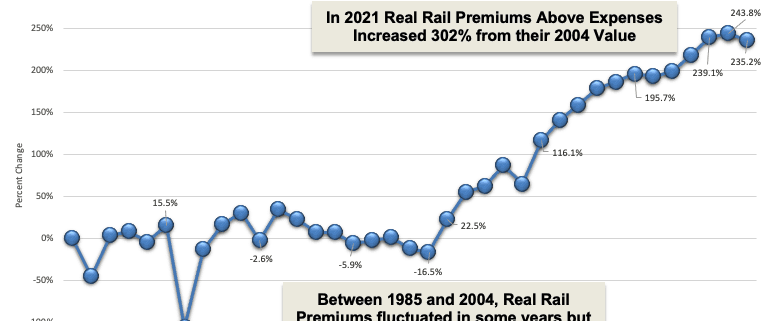
302% Increase In Rail Premiums Above Expenses

January 24, 2023

2023 Rail Negotiation Seminar Early Bird Pricing

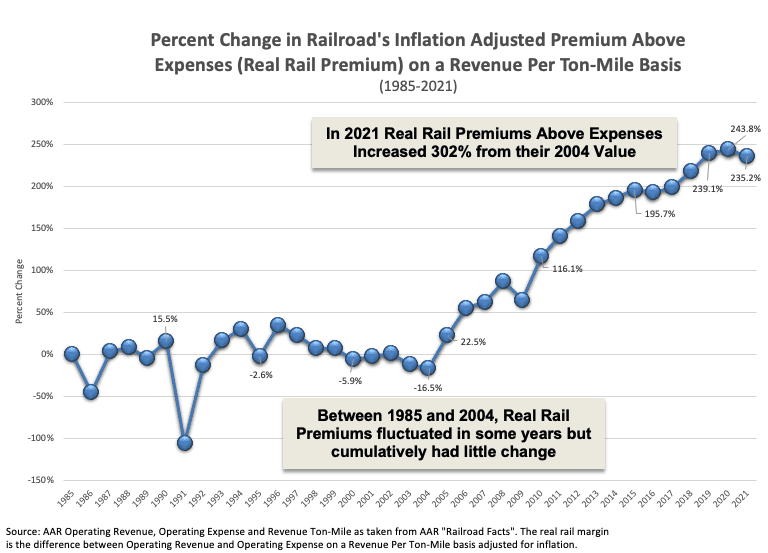
The premium railroads make above their operating expenses, in inflation adjusted terms (Real Terms), has dramatically increased in recent years, but not in the more distant past.

Change in RR's Inflation Premium Above Expenses

The chart shows:

  1. Railroad profit, as measured by the difference between railroad’s Real operating revenue and expenses, increased 302% since 2004.
  2. Over the prior 19 years (1985 – 2004) Real rail profits fluctuated in some years, but cumulatively did not change.
  3. In Real Terms railroad profits simply kept up with inflation between 1985 and 2004.

The goal of effective rail negotiations is for a shipper to minimize rates that generate the type of results obtained by railroads in recent years by developing leverage to maximize the type of results obtained by shippers in prior years.

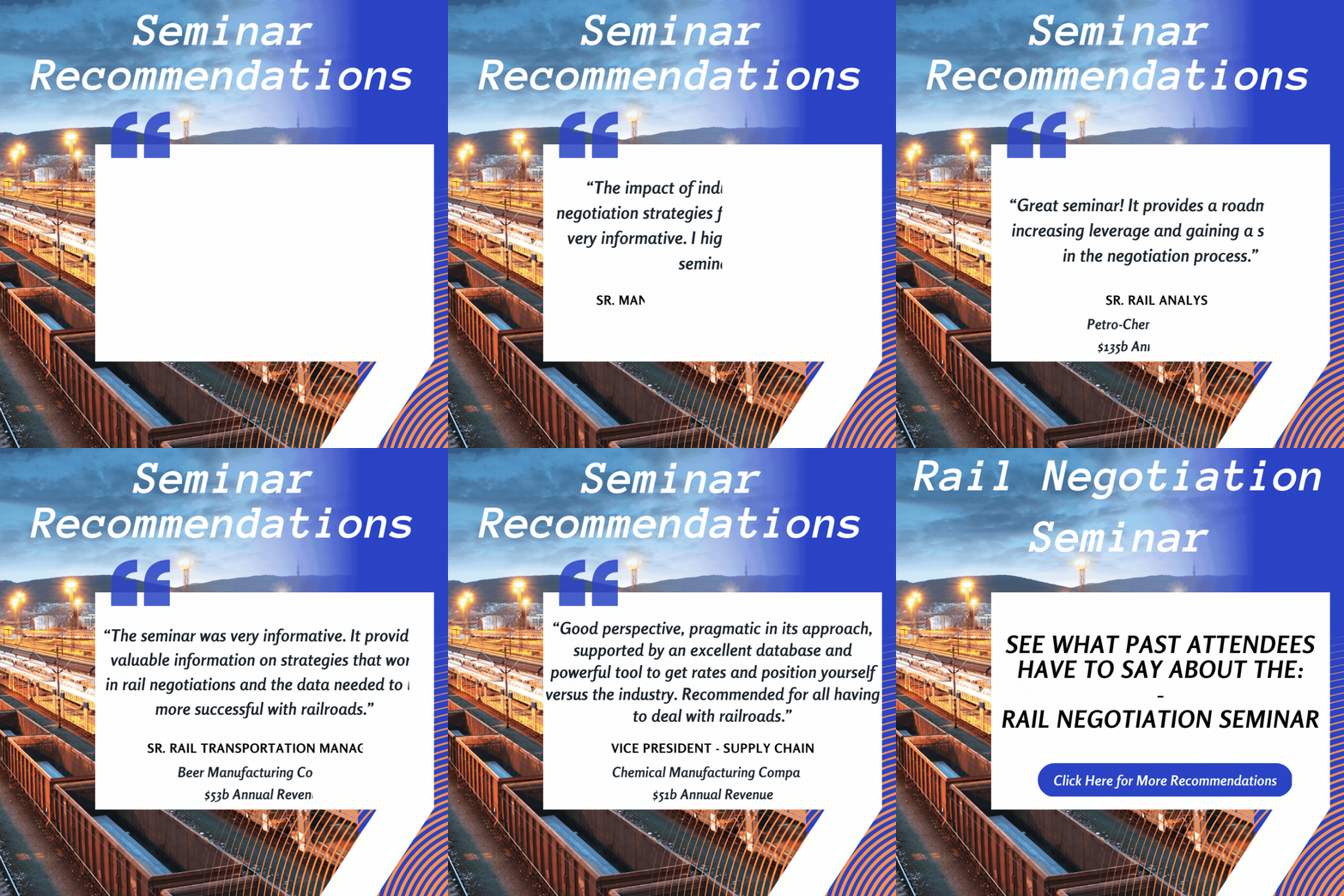
How shippers structure their rail negotiations has a big impact on their ability to control the cost of rail freight. The Rail Negotiation Seminar is a program that is structured to improve rail negotiations and stop shippers’ cost of rail freight from always increasing.  Don’t just take our word, check out the recommendations of past attendees to this program.  

Rail Negotiation Seminar Recommendations

Some important topics covered in the seminar that increase negotiation leverage:

  • Negotiation leverage not related to the competition for a movement
  • The benefits of being proactive and not reactive with railroads
  • Structuring the RFP to reduce cost by creating more pricing options
  • Optimizing your rail spend to increase negotiation leverage with railroads

Don’t wait to register – Early Bird pricing is available through January 31st! For more information about the Rail Negotiation Seminar, click banner below to download the brochure. 

2023 Rail Negotiation Seminar Brochure

https://www.railcostcontrol.com/wp-content/uploads/Screen-Shot-2023-01-24-at-9.05.57-AM.png 553 768 Keith Nestman https://www.railcostcontrol.com/wp-content/uploads/RCC-Logo-2026.svg Keith Nestman2023-01-24 17:49:132023-07-07 15:42:02302% Increase In Rail Premiums Above Expenses
STB’s Annual Rail Rate Index Study: A Deeper Dive

STB’s Annual Rail Rate Index Study: A Deeper Dive

January 23, 2023

As of January 27, 2022, the newly released STB Annual Rail Rate Index Study (Study) summarizes trends in freight rail rates between 1985 and 2019. The Study shows that inflation-adjusted Real Rail Rates have decreased 27% over the past 34 years. Because Real rail rates are lower now than in 1985, the STB Study may be read by some to imply that current rail rates are reasonable in relation to what they have been historically. Unfortunately, this is not an accurate conclusion, because the historical trend in rates provides an incomplete picture of the change in cost of shipping freight by rail.


To read the full article, click below:

STB’s Annual Rail Rate Index Study: A Deeper Dive

https://www.railcostcontrol.com/wp-content/uploads/Screen-Shot-2023-01-24-at-11.40.29-AM.png 1256 1574 Keith Nestman https://www.railcostcontrol.com/wp-content/uploads/RCC-Logo-2026.svg Keith Nestman2023-01-23 18:45:202023-01-24 19:15:52STB’s Annual Rail Rate Index Study: A Deeper Dive
Rail Rate Increases by Commodity

Staggering Rail Rate Increases Across Commodities

January 19, 2023

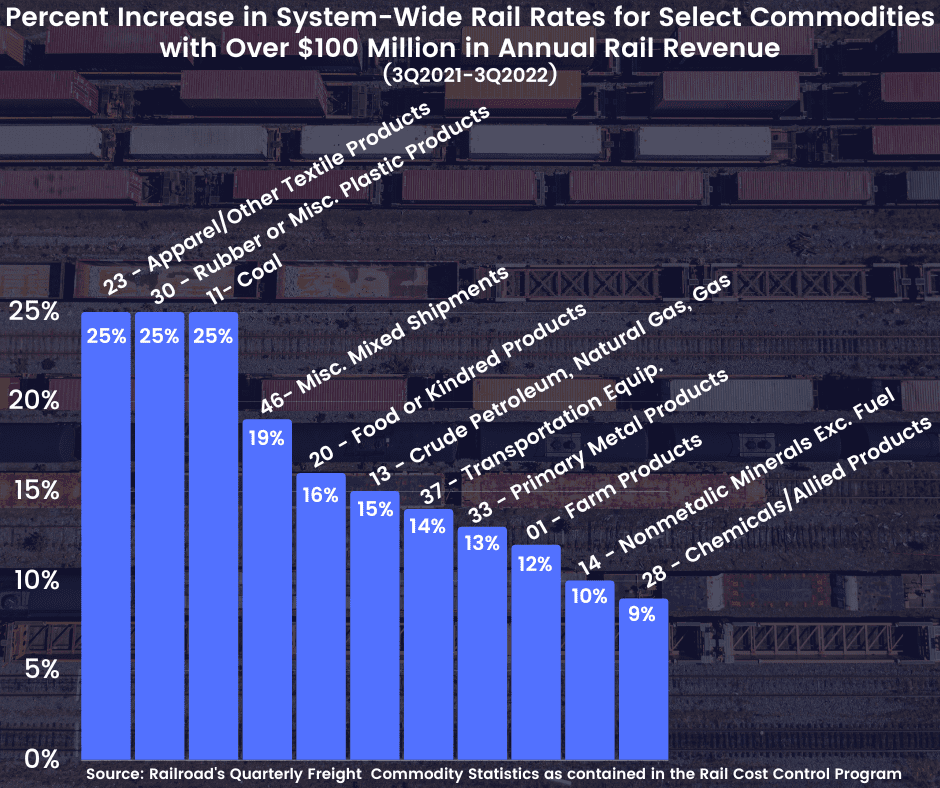
Rail Negotiation Seminar Early Bird PricingThe cost of shipping by rail has increased more in 2022 than any year in the working life of most transportation people!


Rail Rate Increases by Commodity

[Percent Increase Measures the Average Revenue Per Car Including Fuel Surcharge Revenue]


Results from analysis of 2022 rail rates:

  • Double digit rate increases, including fuel surcharge revenue, have become the norm and are no longer the exception.

  • Of the 36 two-digit Standard Transportation Commodity Codes, 69% have had double digit rate increases in 2022.

  • The rate increases railroads are obtaining from different commodities varies dramatically.

Understanding railroads revenue goals for your moves and how you can impact those goals can have a significant impact on your cost of moving rail freight.

The 2023 Rail Negotiation Seminar contains essential information and strategies you need to control rail freight expenses in the current rail market.

Rail rates have increased to the point where the cost of not exploring all your best avenues for better controlling rail expenses is just too costly.

The Rail Negotiation Seminar is an annual event that has changed how many shippers interact with their railroads and this is the most highly recommended program for helping shippers reduce expenses. View the seminar recommendations to find out why.

For information on the Rail Negotiation Seminar and why this program is so important to shippers in the 2023 rail market, click the link below to obtain a brochure for the seminar.

2023 Rail Negotiation Seminar Brochure

https://www.railcostcontrol.com/wp-content/uploads/8-1.png 788 940 Keith Nestman https://www.railcostcontrol.com/wp-content/uploads/RCC-Logo-2026.svg Keith Nestman2023-01-19 19:44:562023-01-19 20:48:51Staggering Rail Rate Increases Across Commodities
Major Railroad Rate Increases

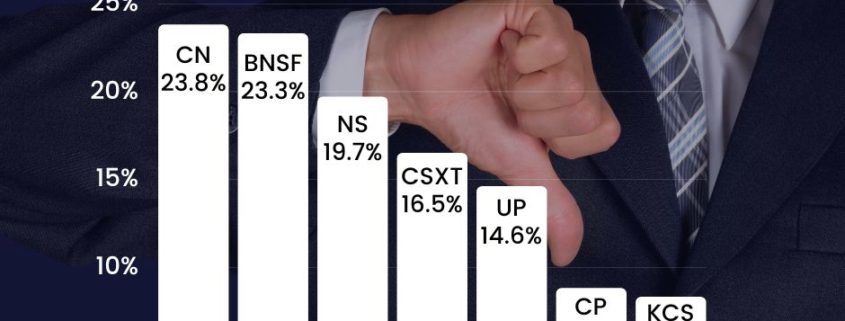
Big Changes in Cost of Rail Freight

January 13, 2023
Read more
https://www.railcostcontrol.com/wp-content/uploads/2023-Rail-Rate-Percent-Increases-.jpg 788 940 Keith Nestman https://www.railcostcontrol.com/wp-content/uploads/RCC-Logo-2026.svg Keith Nestman2023-01-13 22:02:082023-01-17 18:16:54Big Changes in Cost of Rail Freight
RCC Blog: Acknowledging Railroad Service Issues

Are Railroads Turning the Corner on Bad Service?

June 1, 2022

Much has been written about current problems with the United States supply chain. The problems are far ranging, but the primary focus has been on:

  • The backlog of ships at ports;

  • The breakdown of rail service at major ports, which is making it more difficult to clear docks; and,

  • Poor rail service for important Agricultural commodities like Grain and Fertilizer

To assess the current situation with service, this article takes a closer look at railroad’s overall performance of Intermodal, Unit Train, and Manifest traffic. Railroad operating results indicate that service problems are stabilizing on a large segment of rail traffic and the hope is that this is the start of an overall improvement in rail service.

Change in Carloads

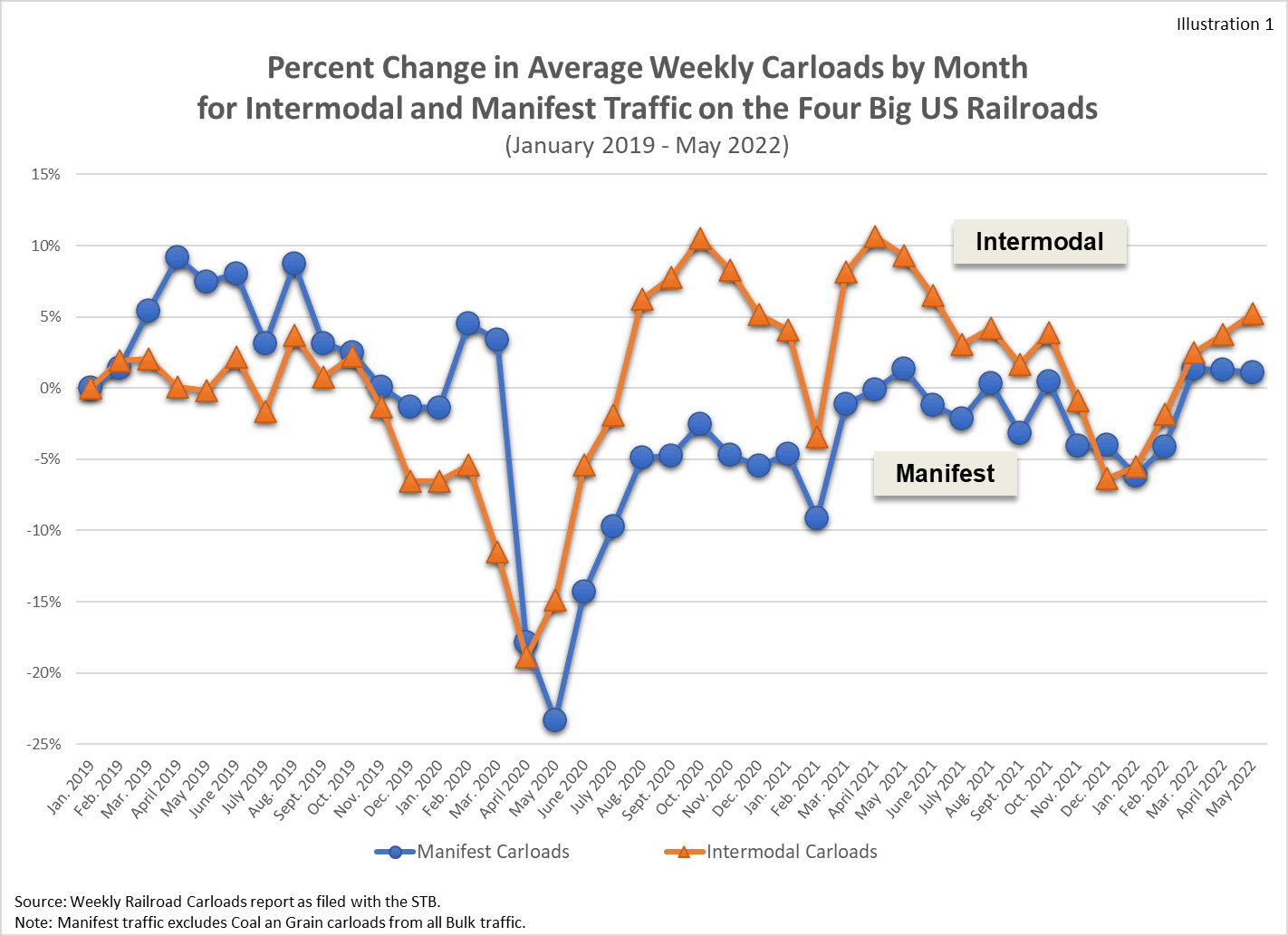
Illustration 1 tracks the percent change in monthly Intermodal carloads versus Manifest carloads on the four major U.S. railroads between January 2019 (beginning of pandemic) and May 2022.

Service Issues Blog 1

Illustration 1 shows that Intermodal carloads recovered more quickly than Manifest carloads from the height of the Covid pandemic in May 2020. Unlike Manifest traffic, Intermodal carloads exceeded pre-Covid levels in much of 2020 and 2021. However, by March 2022 Intermodal and Manifest carloads were both above pre-Covid levels.

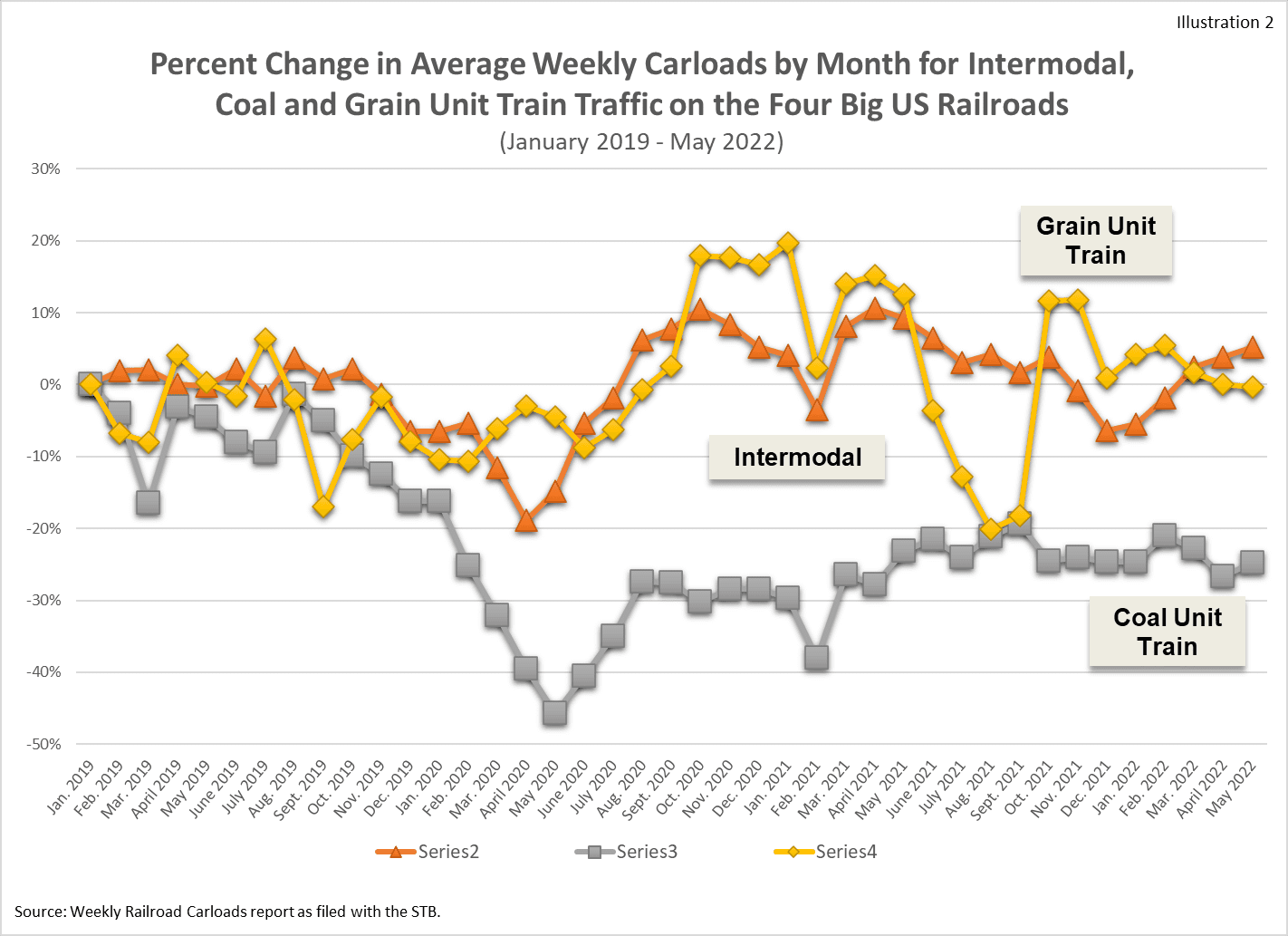
The percent change in carloads for Coal and Grain unit train movements are tracked against Intermodal carloads in Illustration 2. This shows that Grain carloads fluctuate more than Intermodal, but the cumulative percent change is approximately the same as carloads for Grain and Intermodal are both at pre-Covid levels. Coal carloads are down 20% to 30% for reasons that are not related to the Covid pandemic.

Service Issues Blog 2

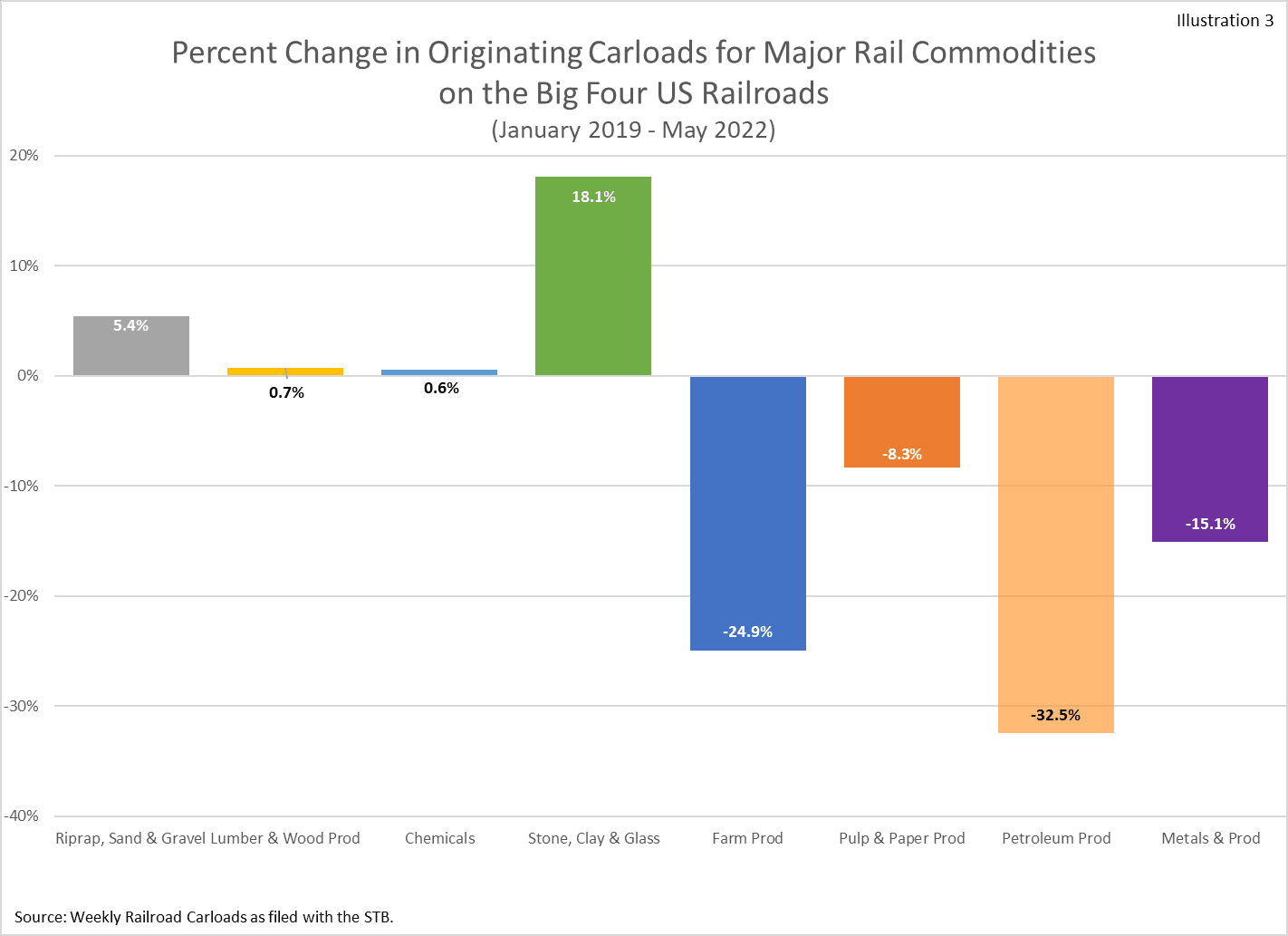
The cumulative change in carloads for other major rail commodities between January 2019 and May 2022 are in Illustration 3. The carload data indicates that service problems are unrelated to an increase in carloads on the rail system, as carloads currently reflect levels similar or below pre-Covid volumes.

Service Issues Blog 3

Change in Train Speed and Dwell Time

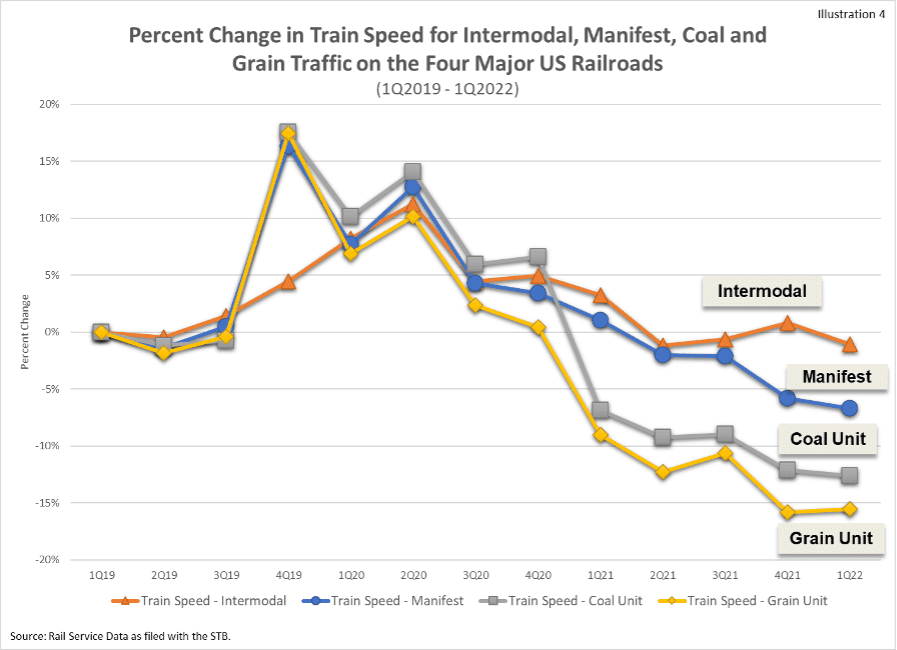
Most rail traffic is moving slower now than before Covid had an impact on the U.S. economy. Intermodal traffic is doing significantly better than Manifest traffic as well as Coal and Grain Unit Train traffic as it is only slightly down from where it was in January 2019.

Illustration 4 shows that the average speed of all types of traffic, other than Intermodal, on the four major U.S. railroads has been in a steady decline since the second quarter of 2020.

Service Issues Blog Illustration 4

Intermodal Train Speed stopped decreasing in the second quarter of 2021, while the speed of Manifest traffic continued to decline.

Overall, the speed of Intermodal traffic is only down 1% since the first quarter of 2019, while the speed of Manifest traffic is down 7% due to a consistent drop in 2021 and 2022. Illustration 4 shows that the decrease in Train Speed is a more significant problem with Coal and Grain Unit Train movements.

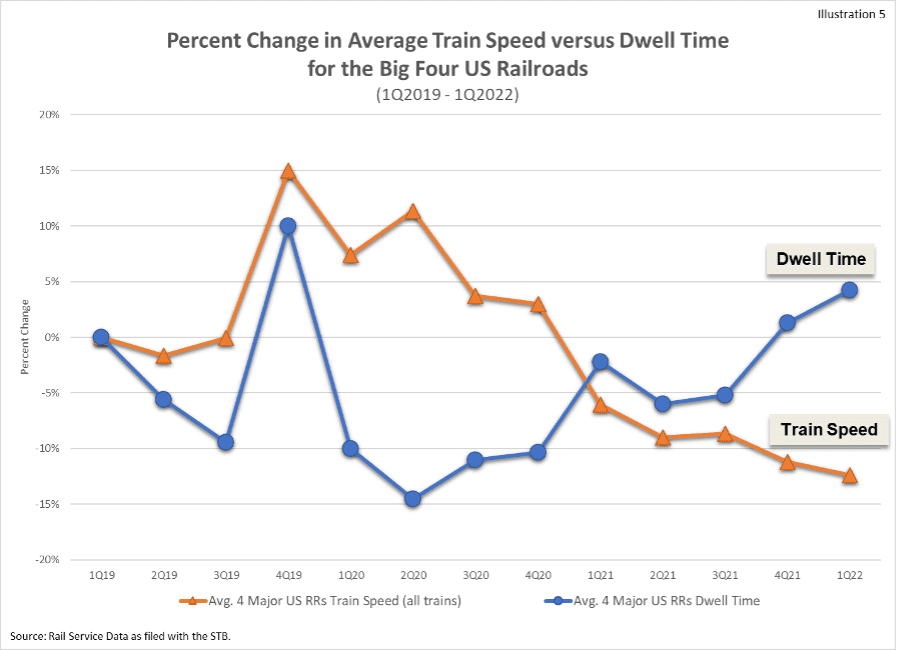
Illustration 5 shows that as Manifest traffic Train Speed started to continually decrease in the second quarter of 2020, the Dwell Time of rail trains at rail terminals continued to increase. This is bad news for rail shippers as trains are spending more time delayed at rail terminals and when leaving the terminal, trains are moving at a slower speed. Illustration 5 shows that this problem has gotten continually worse since the second quarter of 2020. This problem is causing big delays in rail shipper’s deliveries to customers, and it is a significant contributor to the slowdown in the U.S. supply chain.

Service Issues Blog Illustration 5

The one bright spot from this data is that service for Intermodal movements appears to be improving. The Train Speed for Intermodal has been relatively stable since the second quarter of 2021, while Intermodal carloads have had big up and down fluctuations. Intermodal represents a very large percent of all rail traffic, and the hope is that improvements in this area will have a ripple effect on the entire rail system.

Railroad submittals to the Surface Transportation Board (STB) are the source for the data in this report. Current and historical data on rail service, rates, and volumes by commodity and market area are available in the Rail Cost Control program.

https://www.railcostcontrol.com/wp-content/uploads/RCC-Blog-7.png 1080 1080 Keith Nestman https://www.railcostcontrol.com/wp-content/uploads/RCC-Logo-2026.svg Keith Nestman2022-06-01 18:47:052022-06-07 16:07:27Are Railroads Turning the Corner on Bad Service?
STB Rate Case Index Study Rebuttal

The STB Study Saga Continues

February 28, 2022

Escalation Consultants, Inc.

The STB Study Saga Continues

An article was recently published by Railway Age. This article contains an exchange between Jay Roman, Founder and President of Escalation Consultants, Inc., and Dr. William Huneke, former Director and Chief Economist at the STB, on the STB’s Annual Rail Rate Index Study (STB Study).

The dialog that the article contains is of significant importance to all rail shippers as it highlights a need for a change in how the STB operates and the lens in which interested parties would utilize its data.

It is important to raise questions about the STB Study, because it will likely be used by lobbyists, politicians, and railroads to show that there are no major problems with rail rates. This may not be the STB’s purpose for the Study, but this is likely how companies that benefit from railroads ability to continually increase rates will use the findings in the Study.  In other words, if rates are “reasonable” there is no need to change STB regulations to have a more effective process for shippers to challenge rates.

The following link will take you to the Railway Age article.

STB Rate Index Study Rebuttal

We encourage you to forward this email, or share the article, with your teams and fellow rail shippers. 


Please contact us directly if you have questions or would like more information on the article: Info@RailCostControl.com


Rail Negotiation Seminar

https://www.railcostcontrol.com/wp-content/uploads/Copy-of-RCC-Rule-11-List-B-Instagram-Post-1080-×-1080-px.png 1080 1080 Keith Nestman https://www.railcostcontrol.com/wp-content/uploads/RCC-Logo-2026.svg Keith Nestman2022-02-28 08:00:082022-02-28 16:57:59The STB Study Saga Continues
NEW YEAR’S RESOLUTION FOR IMPROVING RESULTS WITH RAILROADS

New Year’s Resolution for Improving Results with Railroads

January 6, 2022

As you start the year of 2022, it is good to consider a new year’s resolution that will make 2022 better than 2021. The best resolution for rail shippers to consider is to become much more proactive in rate negotiations with railroads. The reason for this resolution is that it will help reduce rail expenses by counteracting the substantial change railroads have made in how they develop rates for movements.

Railroads have changed how they develop rates which means that shippers need to change how they negotiate rates. This is why being more proactive in establishing the rate structure for movements is a great new year’s resolution for rail shippers in 2022.

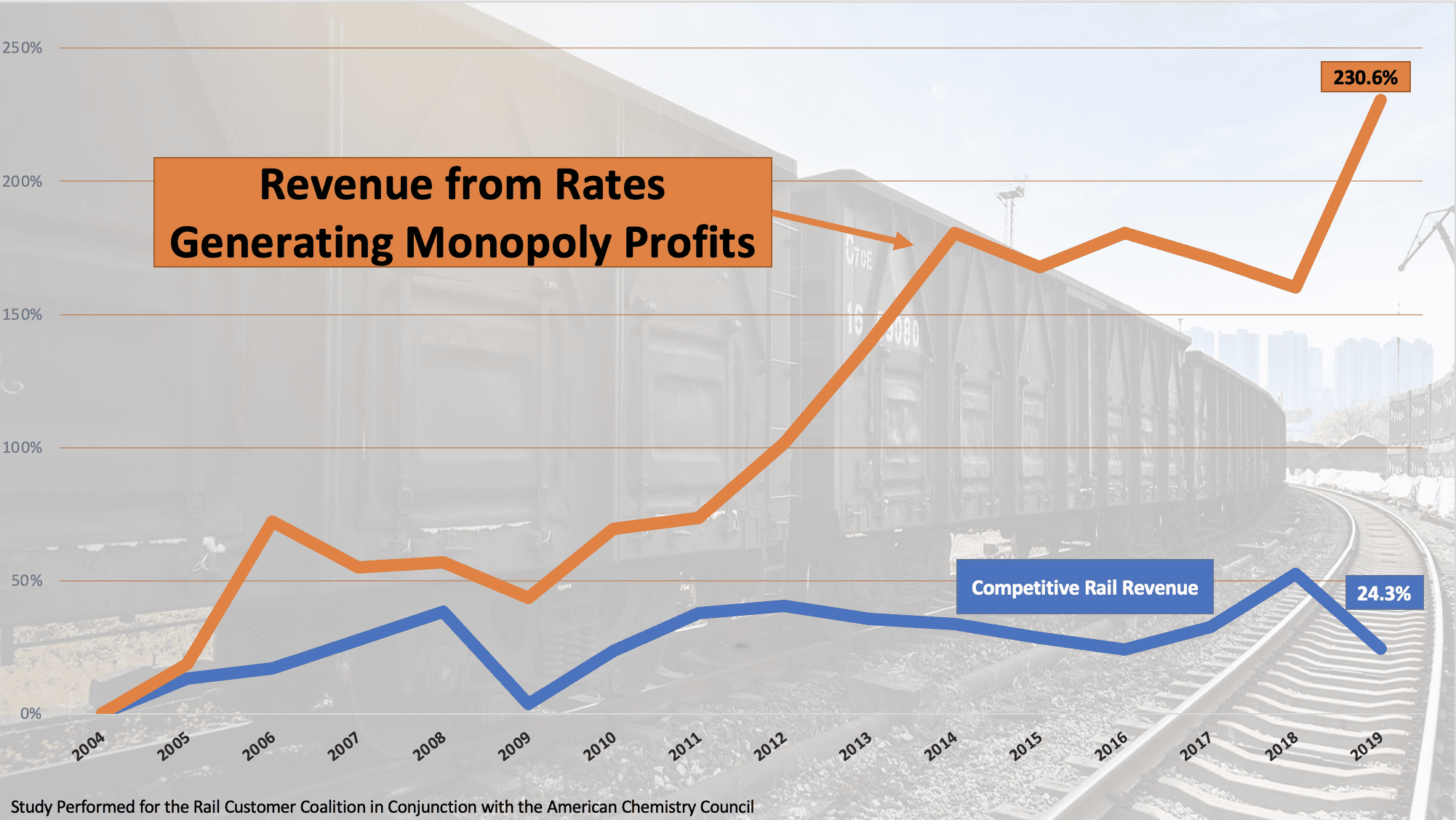
Illustration 1 shows the impact of the change in railroads pricing practices on their revenue. This analysis was performed by Escalation Consultants for the Rail Customer Coalition in conjunction with the American Chemistry Council.

[Illustration 1]
Improving Results with Railroads 1

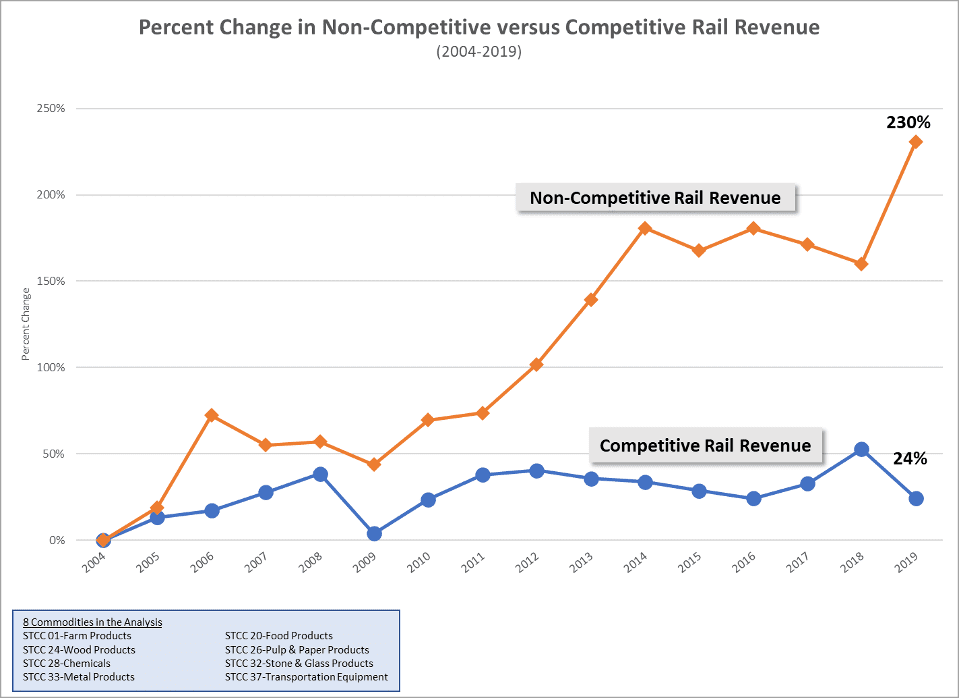
The graph shows that the total revenue from competitive rates (rates with RVC’s below 180%) was virtually unchanged over the last fifteen (15) years. However, revenue from rates generating monopoly level profits (rates with RVC’s greater than 180%) increased a whopping 231%. The graph shows that:

  • There has been a sea change in how railroads establish rates for movements; and,
  • Actions shippers are taking to control rail expenses have just not been very effective

The change in railroads rate making practices has resulted in revenue from rates generating monopoly profits being the norm and is no longer the exception.

[Illustration 2]
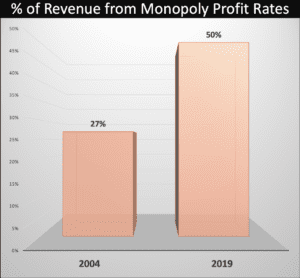
Improving Results with Railroads

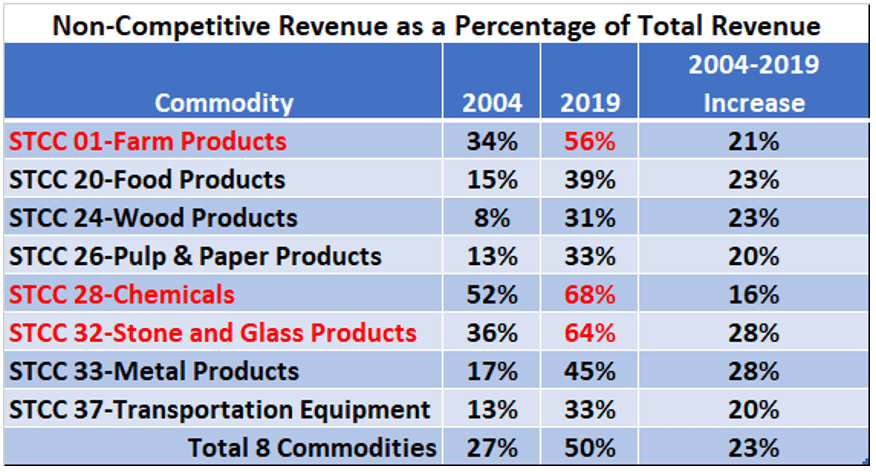
Illustration 2 shows that in 2004 revenue from rates generating profits at monopoly levels represented 27% of all rail revenue. However, by 2019 monopoly profit revenue represented 50% of all revenue. Illustration 1 shows that the revenue railroads make from rates generating profits at monopoly levels continues to increase. It is unlikely that railroads will be satisfied with 50% of all revenue coming from monopoly profit rates. This is because two of the eight major commodities in the analysis had monopoly profit revenue, represent over 60% of all revenue. (Footnote 1)

To deal more effectively with the change in railroad pricing practices shippers need to be more proactive in establishing rates for their movements. A great new year’s resolution is therefore to be in the position to tell railroads:

  • The rates you need
  • Why you need them and
  • The Reasons a railroad should give these rates to you

There are many things that need to be considered in a comprehensive plan for reducing rail expenses. However, everything starts by understanding the rates you compete against in your markets.

As an example, Escalation Consultants is annually involved with more than a billion dollars in shippers rail spend. In reducing clients rail expenses, we look at numerous issues as well as the political environment at plants.(Footnote 2) However, we always start by understanding what our clients compete against in their primary markets. This allows us to be much more proactive in establishing reasonable rates with railroads.

There is a reason why Escalation Consultants is successful in reducing rail expenses for shippers that have never reduced cost before. The process for reducing rail expenses starts with a comprehensive strategy and includes:

  • Understanding and quantifying all your win/win opportunities
  • Understanding all your logistics options
  • A process for increasing your pricing options
  • Understanding all your sources of negotiation leverage
  • A process for making your movements more important to railroads
  • Having immediate access to market intelligence.

Not everyone can retain Escalation Consultants to assist in reducing rail expenses. However, everyone CAN use our Rail Cost Control Program (RCC) to become more proactive in rate negotiations with railroads. The RCC provides immediate access to rates you compete against in markets and identifies your primary competitors in markets.

The RCC does much more than determine reasonable rates for movements, it is a comprehensive database management system that offers shippers multiple valuable tools. These include: a bid evaluation tool that optimizes your rail spend. As well as an RFP generation tool that increases your pricing options and develops win/win opportunities that decrease your cost while increasing railroad profit and much, much more.

The change in railroad pricing practices demonstrates that shippers need the RCC program now more than ever. A good new year resolution is to know more about how the RCC will help you deal more effectively with the change in railroads pricing practices. This change is allowing railroads to obtain a significant increase in the number of rates generating monopoly level profit and the RCC is an effective tool for combatting this practice.


Footnote 1 – More detail on the analysis is included on the Rail Cost Control website under the blog titled “Impact of Consolidation on Freight Rail Rates.”

Footnote 2 – Several issues that need to be analyzed in an effective cost reduction strategy are included in Escalation Consultants Rail Negotiation Wheel which was shown in the blog titled “Obtaining the Rail Cost Reductions that Shippers’ Management Needs.” This blog is available on the Rail Cost Control website.
https://www.railcostcontrol.com/wp-content/uploads/RCC-Blog-6.png 1080 1080 Keith Nestman https://www.railcostcontrol.com/wp-content/uploads/RCC-Logo-2026.svg Keith Nestman2022-01-06 08:00:562022-01-26 18:39:13New Year’s Resolution for Improving Results with Railroads
Negotiating Multiple Gateway Rule 11 Movements

Negotiating Multiple Gateway Rule 11 Moves

December 14, 2021

Negotiating Multiple Gateway Rule 11 Rates for Movements

Imagine you’re in the market for a brand new [insert large ticket item]. You think you have a good idea of the price range, but how do you know for sure? Next, you shop around to compare prices, availability, included perks, and interest rates. All these factors are critical elements to be considered before making your purchase. Sounds logical, right?

If you were to replace the “large ticket item” with “Rail Rates,” does the same premise hold true? It should! Especially considering the monopolistic power that railroads have over rail shippers and their rates.

It is always good to get more pricing options from railroads. One of the best ways of doing this is to use Request for Proposals (RFP’s) that have railroads provide Rule 11 rates through multiple gateways. I know what you’re thinking: is the juice worth the squeeze? Is the potential savings enough to justify the time and effort needed to generate these RFPs and analyze the responses? Let alone rearrange the segments to complete the move? What if this was easy to do? What if the RFP and bid evaluation process could be done in less time? Then there would be no reason for NOT generating multiple gateway RFP’s. This type of RFP and bid evaluation process can be a game changer for shippers looking to reduce rail expenses. The barriers for doing this have been eliminated by the Rail Cost Control (RCC) program.

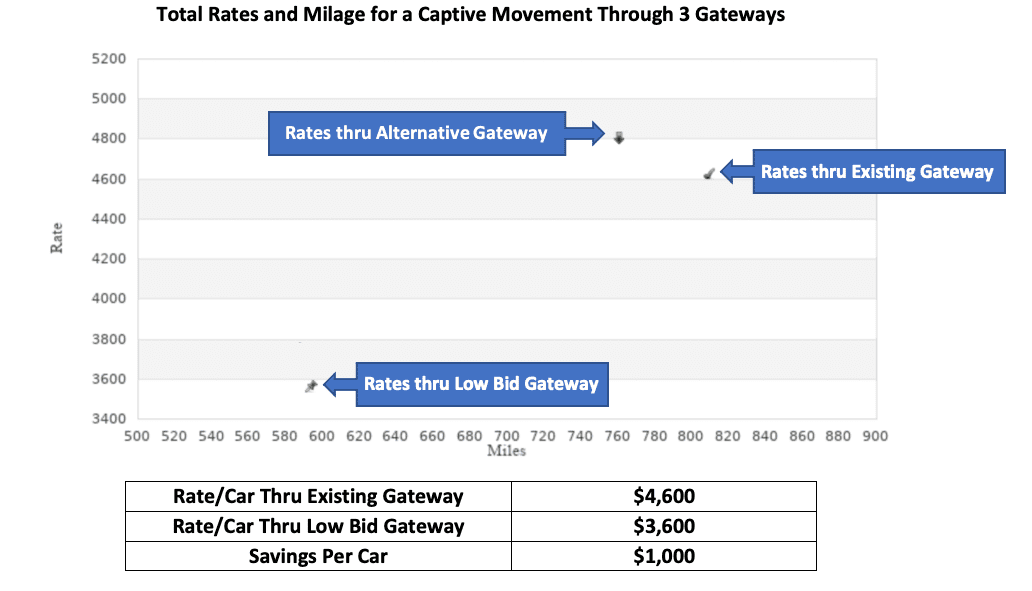
The illustration below provides a real-world example of the potential savings that can be generated for a captive movement by having railroads provide Rules 11 rates through multiple gateways. The total rate and mileage for this complete movement, through three different gateways, is shown below.

Mileage for the move ranges between 600 and 800 miles. The total rate using the existing gateway is $4,600, while the rate through the low bid gateway is $3,600.

Total Rate for a Captive Movement Through 3 Gateways

The difference between the rate through the existing gateway and the low bid gateway is $1000. This move is for 50 annual carloads, which represents a savings of $50,000 on this one move. The low bid move also travels a shorter distance [200 miles shorter] thus improving transit times. Applying the full effect of this process on all of a shipper’s moves can easily add up to millions of dollars saved.

If you don’t go out to your railroads with multiple-gateway RFPs, how do you know you are truly getting the best rates possible? However, there is a harsh reality to generating Rule 11 RFPs for multiple gateways … Shippers can’t generate, analyze, and optimize multi-gateway Rule 11 RFPs for ALL their movements in excel.

To generate and evaluate multiple-gateway Rule 11 rates you’ll need a robust program that automatically does the work for you. This is exactly what the RCC – Cost Optimizer program does for rail shippers.

This comprehensive program allows shippers to AUTOMATICALLY generate multiple-gateway Rule 11 RFPs for ALL their railroads, for ALL their movements. Then RCC analyzes, optimizes, and even generates counterproposals the very same day responses are received from the railroads. Too good to be true? It’s not!

The Cost Optimizer generates RFP’s, evaluates railroad responses, determines win/win opportunities for both the shipper and railroads, creates counter proposals, and tabulates savings for management. The Optimizer is a finely tuned program that seeks out and quantifies your best opportunities for reducing the cost of rail freight.

Generating multiple-gateway Rule 11 RFPs is just one of many functions that the RCC provides rail shippers. If you’d like to expand your rate options, reduce your rail spend, and obtain immediate access to all your current and historical rates with just one click, schedule a RCC demonstration.

There is a better way to deal more effectively with railroads in less time.

See for yourself! Click this link to schedule a demonstration of the RCC program today.


Registration is still available for the 2022 Rail Negotiation Seminar. Treat yourself and your team to the #1 recommended rail negotiation program in warm & sunny Tampa, Florida. Click the banner below for more information.

Rail Negotiation Seminar

https://www.railcostcontrol.com/wp-content/uploads/RCC-Blog-3.png 1080 1080 Keith Nestman https://www.railcostcontrol.com/wp-content/uploads/RCC-Logo-2026.svg Keith Nestman2021-12-14 19:03:532022-02-09 17:20:32Negotiating Multiple Gateway Rule 11 Moves
Non-Competitive Pricing Practices

Non-Competitive Pricing – The New Norm?

October 14, 2021

Study shows that shippers need to be more proactive in rate negotiations with their railroads.

The analysis demonstrates that railroads have fundamentally changed how they establish rates for movements. The takeaway from the analysis is that in order to deal effectively with these changes shippers will need to change how they negotiate rates with railroads.

Escalation Consultants analysis of the 8 commodity groups listed below demonstrates a startling finding:

Rail moves with “non-competitive” pricing are no longer the exception. They have become the norm.

Preparing for Rapid Inflation

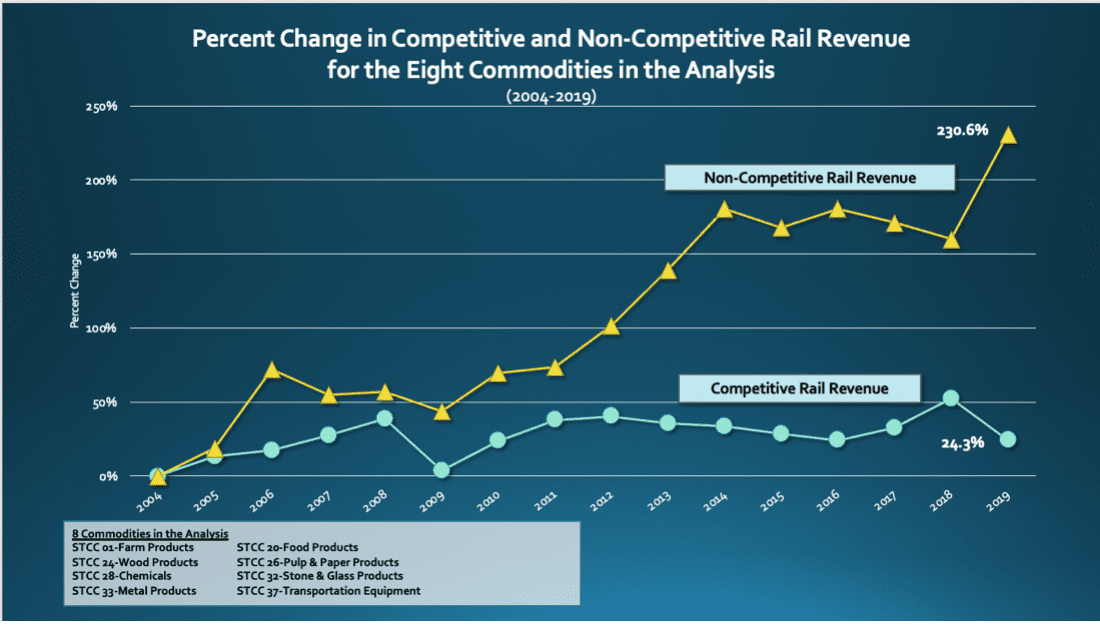
The study shows that between 2004 and 2019, railroad revenue generated from competitively priced movements has risen 24.3%. Meanwhile, rail revenue generated from non-competitively priced movements has risen a staggering 230.6%.

To put this into perspective, half (50%) of all rail revenue generated in 2019 was derived from non-competitive rates. Compared to just 27%, in 2004.

Non-competitive rail revenue going from 27% to 50% of rail revenue for commodities represents a dramatic shift in railroad pricing practices. The good news is that this is not a situation without a solution.

Escalation Consultants has found that in order to effectively deal with the changes in railroad pricing practices, you must be more proactive with rail rate negotiations. If not, your rates will likely increase each year, and most traffic will move under non-competitive rates. Being aware that railroad pricing practices have changed is an important first step in building a strong case for lower rail rates. However, shippers must then take corrective actions. To generate cost reductions:

Shippers need an effective plan for both determining and obtaining reasonable rates for their rail traffic.

In 40+ years of assisting rail shippers across ALL industries, Escalation Consultants has helped achieve over $4 billion in cost savings.

If you’d like to learn how, we’re here to help!

Click to Schedule a Call

Registration for the 2022 Rail Negotiation Seminar is now open. This is the #1 recommended program for rail shippers and slots are limited. Click the link below for more information.

Rail Negotiation Seminar

https://www.railcostcontrol.com/wp-content/uploads/RCC-Blog-1.png 1080 1080 Keith Nestman https://www.railcostcontrol.com/wp-content/uploads/RCC-Logo-2026.svg Keith Nestman2021-10-14 18:01:392021-10-18 19:28:17Non-Competitive Pricing – The New Norm?
RCC Blog: Impact of Consolidation on Rail Freight Rates

Impact of Consolidation on Freight Rail Rates

August 4, 2021

An analysis of railroad pricing practices shows that over the last fifteen years there has been a fundamental change in how railroads establish rates for movements. The analysis shows that rail movements with pricing considered potentially non-competitive by the Surface Transportation Board (STB) have become the norm and not the exception.

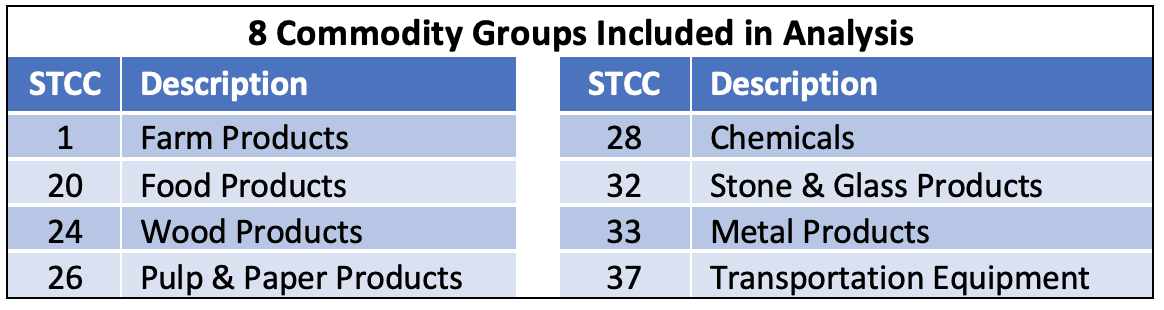
The analysis, performed by Escalation Consultants, for the Rail Customer Coalition, covers the change in railroad pricing for eight major commodity groups between 2004 and 2019. Table 1 shows these eight commodity groups. In the analysis, non-competitive pricing consists of revenue from rail moves with Revenue to Variable Cost Ratios (RVC’s) greater than the 180% RVC Regulatory Jurisdictional Threshold. Revenue from moves with RVC’s below 180% is considered competitive revenue.

(Table 1)

8 Commodity Groups Included in RCC Analysis

The analysis shows the following changes in railroad pricing practices between 2004 and 2019.

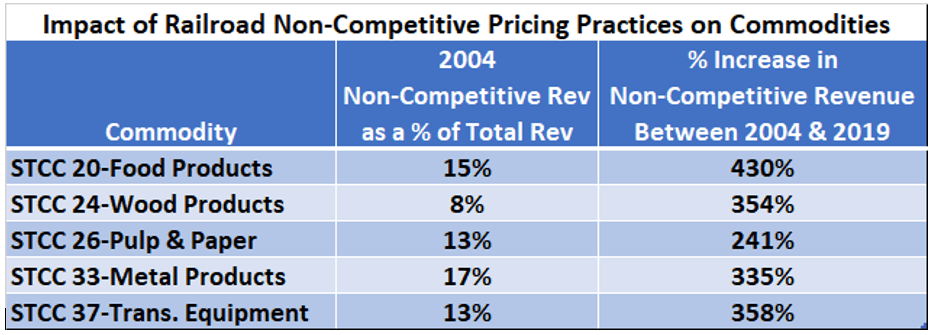
Revenue from rail moves with non-competitive pricing increased by an average of 230% over the last 15 years.
  • Half the commodities had non-competitive pricing revenue increase by more than 300%.
  • Commodity revenue from rail moves without non-competitive pricing either decreased, or had small increases over the last 15 years.
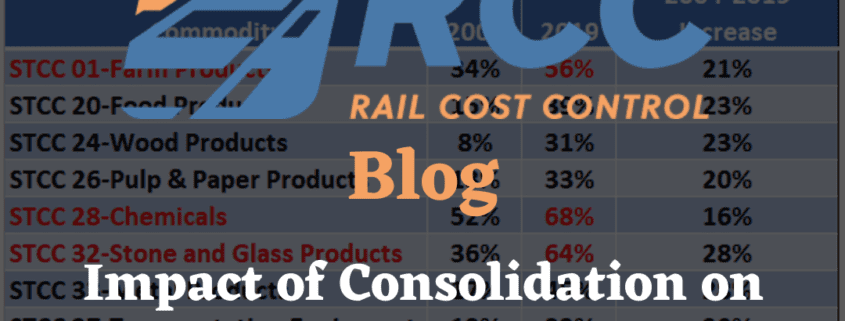
Moves with non-competitive pricing generated 50% of all 2019 railroad revenue (see Table 2).
  • Chemical movements are most significantly impacted, as 68% of all Chemical revenue is generated from rail moves with non-competitive pricing.
    • 64% of Stone and Cement revenue comes from non-competitive pricing
    • 56% of Farm Products revenue comes from non-competitive pricing
  • The percentage of total revenue from moves with non-competitive pricing increased by 23% over the last 15 years. While revenue from moves with competitive pricing decreased by 23%.

The large increase in non-competitive revenue caused the average RVC to increase from 134% to 165% between 2004 and 2019 for shipments of the eight commodities in the analysis.


Conclusions from Analysis

Illustration 1 shows the cumulative percent change in total non-competitive revenue and competitive revenue by year for these eight commodities. This shows that non-competitive revenue has consistently increased over time while competitive revenue has had little change. These historical changes indicate that the STB is regulating a very different rail industry today, than it regulated in 2004.

(Illustration 1)

Percent Change in Non-Competitive vs Competitive Rail Revenue

Based upon the large increase in non-competitive revenue, it would be logical to expect a large number of rate cases before the STB. This has not happened!

Many shippers believe that the existing regulatory process is weighted too much in favor of railroads. The large increase in non-competitive revenue, shown in Illustration 1, supports this contention. Non-competitive revenue has increased 230% over the past 15 years. This indicates that railroads are not worried about regulatory pushback from generating non-competitive revenue from a large portion of their rail traffic.

The analysis shows that commodities are not impacted by a railroad’s non-competitive pricing practices to the same degree. Table 2 shows that 3 commodity groups had non-competitive revenue representing more than 50% of all rail revenue:

          • Chemicals – 68% of all revenue

          • Stone & Glass Products – 64% of all revenue

          • Farm Products – 56% of all revenue

These are very large commodity groups, and they have a significant impact on the total non-competitive revenue railroads make from their pricing practices. These commodity groups benefit the most from an improvement in regulations that impact rates.

(Table 2)

Non-Competitive Revenue as a Percent of Total Revenue

Table 3 shows the largest increase in non-competitive revenue occurred in commodities with the smallest percent of non-competitive revenue in 2004. Paper, Wood, Food, and Transportation Equipment commodities make up a relatively small percentage of total rail revenue under non-competitive pricing in 2004. These commodities now have around a third of all revenue subject to railroad non-competitive pricing. The analysis demonstrates that railroad’s non-competitive pricing practices are widespread and affect more movements now, than they did in 2004.

(Table 3)

Impact of Railroad Non-Competitive Pricing Practices on Commodities

Summary 

The Rail Pricing Analysis indicates that railroad pricing practices have changed dramatically over the last 15 years. It also indicates that rail rate regulations have not kept pace with these changes. The 230% average increase in non-competitive revenue indicates that railroads do not appear to be particularly worried about existing rate regulations. 

If the pattern of change over the last 15 years continues, the majority of rail traffic will move under rates that generate non-competitive revenue for railroads. To change this, the potential for winning a rate case before the STB will need to be more favorable to shippers than it has been over the last 15 years. This will likely require a more effective and less expensive method to challenge non-competitive rail rates. 

Consolidation within the Transportation Industry is facing additional scrutiny as regulators contemplate additional rail mergers. Mergers that could have further negative impact on the competitive landscape and the affordability of shipping US goods by rail. This analysis indicates that regulators need to carefully consider the changes needed to the regulatory system to protect shippers from the impact of a smaller number of railroads competing for their business. 

Note – The STB Commodity Revenue Stratification Reports are the source for all data used in the Analysis of Railroad Pricing Practices. 


Escalation Consultants, Inc. developed the Rail Cost Control (“RCC”) program to help shippers reduce rail expenses by managing costs and empowering negotiations. For more information about RCC and other related articles, visit the RCC Blog.

https://www.railcostcontrol.com/wp-content/uploads/Webinar-9.png 1080 1080 Keith Nestman https://www.railcostcontrol.com/wp-content/uploads/RCC-Logo-2026.svg Keith Nestman2021-08-04 13:29:422021-08-18 20:38:22Impact of Consolidation on Freight Rail Rates
Page 4 of 7«‹23456›»

Pages

  • About Us
  • AXIS
  • Contact Us
  • Cost Optimizer
  • Costing Dashboard Update
  • Database Management System
  • Evaluation Exercise Calendly
  • Evaluation Exercise Contact Form
  • Home
  • Landing Page – 2025
  • Movement Evaluation Exercise
  • News & Events
  • PopUp Testing 05172021
  • Privacy Policy
  • Rail Cost Control Demo
  • Rail Rate Checker
  • Seminars and Training
  • YT

Categories

  • Uncategorized

Archive

  • August 2026
  • June 2026
  • May 2026
  • March 2026
  • February 2026
  • January 2026
  • December 2025
  • November 2025
  • October 2025
  • September 2025
  • June 2025
  • November 2024
  • October 2024
  • June 2024
  • February 2024
  • September 2023
  • August 2023
  • July 2023
  • June 2023
  • February 2023
  • January 2023
  • June 2022
  • February 2022
  • January 2022
  • December 2021
  • October 2021
  • August 2021
  • July 2021
  • June 2021
  • May 2021
  • April 2021
  • March 2021
  • February 2021
  • January 2021
  • December 2020

Rail Cost Control is a product of Escalation Consultants, Inc.—serving railroad customers since 1979.

Quick Links

  • AXIS
  • Rail Rate Checker
  • Cost Optimizer
  • Database Management System
  • News & Events
  • Seminars & Training
  • About Us
  • Contact Us
  • Login

Contact Info

4 Professional Drive, Suite 129
Gaithersburg, MD 20879

info@railcostcontrol.com
301-977-7459 

linkedinfacebook

© 2025 Rail Cost Control. All Rights Reserved.

Scroll to top

Access FREE Trial to Rail Cost Control and Uncover Savings in Seconds