• Solutions
    • AXIS
    • Rail Rate Checker
    • Cost Optimizer
    • DMS
  • Company
    • About Us
    • Contact Us
  • News & Events
  • Seminars and Training
  • Login
  • Start Your Free Trial
  • Schedule Call
  • Menu Menu

Archive for category: Uncategorized

Rail Cost Control Cost Optimizer

Optimizing to Reduce Shippers Rail Expenses

March 31, 2021

The most productive rail negotiations are win/win negotiations where a shipper gets lower rates and the railroad makes greater profit. These type of win/win negotiations are easier to develop than many shippers realize. The best way to create this type of win/win outcome is by a shipper optimizing railroads rates when performing the bid evaluation.
Optimize Your Rail Spend

Millions of dollars in value are created for shippers and railroads through the optimizing process: 

        • The benefit to shippers is cost reductions of 5% to 15%; while, 
        • Railroads benefit from a substantial increase in revenue and profits.

This optimizing process starts by a shipper calculating the railroad’s long term Variable Cost (Cost). This Cost is calculated for ALL rates in a railroad’s bid. Shippers frequently calculate the railroad’s cost for a movement to show that a railroad is making too much profit from the movement. Unfortunately, this is frequently not very effective.

A more productive use of railroad costs is to better understand how a shipper can increase or decrease railroad’s profits with volumes it can add or takeaway in negotiations.

Calculating railroad’s cost for all of a shipper’s moves, opens opportunities to create greater value for both shippers and railroads. It is best for a shipper to use a macro processing program like the Rail Cost Control Program  (RCC) to calculate the cost of all rail moves at one time. Calculations are effortless, as rail costs are automatically calculated and maintained for use in RCC’s bid evaluation optimizing program.  

Once a shipper knows the railroad’s costs for moves, it has a much better understanding of the economic impact of adding, or taking away, moves from railroads in the bid evaluation. When a railroad’s rates are reduced it becomes the low bidder on more competitive traffic in the bid evaluation. As a railroad wins more competitive traffic, its carloads increase as well as the profit it makes from the shipper’s business.  

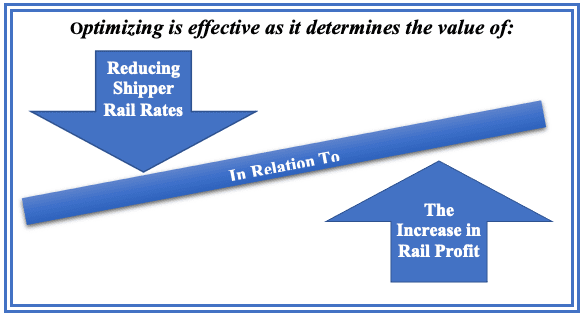
It is important to find win/win opportunities with your railroads. These opportunities come from understanding the relationship between reductions in spend a shipper receives from reduced rates versus the increase in profit the railroad receives from obtaining additional volumes. 

As an example, if competitive rates are reduced by 11% on a railroad resulting in $6 million in savings this looks like a great deal for the shipper. But is this a good deal for the railroad? The shipper needs to know the economic impact on the railroad. If the railroad is awarded an additional 3,100 carloads, because it is now the low bidder on more competitive carloads, the shipper needs to know how this impacts railroad profit. Table 1 provides a summary of the results for the 11% rate decrease.  

Table 1 

 Example of Summary Results for a 11% Rate Reduction on a Railroads Competitive Moves   

Shipper Savings
$6.0 million
Increase in Railroad Profit
$7.3 million
Increase in Railroad Revenue
$13.4 million
Increase in Railroad Carloads
3,100

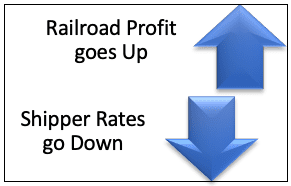
Railroad Profit vs Shippers Rates

Table 1 shows that the 3,100 additional carloads represent a $7.3 million increase in the railroad’s profit. This is $7.3 million in profit and $13.4 million in revenue the railroad would not get with the rates in its original bid. Table 1 shows that the railroad makes out better than the shipper from the 11% rate decrease. The value to the railroad is $1.3 million greater ($7.3 million versus $6.0 million) than the value to the shipper. By optimizing, you then equalize the benefits from strategic decisions on rates and volumes.

Optimizing created $6 to $7 million in value for both the shipper and the railroad. 

Though the value created by the 11% rate decrease is significant, it may not be the best rate decrease for either the shipper or the railroad. The question that needs to be answered, is how do you know the rate decrease that creates the most value for the shipper and railroad? Would a larger 15% rate decrease generate greater value or would a lower 7% rate decrease work best. Answering this question, you’ll need to know the optimizing Pivot Point for rates in each railroad’s bids for competitive traffic.

Understanding each railroads Pivot Point is important as it: 

  1. Generates greater value from the optimizing process; and, 
  2. Brings captive rail movements rates into the optimizing process. 

Understanding the Pivot Point increases the value created from optimizing. As an example, the Pivot Point for the rail traffic used in this article increases the value created by optimizing by an additional 71% (more than a $5 million increase) . This is not an unusual Pivot Point optimizing result for mid to large rail shippers. Optimizing the rates in railroads bids creates a significant increase in value for the shipper and the railroad. 

It should be noted that though the calculations for optimizing are complex the process has become very easy to perform. For example, the Pivot Point is automatically calculated for the rates in each railroad’s bids in RCC’s: Cost Optimizer.   

Our next blog will address determining the Pivot Point for each railroad and bringing captive rates into the optimizing process. 


 Escalation Consultants, Inc. developed Rail Cost Control (“RCC”)  to help shippers reduce rail expenses by managing costs and empowering negotiations. Furthermore, for more information about RCC and other related articles, visit the RCC Blog.
 

Rail Cost Optimizer

https://www.railcostcontrol.com/wp-content/uploads/hero_cost_optimizer-scaled.jpg 916 2560 Keith Nestman https://www.railcostcontrol.com/wp-content/uploads/RCC-Logo-2026.svg Keith Nestman2021-03-31 08:00:282021-06-01 13:49:34Optimizing to Reduce Shippers Rail Expenses
Rail Cost Control - Educate Railroads

Reduce Captive Rates by Educating Railroads

March 24, 2021

The March 17th blog titled “6 Ways to Make Railroads Compete for Your Captive Movements” stated that it is important to educate railroads. This is an important way to demonstrate why high captive rates are bad for both you and your railroads. Through this process, you educate railroads on the overall impact of high rates on your business. In addition, this process also shows how you can help improve the railroads business model for your commodities.  

The following are five examples of how educating railroads helps reduce rail expenses on captive movements.  

1. Capital Investment Plans to Increase or Maintain Production

Your railroad needs to be shown that investment will not be made at locations where you have high costs. The impact of how high captive rail rates impact your capital investment and production volumes is important for railroads to understand. Railroads have lost substantial business in the past by not listening to their customers. Educating railroads on the downside of high captive rates is a beneficial exercise for both you and your railroads.  

2. Your Competitors Can Be a Big Source of Leverage in Reducing Captive Rates 

There are several reasons for this. One important reason is the location of competitors to your existing and potential customers. When a competitor is close to a customer, this provides a reason for a railroad to provide you with lower rates for movements to that customer. Your competitor will have lower logistics cost, either from a short distance rail move, or by serving the customer by truck.  Either way, if you lose this customer, the railroad also loses all or a major part of the revenue it would get from you. It makes economic sense for both the shipper and the railroad to work together to maintain this business. 

3. Are You Competing Against Imports? 

If the answer is yes, then you and the railroad have the same objective – STOP THE BLEEDING. You both lose out when competing against imports and you will accomplish more by working together than against each other. High captive rates make little economic sense when the objective is to compete more effectively against imports. Reference Blog article “Creating Effective Alliances with Railroads.”

4. Are You a Short Distance from a Port Where Your Product can be Exported? 

If yes, then you have additional negotiation leverage. High captive rates can make it more economical to export than ship domestically. When a shipper makes the switch from primarily serving the domestic market to primarily serving the export market, this can have a large impact on a railroad’s revenue and volumes. This can provide effective leverage in captive rate negotiations.  

5. Understand Problems with Your Railroad’s Business Model for Your Commodities

Many shippers do not take advantage of information that railroads must provide to the STB. This information is provided due to the monopoly power railroad’s hold over a large amount of their traffic. This information can be valuable to shipper’s rail negotiations. One example is the railroad’s Quarterly Fright Commodity Statistics Reports (QCS). Railroad’s QCS reports show what is good and bad about a railroad’s business model for your commodities. This data provides direction for how you can help improve weaknesses in the railroad’s results for your commodities.  

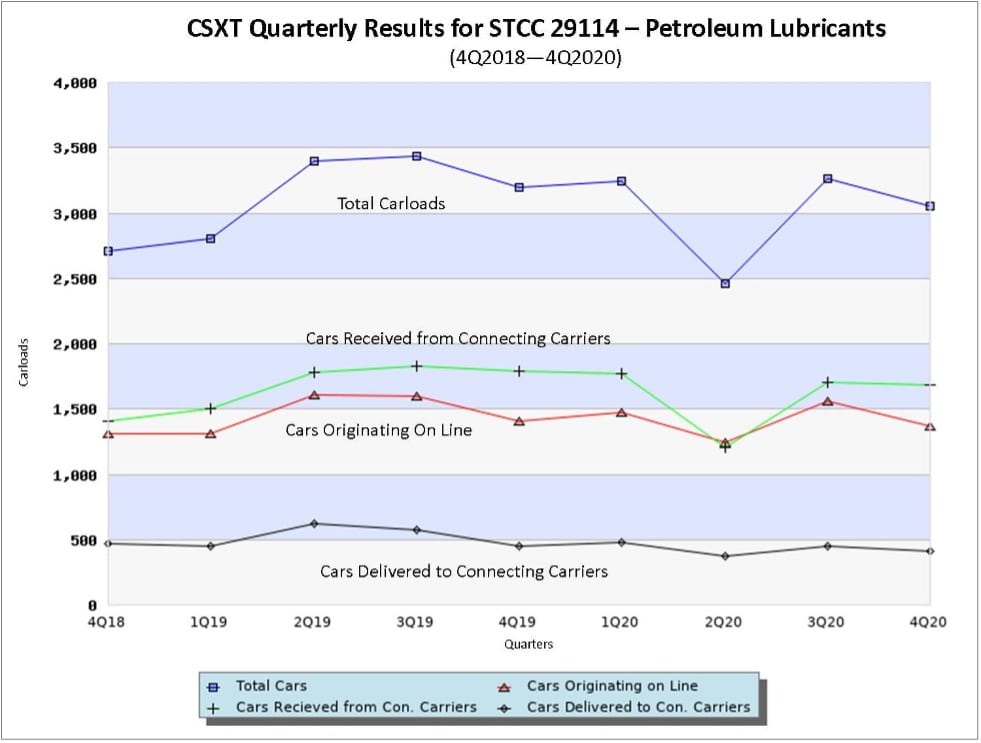
The illustration below provides an example using results for Commodity Code 29114-Petroleum Lubricants on CSXT.

Rail Cost Control - Educate Railroads - Reduce Captive Rates

This illustration shows that CSXT receives more cars from connecting carriers than it originates on its lines. This means that there is not enough production capacity on the CSXT system to satisfy the demand for this commodity from customers on the CSXT system. As a result, few cars are delivered by CSXT to connecting carriers.  

To grow revenue CSXT needs to provide rates that encourage you to increase production. To incentivize this investment,  CSXT needs to, at a minimum, provide lower rates to gateways with other railroads. This would be good for both CSXT and the shipper. CSXT growth is limited without further investment from shippers on its system. High captive rates that stifle growth appear to limit CSXT and its customers revenue for this commodity. This is fertile ground for negotiations focused on reasonable rates for captive movements. 

Railroads current and historical QCS results are included in the Rail Rate Checker section of the Rail Cost Control Program. In addition to carloads, the QCS data in Rail Rate Checker includes the following information for each Class 1 Railroad: 

          • Average rate for moving the commodity 

          • Historical change in average rates  

          • Total revenue from movements of the commodity 

          • How railroads total commodity revenue has changed over time 

This data is available down to the five-digit commodity code level in the Commodities by Railroad section of Rail Rate Checker.  


Rail Cost Control (“RCC”) is a program developed by Escalation Consultants, Inc. to help shippers reduce rail expenses by managing costs and empowering negotiations. Furthermore, for more information about RCC and other related articles, visit the RCC Blog.

Database Management System

https://www.railcostcontrol.com/wp-content/uploads/train_cars_filled_cargo.jpg 1408 1672 Keith Nestman https://www.railcostcontrol.com/wp-content/uploads/RCC-Logo-2026.svg Keith Nestman2021-03-24 13:34:342021-06-01 13:50:28Reduce Captive Rates by Educating Railroads
Rail Cost Control- Competitive Traffic

6 Ways to Make Railroads Compete for Your Captive Movements 

March 17, 2021

Last week, Escalation Consultants’ blog, “The Cost of Being Captive to a Railroad” showed that traffic railroads view as captive has rates 107% higher than traffic railroads view as competitive. A shipper looking to substantially reduce rates must, therefore, make a railroad compete for more of its traffic. There are a number of ways to do this. The following are six examples to make railroads compete for your captive movements:  

1) Alternate Logistic Options:

The cost of trucking and transloading need to be understood. The higher the rail rate for a move the more viable other logistics options become. It is always good to know the ceiling price for rail movements. The cost of alternate logistics determines this price because once rail costs are higher than other logistic options, a railroad can lose the business. 

2) Create Geographic Competition:

If you produce a product at more than one plant, you can have railroads provide bid rates from each viable plant to customer destinations. This type of geographic competition can make a railroad compete for movements even though a shipper’s plant only has access to one railroad. Geographic competition can significantly reduce the rates for movements as it makes railroads provide competitive rates at captive locations. 

3) Commodity Swap Agreements:

Commodity swaps with competitors are used to reduce logistic cost for both you and your competitors. The framework for a commodity swap: 

      • You have customers closer to your competitors’ plant than your plant,
      • Your competitor has customers closer to your plant than his plant; and, 
      • The competitor serves your customer and you serve your competitors’ customer. 

Companies do not like competitors to serve their customers. However, when cost savings are very large a swap agreement is too good to pass up. The higher a railroad’s cost for a movement, the larger the savings from a commodity swap agreement. This type of agreement does not normally last for multiple years. The railroad gets the message loud and clear. 

4) Perform an Analysis of the Cost of Building a Rail Spur to Another Railroad:

Many rail spur analyses are performed, but few of these build-outs materialize. The reason, if a rail spur is viable, a railroad is under greater pressure to reduce rates. The railroad will need to lower rates to a level that does not provide the economic incentive for you to build the rail spur. Performing an analysis of the viability of building a rail spur to another railroad can be very valuable in captive rate negotiations.

5) Build a Rail Spur to Another Railroad:

If you build a line to another railroad, then you have two railroads competing for your business. This changes your moves from captive to competitive in the railroads’ pricing model. As demonstrated in the blog, “The Cost of Being Captive to a Railroad”, rates for captive moves are on average 107% higher than rates for competitive moves. Building a rail spur represents significant savings as it generates downward pressure on your rates.  

6) Educate Railroads:

A shipper needs to educate railroads on why high rates are bad for both you and your railroads. This means you need to show the overall impact of high rates on your business. The best way to do this is to provide railroad management with information on strategic plans for your company. The information needs to show how railroads can benefit the most and the least from your business, going forward. Railroads have smart people in management. They need to be educated on the benefits of a more competitive rate structure on their business. 

The issues presented to railroads will be different for every company. Developing these issues is an important part of preparation for rail negotiations. Examples will be included in the next blog. 

These types of issues need to be considered in strategic planning designed to drive down rail expenses for captive movements. Every companies’ situation is different, but things that work best to reduce rail expenses do not change.  

To get a better rate structure for your moves, you must make railroads look at your traffic differently! 

This is what strategic planning for rail negotiations needs to accomplish. Escalation Consultants works with companies to reduce rates by accomplishing this objective. The Rail Cost Control (RCC) program facilitates this process. 


Rail Cost Control (“RCC”) is a program developed by Escalation Consultants, Inc. to help shippers reduce rail expenses by managing costs and empowering negotiations. Furthermore, for more information about RCC and other related articles, visit the RCC Blog.
Rail Cost Optimizer

https://www.railcostcontrol.com/wp-content/uploads/rail_cars_in_a_train_yard-1.jpg 1408 1672 Keith Nestman https://www.railcostcontrol.com/wp-content/uploads/RCC-Logo-2026.svg Keith Nestman2021-03-17 08:00:552021-06-01 13:51:216 Ways to Make Railroads Compete for Your Captive Movements 
Rail Cost Control Blog Article 11

The Cost of Being Captive to a Railroad

March 10, 2021

Traffic that’s captive to one major railroad is priced significantly higher than traffic where railroads must compete for movements. The difference between Captive Traffic and Competitive Traffic rail rates is very large.

Captive Traffic rates are, on average, 107% greater than Competitive Traffic rates.  

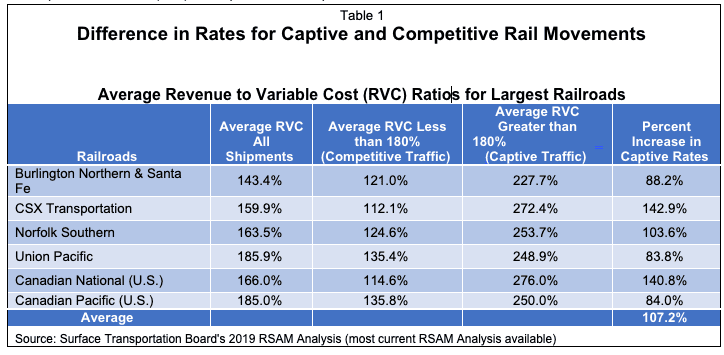
Table 1 demonstrates this rate difference. It illustrates profitability for both captive and competitive movements on the six largest Class I railroads. The table contains the average Revenue to Variable Cost Ratios (RVC) for captive and competitive traffic on each railroad. RVC’s in the table are calculated from the cost and revenue data provided by the Surface Transportation Board (STB) for captive and competitive moves on each railroad. 

Rail Rates for Captive vs Competitive Rail Movements

An RVC measures railroad profitability for movements. It is calculated by dividing the rate for a move by the railroad’s long term Variable Cost (Cost) for the move. Table 1 shows that the 185.9% RVC for Union Pacific (UP) is the highest average RVC. An RVC of 185.9% means that rates are on average 85.9% greater than UP’s Cost for moving its traffic.  

The breakdown of UP RVC’s is 248.9% for Captive Traffic and 135.4% for Competitive Traffic. This makes captive rates for UP 83.8% greater than competitive rates ((2.489 – 1.354) ÷ 1.354). The average increase in captive rates on all six railroads is 107.2%.  

The largest increases in captive rates over competitive rates are on CSXT 142.9%, CN (US) 140.8% and NS 103.6%.   

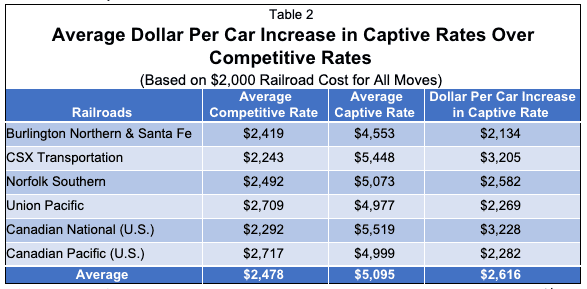
To convert RVC’s in Table 1 to rates, assume that the railroad’s average variable cost of moving captive and competitive carloads is $2,000. Table 2 shows that the average dollar per car increase for all railroads is $2,616.  

The average $2,616 captive rate increase, by itself, is greater than the total rate of $2,478 for railroad’s Competitive Traffic. 

Average Dollar Per Car Increase: Captive vs Competitive Rail Rates

The most significant captive rate increases, as compared to competitive rates, were observed on CSXT ($3,205) and CN (US) ($3,228). These are by far the largest dollar increase in captive rates. 

In order to obtain large rate reductions, shippers must make railroads compete for more of their traffic. There are several ways to accomplish this. With this in mind, Escalation Consultants’ next blog will address: Five Ways to Make Railroads Compete for Your Captive Traffic. 

Note – The US railroad industry is regulated by the STB. An RVC of 180% represents the Jurisdictional Threshold for rail movements. This is because the STB has no authority over rates with RVC’s below 180%. Moves with RVC’s above 180% have high levels of profit and are therefore considered captive by the STB. Rail moves with RVC’s below 180% have lower profit levels, and therefore, considered competitive.  


Rail Cost Control (“RCC”) is a program developed by Escalation Consultants, Inc. to help shippers reduce rail expenses by managing costs and empowering negotiations. Furthermore, for more information about RCC and other related articles, visit the RCC Blog.
Rail Cost Control

https://www.railcostcontrol.com/wp-content/uploads/img_decrease_your_rates_while_increasing_rail_profits.jpg 544 720 Keith Nestman https://www.railcostcontrol.com/wp-content/uploads/RCC-Logo-2026.svg Keith Nestman2021-03-10 08:00:272021-04-07 19:37:26The Cost of Being Captive to a Railroad
Rail Rate Benchmarking

Use Competitor Rates to Reduce Your Rates

March 3, 2021

Railroads do not mind a shipper saying they have high rates. What does have an impact is showing that a railroad’s rates are putting you at a competitive disadvantage in your markets.

What this means is, in order for a shipper to have reasonable rates, it needs to know something about its competitors’ rates.

Fortunately, obtaining information on competitors’ rail rates is easier than many shippers realize. Railroads are required to submit a large amount of data on their moves to the Surface Transportation Board (STB). This data contains costs, rates, volumes, and profit which helps shippers become more knowledgeable about the rates they compete against in their markets.

Two primary methods for benchmarking a shipper’s rates against competitors:

1) Public Use Carload Waybill Statistics (Waybill)

The Waybill is a large database, containing information on over 700,000 rail movements with detail down to the five-digit STCC. The Waybill provides information on where volumes going into a market originate. It also provides the rate levels moving the volumes.

2) Cost and Profit Benchmark Rates

Benchmarking shows the rate that gives the railroad the average profit received from all movements of your commodity on the whole rail system. No shipper wants to have above average rates which make this an important benchmark to understand. This benchmark rate is calculated using data railroads submit to the STB and is determined separately for captive and competitive moves as they have different levels of profit.

To get reasonable rates you first need to know what reasonable rates are. Railroads thrive on a lack of rate transparency which means it is up to the shipper to provide that transparency. Rate benchmarking provides ammunition that helps protect rail shippers from excessive rates from railroads that hold monopoly power over their traffic.

Railroads react differently to you saying you have high rates than they do to you showing that their rates are putting you at a competitive disadvantage in markets. If you can show railroads where their rates are putting you at a competitive disadvantage you will have much better success in rail negotiations. In addition, if you can show that high rates are causing both you and your railroad to lose volume in markets, you can accomplish a lot with your railroads. This all starts with rate benchmarking.

The types of rate benchmarks described above are automatically calculated for individual moves or on a macro basis in the Rail Cost Control program (RCC). Click on the link to learn more about the RCC.


Rail Cost Control (“RCC”) is a program developed by Escalation Consultants, Inc. to help shippers reduce rail expenses by managing costs and empowering negotiations. For more information about RCC and other related articles, visit the RCC Blog.”


Rail Cost Control

https://www.railcostcontrol.com/wp-content/uploads/two_men_discuss_financial_trends.jpg 674 800 Keith Nestman https://www.railcostcontrol.com/wp-content/uploads/RCC-Logo-2026.svg Keith Nestman2021-03-03 10:00:282021-06-01 13:52:26Use Competitor Rates to Reduce Your Rates
US Rail Station Captivity Map

Making Your Moves More Important to Railroads

February 24, 2021

The Rail Station Captivity Map

A basic rule to follow in getting more attention to your issues from railroads:

If you have the ear of people that are important to your railroads, then you make your moves more important to railroads.

Politicians have a big influence on railroads and can have a very positive impact on shipper’s rail negotiations. Politicians are also easy to access as they want to talk to shippers for self-serving reasons. Obtaining political support for your position in rail negotiations costs very little to pursue and can yield a positive return. The Rail Station Captivity Map was developed by Escalation Consultants to support discussions with politicians on railroad issues.

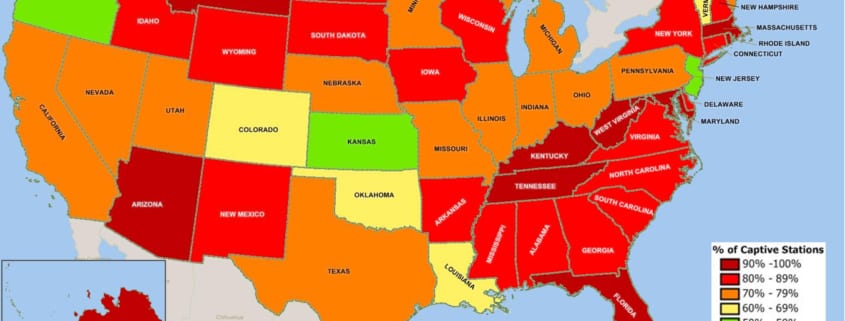
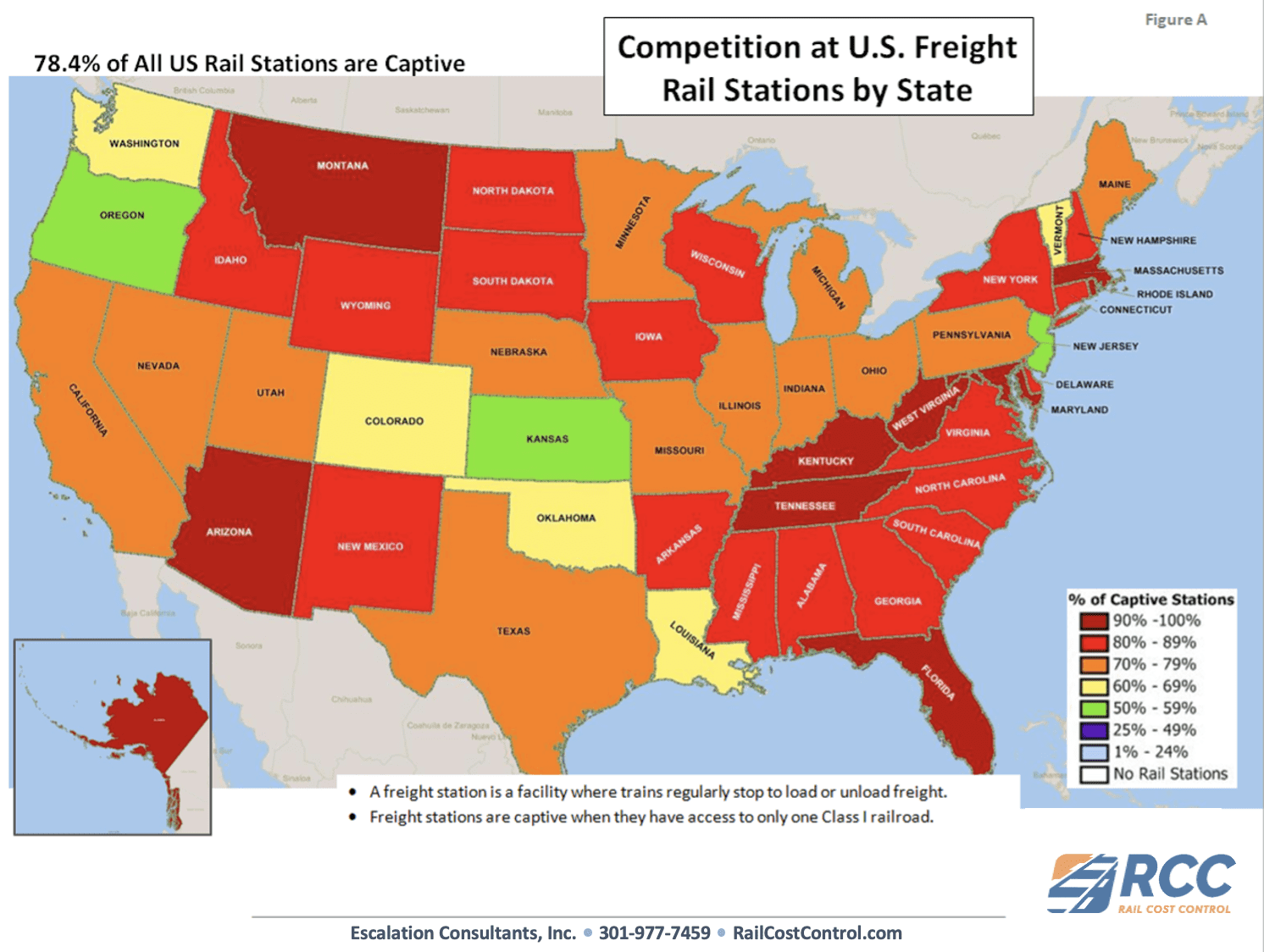
The Rail Station Captivity Map shows that 78.4% of all rail stations in the United States are captive to one Class I Railroad.

Figure A is color coded to show the percentage of all rail stations by state, that are captive to a single Class I railroad. Rail stations are captive if they don’t have either direct or indirect access, through a short line, to more than one Class I Railroad.

Making your movements more important to your railroads, USA


The number of states in each captivity range are shown below.

Breakdown of Rail Station Captivity in the US

# of States
% of Stations Captive to One Major Railroad
10 90% – 100%
18 80% – 89%
13 70% – 79%
5 60% – 69%
3 50% – 59%
0 25% – 49%
0 1% – 24%
Note: Hawaii is not included.

Railroads are always concerned about politicians, as they can have a significant impact on how railroads are allowed to operate. Unfortunately for railroad customers, it is frequently difficult to get the attention of politicians on rail rate issues. This is because the problems shippers experience with railroads are complex and not easy to explain.

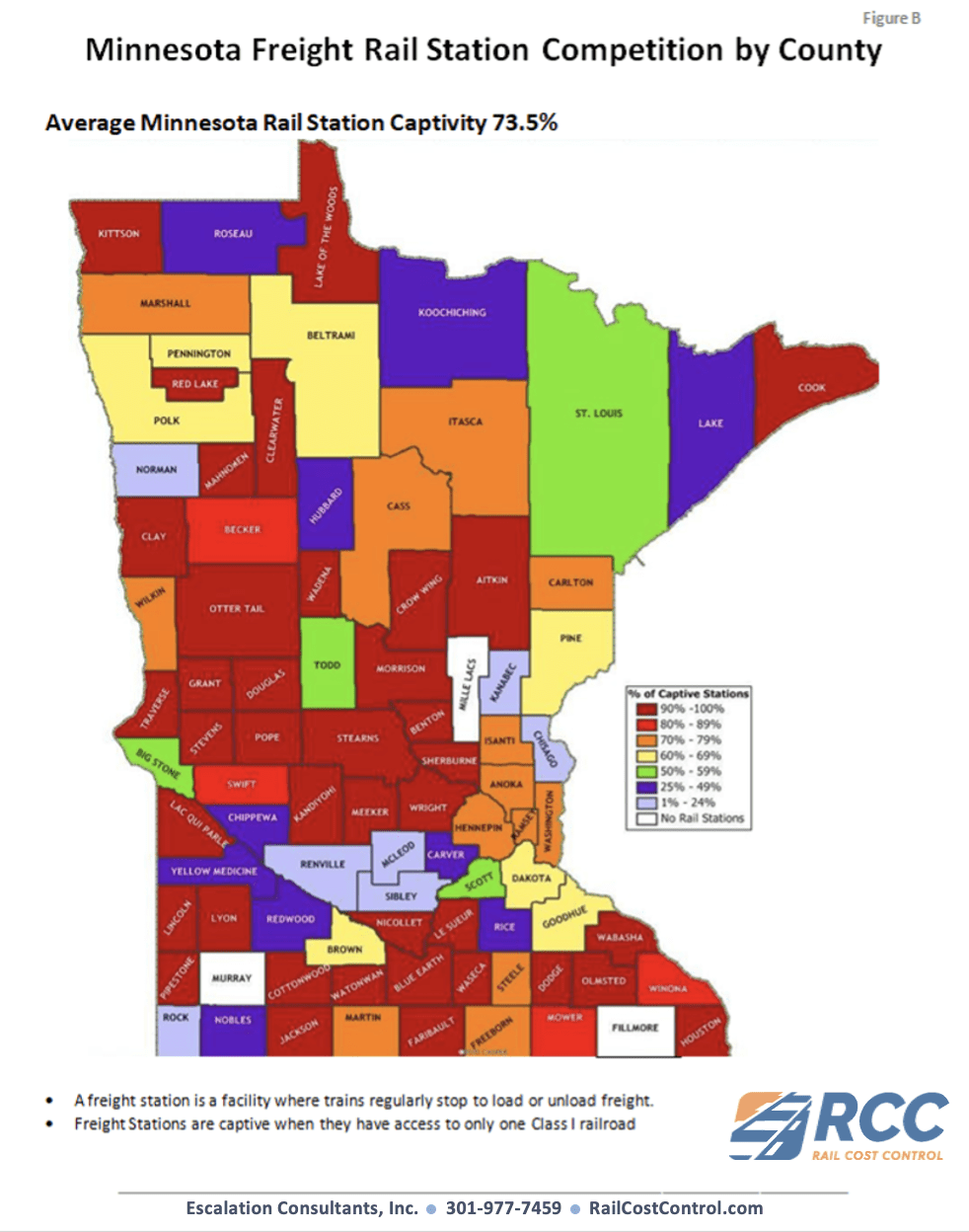
It is easier to get a politician’s attention with an easy-to-understand picture, highlighting the importance of rail to specific areas they represent. Figure B shows this as it contains the rail station captivity by County for the state of Minnesota. Rail Station Captivity Maps are available, by county and Congressional District, for all states in the United States.

Making your movements more important to your railroads MN.

Escalation Consultants is making state maps available for rail shippers. Simply contact Escalation Consultants to request the Rail Station Captivity Map for your states of interest.  

The State Rail Station Captivity Maps are effective at getting the attention you need to help resolve problems. When shippers want to make movements more important to railroads, getting the attention of Congressmen and Senators is a good way of accomplishing this. Please note: all politicians do not have the same amount of sway over railroads. In addition, there is a right way and a wrong way to deal with politicians. This needs to be understood, and allowed for, in your discussions with politicians.

Rail Station Captivity Maps, for a specific area, are an excellent way of showing railroads and politicians why production will not increase, and capital investment will not be made at an existing location that is captive to one Class I railroad. Captivity maps illustrate areas that will have difficulty in achieving economic development from companies that rely on rail freight.

Shippers need to be able to show that railroads’ monopoly power over captive movements at a facility creates problems for both politicians and railroads.

Rail Station Captivity Maps are proof of the expression: “A picture is worth a thousand words.” Shippers are encouraged to use these maps to increase their leverage in rail negotiations.


Rail Cost Control (“RCC”) is a program developed by Escalation Consultants, Inc. to help shippers reduce rail expenses by managing costs and empowering negotiations. For more information about RCC and other related articles, visit the RCC Blog.”

Rail Cost Control

https://www.railcostcontrol.com/wp-content/uploads/US-Rail-Station-Captivity-Map.bmp 843 1354 Keith Nestman https://www.railcostcontrol.com/wp-content/uploads/RCC-Logo-2026.svg Keith Nestman2021-02-24 08:00:052021-04-07 19:39:40Making Your Moves More Important to Railroads
Track Rail Rate Increased Over Time

Use Past Rail Rate Increases to Reduce Current Rates

February 17, 2021

Would your position on a proposed rate increase of 3% for a rail move be different if that rate had already increased by 40% in prior time periods?

Many shippers answer this question with a resounding YES! The reason – Your railroad knows how its rates have changed.  If your past rate problems are not addressed in current rate negotiations this either indicates that:

  • You have forgotten about the large rate increases of the past; or,
  • Large rate increases are not causing you a problem.

Either situation can be detrimental to a shipper’s rates, as silence does not send the proper message to a railroad.

If rates increased 20% over two bid cycles, it doesn’t matter whether the 2021 or 2019 rate increases caused the problem. The 20% rate increase is the problem!

Past performance can be a powerful source of leverage for obtaining lower rates from railroads. Unfortunately, it’s difficult to keep track of the impact past rate increases have had on current rates and volumes for specific moves. This is especially true when you have employee turnover as you lose the knowledge of people previously involved with your moves.

Large rail rate increases make an effective Database Management System (DMS) an essential tool for shippers. This is the reason for the DMS in the Rail Cost Control Program (RCC).  The DMS automatically identifies and quantifies past rate problems and establishes an effective source of leverage for shippers. The RCC makes rail negotiations more productive and helps better control the cost of rail freight.


Rail Cost Control (“RCC”) is a program developed by Escalation Consultants, Inc. to help shippers reduce rail expenses by managing costs and empowering negotiations. For more information about RCC and other related articles, visit the RCC Blog.”

Database Management System

https://www.railcostcontrol.com/wp-content/uploads/img_market_data-1.jpg 900 1068 Keith Nestman https://www.railcostcontrol.com/wp-content/uploads/RCC-Logo-2026.svg Keith Nestman2021-02-17 08:00:332021-04-07 19:40:41Use Past Rail Rate Increases to Reduce Current Rates
Railroad Strategic Alliances

Creating Effective Alliances with Railroads

February 10, 2021

Develop Strategic Alliances to Create Greater Value for You and Your Railroads

The term partnering is overused. Many rail shippers refer to any contractual agreement with a railroad as a partnership. The term partnering is even used in agreements with high rail rates for moving shippers’ commodities with thin profit margins. To obtain a better rate structure from railroads, shippers should focus on creating strategic alliances with railroads.

Strategic Alliances establish a process with defined goals for improving revenue and profits for both shippers and railroads.

The alliance needs to detail what is expected from each party and the outcome (goals) each party will receive from the process. Strategic alliances that impact rail rates normally have little to do with the captive or competitive nature of movements. A strategic alliance starts by first identifying common goals between shippers and railroads. An effective alliance then works to better accomplish these goals.

Some alliances are simple while others are complex. A prime example of a complex alliance involves foreign imports. Greater value can frequently be obtained by working together than apart on import issues. This makes imports a prime candidate for a strategic alliance between shippers and railroads.

When imported products become a threat to a company’s domestic production, the shipper and railroad have the same goal – STOP THE BLEEDING.

Imports cause both shippers and railroads to lose volumes and revenue when they impact a company’s domestic production. Railroads have a lot to lose with imported products, as they:

  • Lose all inbound movements needed for domestic production
  • Miss out on outbound movements to customers
  • May not move imported products from the port

Consider the impact of each additional container of imported paper. The railroad loses inbound moves of wood chips, slurry, chemicals, and potentially, coal to the paper mill. This loss of business has a big impact on railroads, suppliers to paper companies, and of course the paper company on outbound moves. This scenario demands a strategic alliance amongst impacted companies, because everyone loses if the paper company can’t compete with imports. All impacted companies need to reduce their costs to stop the bleeding. It doesn’t matter whether a railroads moves are captive when high rates only lead to a loss of revenue. To protect the vested interest in the output of the paper company, rates are determined through the alliance, and not the competitive status of rail movements.

Dealing more effectively with imports is an example of a complex strategic alliance. There are, however, many less-complex types of basic agreements struck between shippers and railroads that accomplish a common objective. A shipper’s capital investment to maintain or improve plant output frequently results in an alliance with its railroad. Capital Investment that also benefits a railroad, should not be made without first receiving an incentive from the railroad to make the investment. This is best accomplished through a strategic alliance which details what is needed from each party.

Not all leverage with railroads stems from the operational parameters of a movement.

With smart people on both sides of an opportunity creating value, great things can be accomplished. Rail shippers need to identify these opportunities because they will determine the best rates and contract terms for moving rail traffic.

The path to a more reasonable rate structure frequently starts by understanding common goals you have with railroads. This process leads to more productive rail negotiations and the creation of greater value for shippers and their railroads.


Rail Cost Control (“RCC”) is a program developed by Escalation Consultants, Inc. to help shippers reduce rail expenses by managing costs and empowering negotiations. For more information about RCC and other related articles, visit the RCC Blog.”

Rail Cost Optimizer

https://www.railcostcontrol.com/wp-content/uploads/shutterstock_300890957-scaled.jpg 1709 2560 Keith Nestman https://www.railcostcontrol.com/wp-content/uploads/RCC-Logo-2026.svg Keith Nestman2021-02-10 08:00:262021-06-01 13:53:37Creating Effective Alliances with Railroads
railroad car on sunny day at industrial plant

8 Ways to Improve Your Captive Rail Rates

February 3, 2021

Many rail shippers believe that if they are captive to a railroad at a location, they have little leverage to negotiate better rates.

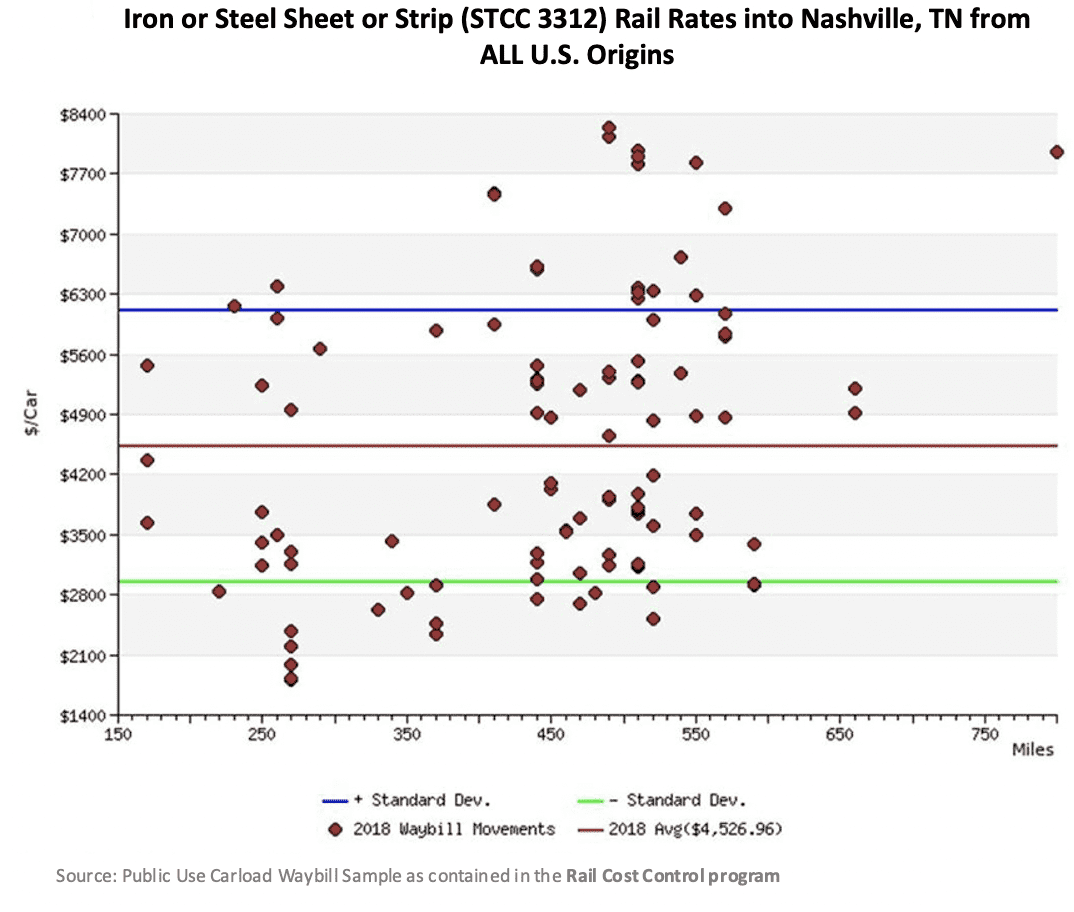
The graph below shows why this isn’t a good way to look at your rail traffic. The graph contains rail rates for Iron or Steel Strip (STCC 33123) going into the captive rail market of Nashville, TN.

The question to answer with this graph is:

Why Are Rates So Different At a Destination Market Like Nashville, TN that Is Completely Captive To CSXT?


Improving captive rail rates graph


The graph shows that some rates are below $2,800, while other rates going the same distance, are above $7,000. The question is: If Nashville is a captive market, then why aren’t all rail rates above $7,000?

There are many reasons why rates for specific movements vary, but the big picture answer is very simple, Effective Strategic Planning. Shippers that make railroads look at their traffic differently get better rates from their railroads.

Strategic Planning causes captive moves to have different rate levels. Significant downward pressure on rail rates can be generated when the following issues are addressed by shippers in strategic planning.

Eight Ways to Get Better Rail Rates at Captive Locations

  1. Railroads need to compete for your business when you have multiple plants that produce the same product.
    • Even when a location is captive to a railroad, a shipper can use geographic competition to obtain lower rates from railroads.
  2. Large shippers that bundle all their rail traffic in an RFP can get better rates at captive locations.
    • In order for a railroad to get more of a shipper’s competitive traffic it must reduce its rates on captive traffic. More traffic is always better than less traffic in rail rate negotiations. RFP’s that take advantage of a shippers entire book of potential business increase negotiation leverage.
  3. Forward storage of products at captive locations.
    • To avoid bottle necks at captive locations, explore forward storage options at sites with rail competition, then truck to captive locations. You don’t have to bypass railroads at captive locations forever. Railroads get the message.
  4. Take freight costs out of the system with commodity swaps.
    • Commodity swaps work best when you have a competitor serve your customer when it’s facility is closer to the customer and you serve a competitor’s customer that is closer to your plant. The greater your rail expenses, the greater the benefit from commodity swaps. Commodity swaps can be a short-term action as a railroad gets the message pretty quickly.
  5. High rates create the economic incentive to invest capital to increase your logistics options.
    • The railroad needs to make it uneconomical for a shipper to take traffic off its system. If its rates are too high then other logistic and capital investment options become more attractive. A railroad must reduce cost to make these options less attractive.
  6. Railroads need to compete against trucking on short and mid distance moves.
    • Large rail rate increases allow trucks to compete with rail for longer distance moves. The cost of trucking and transloading needs to become the ceiling price for short and mid distance moves.
  7. Political pressure!
    • One of the best and easiest sources of leverage to create is political pressure. Politicians want to talk to you as your company is a great source for tax revenue, political contributions, and you employ many voters. Politicians can be a great benefit because if you have the ear of someone that is important to the railroad, then you become more important to the railroad. There is a right way and a wrong way to address politicians and all politicians are not equal which should be considered in your strategic planning.
  8. Foreign Imports: 
    • It doesn’t matter if a railroads moves are captive, if imports are reducing your domestic production. The shipper and railroads have the same goal with imports – STOP THE BLEEDING. Additional information on this topic will be contained in an upcoming Blog Article, on 2/10/2021.


For the last forty years, Escalation Consultants, Inc. has conducted the most highly recommended Rail Negotiation Seminar for shippers, and we have seen the results of changing how railroads view a shipper’s traffic.

Our Rail Cost Control program and consulting services are used extensively by shippers to reduce the rate structure for their movements.

Rail Cost Control (“RCC”) is a program developed by Escalation Consultants, Inc. to help shippers reduce rail expenses by managing costs and empowering negotiations. For more information about RCC and other related articles, visit the RCC Blog.
Rail Cost Optimizer

https://www.railcostcontrol.com/wp-content/uploads/rail_yard_in_sunny_day.jpg 674 800 ACS Admin https://www.railcostcontrol.com/wp-content/uploads/RCC-Logo-2026.svg ACS Admin2021-02-03 08:00:472021-06-01 13:54:458 Ways to Improve Your Captive Rail Rates
Rail Negotiation Wheel

Obtaining the Rail Cost Reductions that Shippers’ Management Needs

January 20, 2021

“If YOU don’t change what YOU do, it will be difficult to get railroads to change what THEY do.”

Escalation Consultants, Inc. is regularly involved in assisting shippers in reducing their cost of rail freight. Furthermore, we frequently receive inquiries from companies asking how they can best achieve the cost reductions that management is demanding. This article provides some direction for transportation and logistics departments looking to reduce rail costs for their rail movements.

To start out the process of reducing rail expenses, there are two basic issues to keep in mind in getting a better rate structure from railroads:

  • You must do something different than what you are currently doing with … you guessed it… railroads! This is a pretty logical rule that people frequently try to ignore because of a resistance to change. To change your rate structure, you must change how you negotiate with railroads. If you don’t change what YOU do, it will be difficult to get railroads to change what THEY do.
  • Every company has a unique situation. Therefore, the specific process for reducing rail expenses for one company, will be different from what is most effective at another. However, the analysis of fundamental issues to determine the best path to reducing and better controlling rail expenses, are similar.

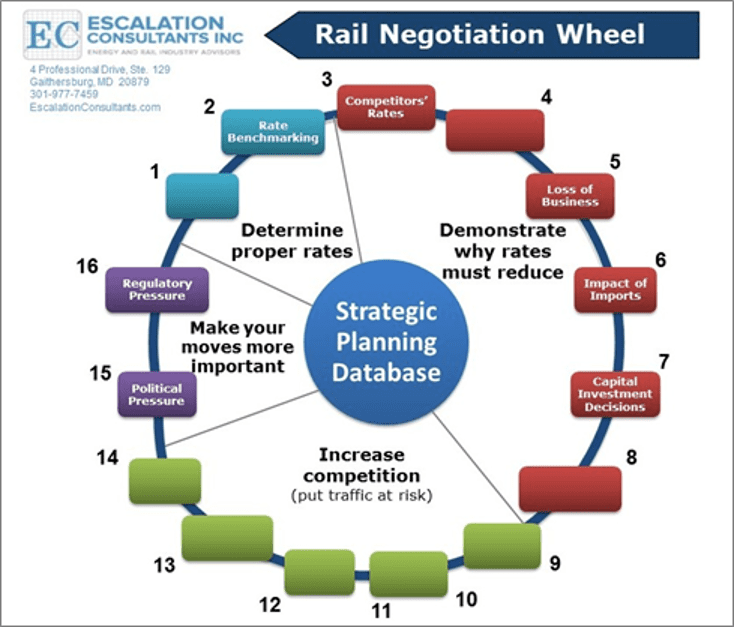
A number of the fundament issues that need to be analyzed and incorporated as part of a negotiation strategy that will create different dynamics in a rail negotiation are included in the illustration below.

Rail Negotiation Wheel

**Please note that many of the action items on the outside of the Rail Negotiation Wheel have been left blank. A review of ALL actions would be too large a topic for one article.**

These issues in the Rail Negotiation Wheel form the building blocks for strategic planning, designed to obtain better rates for rail movements.

Many things need to be considered in an effective rail negotiation. Not all of the issues that are analyzed, have the same objective. The Rail Negotiating Wheel demonstrates this. The outside of the Rail Negotiation Wheel has analysis that can be performed and actions that can be taken, and the results achieved are on the inside. 

For example, when you benchmark your rates (Position 2 “P2” on the wheel), you determine reasonable rates for your movements. If this analysis shows that your rates are higher than competitors’ rates in a market (P3), then these rates must be reduced as they are putting you at a competitive disadvantage in the marketplace. The results in the middle of the wheel demonstrate why rates must be reduced.

When multiple issues on the outside of the wheel support the same result, this increases your leverage for obtaining better rates for your traffic.

For example, if your rates are higher than your competitors’ (P3), your negotiation position gets even stronger if your rates impact your business in the following ways:

  • Loss of business to competitors’ (P5)
  • Loss of business to imports (P6)
  • Where you invest capital to maintain and increase capacity, and where you don’t invest capital (P7)

All of these types of issues demonstrate why rates must be reduced and increase a shippers’ leverage in negotiations with railroads. The more action items you can use to support your negotiation, the greater your chance of success in obtaining the rates you need for your traffic.

As a shipper, you have the strongest position when you can bring all of the items on the inside of the Rail Negotiation Wheel into your negotiation position with railroads. Those who have attended Escalation Consultants’: Rail Negotiation Seminar know that we are big on shippers developing their rail negotiation “Story.” The story contains a shippers’ position for why it needs rates at a specific level. It also needs to provide the reasons why a railroad should agree to those rates. The Rail Negotiation Wheel provides the roadmap for developing that story.

Effective negotiation positions address issues that support each of the results on the inside of the Rail Negotiation Wheel.

When shippers can demonstrate some or all of the following issues, they will have more effective negotiations with railroads.

  • The rates you need
  • Why you need these rates
  • Why the railroads should give these rates to you

Make your moves more important to railroads.

When your moves become more important to railroads your chances of success increase dramatically (P15 & P16) . If you have the ear of people that are important to railroads, you become more important to railroads. This makes it imperative for a railroad to act promptly on your problems.

These are the types of issues that are analyzed and acted upon in strategic planning. When the Rail Negotiation Wheel is used effectively, a shipper has more productive negotiations with railroads. As a result, a shipper increases its potential for obtaining a rate structure that will keep it competitive in its markets.

Addressing the actions and results included in the Rail Negotiating Wheel is an important concept for every shipper to understand.

The success of a rail negotiation hinges on shippers obtaining the results on the inside of the Rail Negotiation Wheel. Using the leverage you obtain from the Rail Negotiation Wheel is especially important, due to the drop in bulk rail volumes and employment. These changes are providing shippers with significant leverage. Moreover, the Rail Negotiation Wheel helps shippers utilize this leverage in a proactive process for establishing reasonable rates for their movements.


Rail Cost Control (“RCC”) is a program developed by Escalation Consultants, Inc. to help shippers reduce rail expenses by managing costs and empowering negotiations. For more information about RCC and other related articles, visit the RCC Blog.”

Database Management System

https://www.railcostcontrol.com/wp-content/uploads/RailNegotiationWheel.png 628 734 Keith Nestman https://www.railcostcontrol.com/wp-content/uploads/RCC-Logo-2026.svg Keith Nestman2021-01-20 15:41:342021-06-01 13:55:54Obtaining the Rail Cost Reductions that Shippers’ Management Needs
Page 6 of 7«‹4567›

Pages

  • About Us
  • AXIS
  • Contact Us
  • Cost Optimizer
  • Costing Dashboard Update
  • Database Management System
  • Evaluation Exercise Calendly
  • Evaluation Exercise Contact Form
  • Home
  • Landing Page – 2025
  • Movement Evaluation Exercise
  • News & Events
  • PopUp Testing 05172021
  • Privacy Policy
  • Rail Cost Control Demo
  • Rail Rate Checker
  • Seminars and Training
  • YT

Categories

  • Uncategorized

Archive

  • August 2026
  • June 2026
  • May 2026
  • March 2026
  • February 2026
  • January 2026
  • December 2025
  • November 2025
  • October 2025
  • September 2025
  • June 2025
  • November 2024
  • October 2024
  • June 2024
  • February 2024
  • September 2023
  • August 2023
  • July 2023
  • June 2023
  • February 2023
  • January 2023
  • June 2022
  • February 2022
  • January 2022
  • December 2021
  • October 2021
  • August 2021
  • July 2021
  • June 2021
  • May 2021
  • April 2021
  • March 2021
  • February 2021
  • January 2021
  • December 2020

Rail Cost Control is a product of Escalation Consultants, Inc.—serving railroad customers since 1979.

Quick Links

  • AXIS
  • Rail Rate Checker
  • Cost Optimizer
  • Database Management System
  • News & Events
  • Seminars & Training
  • About Us
  • Contact Us
  • Login

Contact Info

4 Professional Drive, Suite 129
Gaithersburg, MD 20879

info@railcostcontrol.com
301-977-7459 

linkedinfacebook

© 2025 Rail Cost Control. All Rights Reserved.

Scroll to top

Access FREE Trial to Rail Cost Control and Uncover Savings in Seconds