• Solutions
    • AXIS
    • Rail Rate Checker
    • Cost Optimizer
    • DMS
  • Company
    • About Us
    • Contact Us
  • News & Events
  • Seminars and Training
  • Login
  • Start Your Free Trial
  • Schedule Call
  • Menu Menu

Archive for category: Uncategorized

RCC Blog: Rail Cost Control Even Benefits Non-Payers-of-Freight

Rail Cost Control Even Benefits Non-Payers-of-Freight

November 7, 2025

How Rail Cost Control (RCC) Empowers Shippers — Even When They’re Not the Payer of Freight 

In today’s complex rail logistics environment, visibility is power. For many manufacturers and distributors, freight is billed and managed by suppliers, meaning the buyer never directly negotiates with the railroad. However, even when a company isn’t the payer of freight, understanding what rail transportation should cost remains critical to managing delivered prices and maintaining competitiveness. That’s where RCC comes in. 

Uncover Hidden Transportation Costs in Delivered Pricing 

When freight is prepaid, shippers often accept the supplier’s delivered cost at face value. Yet, that price includes rail transportation – an expense that can fluctuate significantly based on carrier contracts, market dynamics, and rate negotiations. Without access to those underlying numbers, it’s impossible to know whether the supplier is passing along a fair transportation charge. 

RCC provides the tools to change that. By entering the origin, destination, commodity details, and other known details of a movement, shippers can use Rail Rate Checker (part of the RCC program) to estimate what the benchmark rail rate should be for that route. This comparison allows the shipper to evaluate whether the supplier’s delivered cost aligns with market averages—or if hidden freight markups are inflating total landed costs. 

Example: If a supplier’s delivered cost is significantly higher than RCC’s benchmark rail rate for the same movement, the discrepancy often indicates that the supplier’s negotiated rail rate is above market, or that margin is being added to the freight portion of the sale. 

Use RCC to Confirm Supplier Competitiveness 

RCC’s Database Management System (DMS) provides a macro-level view of rates and movement economics. This allows shippers to: 

  • Reverse-engineer supplier rates using known routes and delivery costs.
    •Validate supplier competitiveness by comparing rates against regional and national market averages. 
    • Strengthen negotiations by knowing whether suppliers’ transportation arrangements are optimized—or leaving money on the table. 

Armed with this information, shippers gain leverage in supplier discussions and procurement decisions. It transforms delivered pricing from a black box into a transparent, data-driven process. 

Track Rate Changes Over Time 

Markets evolve. Rail rates rise and fall based on carrier cost structures, inflation, and network changes. What was a fair rate three years ago may no longer be competitive today. 

RCC’s historical rate tracking capabilities allow users to: 
• Analyze rate trends over time for specific lanes and commodities. 
• Quantify how rates have changed across different carriers, origins, or destinations. 
• Anticipate future shifts and build cost models that reflect true transportation economics. 

By viewing multi-year rate histories, shippers can identify when suppliers’ delivered costs have increased faster than industry benchmarks—a strong signal that freight expenses may not be optimized. 

Turning Delivered Cost into Strategic Insight 

Even when a company isn’t managing rail contracts directly, RCC helps bridge the information gap between delivered cost and true rail market conditions. With this visibility, shippers can: 

  • Ensure suppliers are obtaining competitive rail rates
  • Improve total cost of goods delivered analysis for sourcing decisions
  • Strengthen budget forecasting and cost control across supply chains.
     

In short, Rail Cost Control transforms passive freight recipients into informed supply chain decision-makers. 

Conclusion 

Whether you control freight or buy on a delivered basis, rail costs are a critical part of your total spend. Rail Cost Control empowers shippers to see what’s happening behind the invoice—to identify inefficiencies, confirm competitive pricing, and track long-term rate trends. The result: greater transparency, stronger supplier relationships, and better-informed logistics strategy. 

Schedule Free Movement Evaluation

https://www.railcostcontrol.com/wp-content/uploads/Rail-Negotiation-Seminar-Survey-Tile-57.png 540 540 Keith Nestman https://www.railcostcontrol.com/wp-content/uploads/RCC-Logo-2026.svg Keith Nestman2025-11-07 20:32:222025-11-11 14:43:19Rail Cost Control Even Benefits Non-Payers-of-Freight
Free Rail Movement Evaluation Exercise

Rail Movement Evaluation Exercise

October 22, 2025

FREE Rail Movement Evaluation Exercise


FREE Rail Movement Evaluation Exercise:

Take Your First Step to Strategic Rail Savings

Overview:

The FREE Movement Evaluation Exercise gives rail shippers a data-driven, no-cost opportunity to understand how their rail rates stack up against the market and to uncover actionable cost-saving opportunities. Conducted using Escalation Consultants’ (“EC”) Rail Cost Control – Database Management System, this exercise is designed to deliver both micro-level rate insights and a macro-level strategic perspective on your rail spend.

Evaluation Process:

1.    Data Curation & Setup – Shipper to provide movement and rate data to EC for import into the Rail Cost Control – Database Management System.

2.    Rate Benchmarking – Each movement is benchmarked against industry data to determine how your rates compare to market levels.

3.    Detailed Analysis – The system identifies where rates are above, at, or below competitive levels, highlighting potential inefficiencies and cost-reduction opportunities.

4.    Results Review – EC to provide presentation summarizing insights into key findings, helping you visualize how specific movements and broader trends directly impact your overall rail costs.

Benefits for Rail Shippers:

  • Gain both micro (lane-specific) and macro (systemwide) visibility into rate performance.
  • Identify hidden cost savings and inefficient rate structures.
  • Establish fact-based leverage for upcoming rail negotiations.
  • Develop a data-backed strategy to manage and reduce rail spend.
  • Understand where your rates truly stand relative to peers and the market.

Why Participate?

The Movement Evaluation Exercise gives shippers the insight advantage that supports smarter decisions, stronger negotiating positions, and measurable cost reductions — all at no cost and with no obligation.

Get Started:

Click below to schedule your Free Movement Evaluation Exercise and start uncovering opportunities to reduce your rail expenses today.

https://www.railcostcontrol.com/wp-content/uploads/Rail-Negotiation-Seminar-Survey-Tile-56.png 540 540 Keith Nestman https://www.railcostcontrol.com/wp-content/uploads/RCC-Logo-2026.svg Keith Nestman2025-10-22 15:22:172025-10-30 14:24:36Rail Movement Evaluation Exercise
Don’t Wait for the UP–NS Merger to Define Your Rail Future

Don’t Wait for the UP–NS Merger to Define Your Rail Future

October 8, 2025

Why Every Rail Shipper Needs a Formal Position on the UP–NS Merger 


As the rail industry braces for potential structural shifts driven by the proposed Union Pacific (UP) and Norfolk Southern (NS) merger, rail shippers face a defining moment. Whether the merger proceeds as proposed or undergoes regulatory revisions, the decisions made today will reshape rate structures, routing options, and competitive access for years to come. 
 
For shippers, neutrality isn’t a strategy — it’s a missed opportunity. Establishing a formal position on the UP–NS merger is essential to protect both short- and long-term transportation interests. 

1. Defining Your Interests Before Others Define Them for You 

In every major railroad consolidation, stakeholders that clearly communicate their needs early tend to shape the outcome in their favor. Railroads and regulators look closely at shipper feedback when assessing market impacts, competition, and network efficiency. 
 
By formally stating your position — whether in support, opposition, or with conditions — your company ensures that its voice is heard in the Surface Transportation Board’s (STB) review process. Silence can be interpreted as acceptance, and that leaves your transportation costs and access at the mercy of others’ priorities. 

2. Anticipating How the Merger Could Affect Your Network 

The UP–NS merger could influence more than rate structures. It may reshape interchange points, alter routing options, and redefine how traffic flows across regions. For shippers with multiple facilities or diverse commodity portfolios, even subtle shifts in routing control can lead to significant changes in cost and service reliability.  

Developing a formal position forces a proactive analysis: 
– How could network consolidation impact your lanes and service options? 
– Would your access to competing carriers be limited or enhanced? 
– Could rate or service commitments already negotiated become less competitive post-merger? 

3. Strengthening Your Negotiating Leverage 

Railroads are closely watching how shippers respond. A well-documented position gives your organization a clear and credible foundation for future negotiations, with carriers. This can also affect what is included in the final merger agreement, if approved by the STB. 
 
Taking a stand communicates preparedness and sophistication that you’ve assessed how the merger could influence your network and that you’re ready to advocate for terms that maintain or improve your competitive access. 

4. Building Alignment Across Stakeholders 

Establishing a formal stance isn’t only about submitting comments to the STB; it’s also about aligning your internal stakeholders — from logistics and procurement to legal and executive leadership. 
 
A defined position ensures that everyone within your organization is speaking consistently and strategically when the merger becomes a discussion point with rail partners or industry groups. 

5. Protecting Future Options 

Even if the merger is approved, its implementation will unfold over the years. Railroads often use transition periods to make operational adjustments that can affect pricing and service. Shippers with a clear, documented stance are better positioned to request concessions, monitor compliance, and hold carriers accountable to merger conditions that protect competition. 

The Bottom Line 

The UP–NS merger will likely be one of the most consequential developments in rail logistics this decade. Shippers that take the time to analyze its implications and establish a formal position — supported by data and a clear understanding of how the merger affects their network — will be better prepared to adapt, negotiate, and thrive in the new landscape. 
 
In mergers of this scale, those who speak early have the ability and opportunity to strategically shape the outcome. Those who remain silent are left to navigate the consequences of inaction. 

Take the Next Step 

Understanding how the UP–NS merger could reshape your competitive access is critical — especially if your lanes or facilities may face increased captivity. Escalation Consultants can help you evaluate how the merger will impact your specific commodities, rates, and routing options. 

Click to schedule a review of your network and develop a strategy to protect your position before the market shifts. 

https://www.railcostcontrol.com/wp-content/uploads/Rail-Negotiation-Seminar-Survey-Tile-55.png 540 540 Keith Nestman https://www.railcostcontrol.com/wp-content/uploads/RCC-Logo-2026.svg Keith Nestman2025-10-08 19:19:582025-10-22 14:47:52Don’t Wait for the UP–NS Merger to Define Your Rail Future
Impact of UP NS Merger Blog

Impact of Union Pacific Proposed Merger with Norfolk Southern

September 3, 2025

The Union Pacific (UP) and Norfolk Southern (NS) proposed merger would form the first transcontinental railroad in the United States, and the largest railroad merger that has ever been before the Surface Transportation Board (STB). The Union Pacific Norfolk Southern merger will have an impact on most rail shippers and, if approved, will likely be followed by a proposed merger between BNSF and CSX. It is an understatement to say that the UP/NS merger is important to rail shippers. Understanding the implications of the Union Pacific Norfolk Southern merger is crucial for all stakeholders involved in the rail industry.

The outcome of the merger between UP and NS, and what the railroads will need to concede to get the merger approved, will likely have a significant impact on the rail industry for the next fifty years.

This analysis of the Union Pacific Norfolk Southern merger highlights the potential challenges and opportunities that may arise.

Understanding the implications of the Union Pacific Norfolk Southern merger is crucial for all stakeholders involved in the rail industry.

Rail shippers need to develop their corporate position on the UP/NS merger, and due to the importance of this merger, this should be done as soon as possible.  One of the main things to understand in forming an educated position on this merger is the impact that past mergers have had on railroads pricing practices for your commodities. The Union Pacific Norfolk Southern merger will be a pivotal moment in shaping future market dynamics.

The following graph provides an example of how railroads pricing practices changed for STCC 26 Pulp and Paper Products after the last round of major rail mergers.

Change in Railroads rate Making Practices for STCC 26 -Pulp & Paper

The graph shows that between 2004 and 2023:

The orange line in the graph shows that STCC 26 revenue generated from rates considered potentially non-competitive by the STB (Non-Competitive Rail Revenue) increased 284.4%. The blue line shows that rail revenue generated from rates considered Competitive by the STB (Competitive Rail Revenue) increased only 4.8%.

The graph essentially shows that after the last round of major rail mergers ended in year 2000:

  1. Railroads rate making practices changed significantly for STCC 26.  A 284% increase in revenue from Non-Competitive rates demonstrates that a big change occurred in how railroads priced pulp and paper product movements.
  2. Railroads didn’t appear to be worried about regulatory pushback on their high non-competitive rates in the paper industry
  3. The STB is regulating very different railroad pricing practices for the paper industry than the pricing practices that existed before the merger.

Many things are being analyzed to determine the positive versus negative aspects of the proposed merger between UP and NS. The best advice for shippers is to get smarter about the impact the merger will likely have on your business. Escalation Consultants maintains the largest database that exists on rail rates, costs, profit margins, volumes, routes, and how everything has changed over time.

Due to Escalation Consultants’ expertise and large databases, we are very involved in analyzing the merger. We recommend that everyone start with the type of data included in the above graph for your specific commodities. We should note that the change in competitive versus non-competitive rail revenue for your specific commodities is available down to the five-digit Standard Transportation Commodity Code (STCC).

Click here to schedule time to talk about your commodities!

https://www.railcostcontrol.com/wp-content/uploads/Rail-Negotiation-Seminar-Survey-Tile-54.png 1080 1080 Keith Nestman https://www.railcostcontrol.com/wp-content/uploads/RCC-Logo-2026.svg Keith Nestman2025-09-03 21:58:252025-09-04 15:00:53Impact of Union Pacific Proposed Merger with Norfolk Southern
RCC Blog: SEC Filings Are Valuable Tools for Rail Shippers in Negotiations

Why SEC Filings Are Valuable Tools for Rail Shippers in Negotiations

June 30, 2025

When negotiating rail freight rates, shippers often feel they’re at a disadvantage due to the complexity and lack of competition in the rail industry.


However, one powerful, yet often overlooked, source of leverage comes from an unlikely place: Securities and Exchange Commission (SEC) filings. These public documents—required by law for publicly traded companies—offer a wealth of financial and operational data that rail shippers can use to their advantage during negotiations. 

Transparency into Railroad Financials 

SEC filings, such as 10-Ks and 10-Qs, offer detailed insights into a railroad’s revenue, profit margins, and cost structures. Railroads must disclose information on volumes, revenue, pricing trends, operating ratios, freight expenses, and numerous other details that can be used to determine opportunities for negotiating better rates or service commitments. 

Specific Examples for Reducing Cost 

Once you know how a railroads SEC data has changed over time it opens up new sources of negotiation leverage with railroads. A few examples of how SEC data is used in strategic planning for rail negotiations are: 

1. How a railroads’ costs have changed over time.  

This can put a lid on your rate increases and may also offer an opportunity for discussions about rate decreases. 

2. The level of a railroads’ profit. 

You can then decide whether the railroad’s profit from moving your products is greater than your profit from producing products.  

3. The overall average percent increase in a railroads rate. 

It is always important to Know if your rates are increasing more than the average for your railroad. 

4. The change in railroads’ fuel cost 

This allows you to check the accuracy of a railroads fuel surcharge program. (Change in fuel cost versus fuel surcharge revenue). 

Benchmarking and Competitive Positioning 

If a shipper sees that a railroad has had rising profit margins, while service levels have remained static or declined, it may signal that there’s room to push back on rate increases. Similarly, if a railroad is heavily investing in a specific corridor or terminal, it could suggest greater willingness to negotiate to fill capacity in that area. 

Shippers can also use SEC data to benchmark rail carriers against one another. This is particularly useful when a shipper is served by more than one Class I railroad or has the option to interchange traffic. Knowing which railroad has the lower operating ratio or which one is investing more aggressively in infrastructure can be a persuasive tool in negotiations. Railroads competing for business respond not only to volume, but to informed shippers who understand their business economics. 

In addition, SEC filings sometimes reveal strategic priorities—such as growing intermodal, agricultural, or energy sectors—which can help shippers align their messaging with the railroad’s goals and potentially secure better terms. 

Conclusion: Rail Shippers Need the Rail Cost Control (RCC) Program 

While SEC filings are a valuable resource, they are just one piece of the puzzle. To fully leverage them in rail negotiations, shippers need context, interpretation, and tools to compare rates and costs across movements. That’s where the Rail Cost Control (RCC) program becomes essential. RCC combines SEC data with proprietary rate benchmarks, the Public Use Waybill Sample, and network modeling tools to give shippers a complete picture of their rail spend and negotiating position. It transforms raw data into actionable insights—empowering shippers to push for fairer rates, defend against unjustified increases, and strategically manage their rail costs.  

In today’s complex freight landscape, informed shippers win—and RCC ensures they are informed. 


Introduction to Rail Cost Control program

https://www.railcostcontrol.com/wp-content/uploads/Rail-Negotiation-Seminar-Survey-Tile-3.jpg 540 540 Keith Nestman https://www.railcostcontrol.com/wp-content/uploads/RCC-Logo-2026.svg Keith Nestman2025-06-30 20:54:502025-09-04 15:01:08Why SEC Filings Are Valuable Tools for Rail Shippers in Negotiations
Benefits of The Public Use Waybill for Rail Shippers

Benefits of The Public Use Waybill for Rail Shippers

June 17, 2025

Maximizing Negotiations: The Benefits of The Public Use Waybill Sample for Rail Shippers

Negotiating with railroads can be a complex process filled with intricacies that rail shippers must navigate to secure favorable rates and terms. One powerful tool that can aid in these negotiations is the use of the Public Use The Public Use Waybill Sample. Understanding how this sample can benefit shippers not only strengthens their position but also streamlines the entire shipping process.

Understanding the Public Use Waybill Sample

Before delving into the benefits, it’s crucial to comprehend what the Public Use Waybill Sample is. A waybill is a document issued by a rail carrier that provides important details such as the consignor, consignee, the shipment’s destination, route, type, and quantity of goods. It’s an essential piece of paper that acts as a receipt for the goods.

The Public Use Waybill Sample is a 20% sample of all movements that touch US soil and is compiled by the Surface Transportation Board.  The Public Use Waybill offers valuable insights regarding shipping patterns, pricing models, and volumes, effectively transforming raw data into strategic analysis.

Benefits for Rail Shippers

  1. Informed Decision-Making

The Public Use Waybill Sample equips rail shippers with data-driven insights. By analyzing this information, shippers can determine prevalent pricing trends. This understanding enables shippers to make informed choices when selecting routes and carriers to optimize cost-effectiveness and efficiency.

  1. Strengthened Negotiation Position

Access to comprehensive traffic data empowers shippers during rate negotiations. By having a clear grasp of existing market rates and transaction volumes reflected in the Public Use Waybill Sample, shippers can counter with data-backed requests for reductions or improved service terms. Knowledge from these samples provides leverage during conversations with railroad representatives.

  1. Competitive Benchmarking

The Public Use Waybill Sample allows shippers to compare their current operations against industry standards. By examining data on competitors’ shipping patterns and costs, rail shippers can identify areas where they need improvement or adjust strategies to gain a competitive edge. This benchmarking fosters more assertive negotiation stances and aids in aligning business strategies.

  1. Long-term Strategic Planning

Besides facilitating immediate negotiation tactics, the Public Use Waybill Sample offer insights crucial for strategic planning. They help shippers forecast future needs based on historical trends, paving the way for more effective long-term rate agreements and partnership evolutions with railroads.

Conclusion

Public the Public Use Waybill Sample serve as a powerful resource for rail shippers in negotiations with railroads. By offering data-driven insights, they amplify the shipper’s ability to make informed decisions, strengthen bargaining positions, offer competitive benchmarking, identify optimization opportunities, and pave the way for strategic long-term planning. Through effectively utilizing these samples, rail shippers can transform negotiations from mere discussions to strategic, data-supported engagements that yield mutually beneficial outcomes.

Empowered with this information, rail shippers stand a better chance to optimize both pricing and service standards—delivering improved efficiency and profitability in their shipping operations.

How the RCC uses the Public Use Waybill Sample

Rail Cost Control (RCC) leverages the Surface Transportation Board’s Public Use Waybill Sample — a stratified, anonymized snapshot of freight rail movements — to empower shippers in rail-rate negotiations. RCC feeds Waybill data into its proprietary tools, enabling shippers to benchmark existing and proposed rates against anonymized averages and standard deviations for similar commodities and lanes.

For example, RCC might reveal that a shipper’s $4,000 rate for a 450‑mile plastic shipment is significantly above the $2,430 average for similar moves and is above one standard deviation — a powerful argument in pushing for more competitive pricing. By translating large-scale Waybill benchmarks into actionable intelligence, RCC helps identify overpriced lanes and support clients in negotiating or challenging rail rates based on robust, market-based evidence.


Click to schedule your introduction to Rail Cost Control

https://www.railcostcontrol.com/wp-content/uploads/Rail-Negotiation-Seminar-Survey-Tile-1.jpg 675 675 Keith Nestman https://www.railcostcontrol.com/wp-content/uploads/RCC-Logo-2026.svg Keith Nestman2025-06-17 14:42:022025-09-04 15:01:15Benefits of The Public Use Waybill for Rail Shippers
RCC Blog: Use Competitor Rates to Reduce Your Rail Rates

Use Competitor Rates to Reduce Your Rates

November 13, 2024

Railroads do not mind shippers saying they have high rates. What does have an impact is showing that a railroad’s rates are putting you at a competitive disadvantage in your markets.

What this means is, in order for a shipper to have reasonable rates, it needs to know something about its competitors’ rates.

Fortunately, obtaining information on competitors’ rail rates is easier than many shippers realize. Railroads are required to submit a large amount of data on their moves to the Surface Transportation Board (STB). This data contains costs, rates, volumes, and profit, which helps shippers become more knowledgeable about the rates they compete against in their markets.

Two primary methods are used for benchmarking a shipper’s rates against competitors:

1) Public Use Carload Waybill Statistics (Waybill)

The Waybill is a large database, containing information on over one million annual rail movements with detail down to the five-digit STCC. The Waybill provides valuable intelligence on rates and carloads:

  1. For specific origin and destination pairs, as well as,

  2. For all origins that serve specific destination markets.

The following scatter graph provides an example of the rate information available for a specific origin/destination pair. The graph contains Waybill rate information for moves between the Houston, TX and St. Louis market areas for Plastic Materials, STCC 28211.

Plastic Rates for moves between Houston and St. Louis

The graph organizes rates by mileage range and our hypothetical shipper’s rate of $6,000 is shown by the purple diamond for this 850-mile move.

The average of all Waybill rates is $4,424 which is shown by the red line.

The blue line shown at $5,400 represents the rate, which is 1 Standard Deviation above average. All moves above $5,400 are therefore in the top 15% of all Houston Plastic rates into this market.

The green line shown at $3,450 represents the rate which is 1 Standard Deviation below average. All moves below $3,450 are in the bottom 15% of all Houston rates into this market.

Some Intelligence Learned from the Graph
  1. There is a wide range of rates for Plastic rail movements between Houston, TX and St. Louis
  2. Rates going shorter distances are priced similar to longer distance moves and, in many cases, are higher than longer distance rates.
  3. The range of rates varies by more than $4,000.
  4. The average rate is $4,424
  5. The shipper’s rate of $6,000 is:
    1. One of the highest rates from Houston into the St. Louis market area
    2. In the top 15% of all rates between Houston and the St. Louis market area.

2) Cost and Profit Benchmark Rates

Cost and profit Benchmarking provides the rate that gives the railroad the average profit received from all movements of your commodity on the whole rail system. No shipper wants to have above average rates, which makes this an important benchmark to understand. This benchmark rate is calculated using data railroads submit to the STB and is determined separately for captive and competitive moves as they have different levels of rail profit.

To demonstrate, Table 1 below contains:

  1. The railroads long term variable cost and Revenue to Variable Cost Ratio (RVC) for the Houston to St. Louis plastic movement

  2. The average Captive, Competitive and Overall Average RVC for all Plastic movements on the whole railroad system (Benchmark RVCs).

  3. Based on the Benchmark RVCs and the specific details for this movement, the table contains rates that would provide the railroad with the average profit being made from all plastic movements. These rate benchmarks are different for Captive and Competitive movements as they have different levels of profit (Benchmark Rates).

Table 1 Railroad Variable Cost for Move – $2,008

 
Cost and Profit Benchmark Rates
Movement RVC/Rate
Captive
Average
Competitive
RVC Ratio
298.8% 275.9% 200.9% 122.8%
Per Car Rail Rates
$6,000 $5,541 $4,034 $2,467


Summary of Waybill and Rail Profit Rate Benchmark Analysis

Table 2 shows the cost and profit benchmark rates that would provide the railroad with no more and no less profit than what railroads make from all plastic movements versus the Waybill market rates and the shipper’s rate:

Table 2: Summary Table for Rate Benchmark Analysis

Cost/Profit Benchmark Rates
Waybill Market Rates

Captive moves (little or no competition)

$5,541

$5,400 (1 STD Above Avg)

Competitive Moves (Direct competition)

$2,467

$3,450 (1 STD Below Avg)

Average of all moves (Partial competition)

$4,034

$4,424 (Average Rate)

Rate for Shipper’s Movement     

$6,000

All benchmark rates are lower than the shipper’s $6,000 rate and the highest benchmark rate is $459 less than the shipper’s rate ($6,000 – $5,541). However, most rates the shipper is competing against are in the $4,000 range. In addition, many movements with Direct competition have much lower rates in the two and three thousand dollar ranges.

To get reasonable rates you first need to know what reasonable rates are.

Railroads thrive on a lack of rate transparency which means it is up to the shipper to provide that transparency. Rate benchmarking provides ammunition that helps protect rail shippers from excessive rates from railroads that hold monopoly power over their traffic.

Railroads react differently to you saying you have high rates than they do to you showing that their rates are putting you at a competitive disadvantage in markets. If you can show railroads where their rates are putting you at a competitive disadvantage you will have much better success in rail negotiations. In addition, if you can show that high rates are causing both you and your railroad to lose volume in markets, you can accomplish a lot with your railroads. This all starts with rate benchmarking.  For information on benchmarking your rates against all competitor origins that serve your destination markets click here to read the “Benchmark to Reduce Rail Expenses” blog article.


The types of rate benchmarks described above are automatically calculated for individual moves or on a macro basis in the Rail Cost Control program (RCC). Click on the link to learn more about the RCC.

The process for determining and negotiating more competitive rates for rail movements is an important part of Escalation Consultants Rail Negotiation Seminar. This seminar changes how shippers negotiate rates with railroads. The next Rail Negotiation Seminar is in Tampa, FL. on March 19th and 20th. Click the link below for more information.  

Rail Negotiation Seminar

Rail Cost Control (“RCC”) is a program developed by Escalation Consultants, Inc. to help shippers reduce rail expenses by managing costs and empowering negotiations. For more information about RCC and other related articles, visit the RCC Blog.”

https://www.railcostcontrol.com/wp-content/uploads/4-2.png 540 540 Keith Nestman https://www.railcostcontrol.com/wp-content/uploads/RCC-Logo-2026.svg Keith Nestman2024-11-13 16:42:462024-12-04 18:22:21Use Competitor Rates to Reduce Your Rates
RCC Blog: Benchmark to Reduce Rail Expenses

Benchmark to Reduce Rail Expenses

November 13, 2024

To reduce rail expenses and consistently improve performance, companies need to consistently benchmark. The reason for benchmarking is simple. If you do not benchmark, you will likely do things the same way next year as you did this year. This means the problems you have this year will not get corrected.

When negotiating with railroads that have monopoly power over your traffic it needs to be recognized that:

You will always tend to receive rate increases

IF

You do not know what reasonable rates are for your movements.

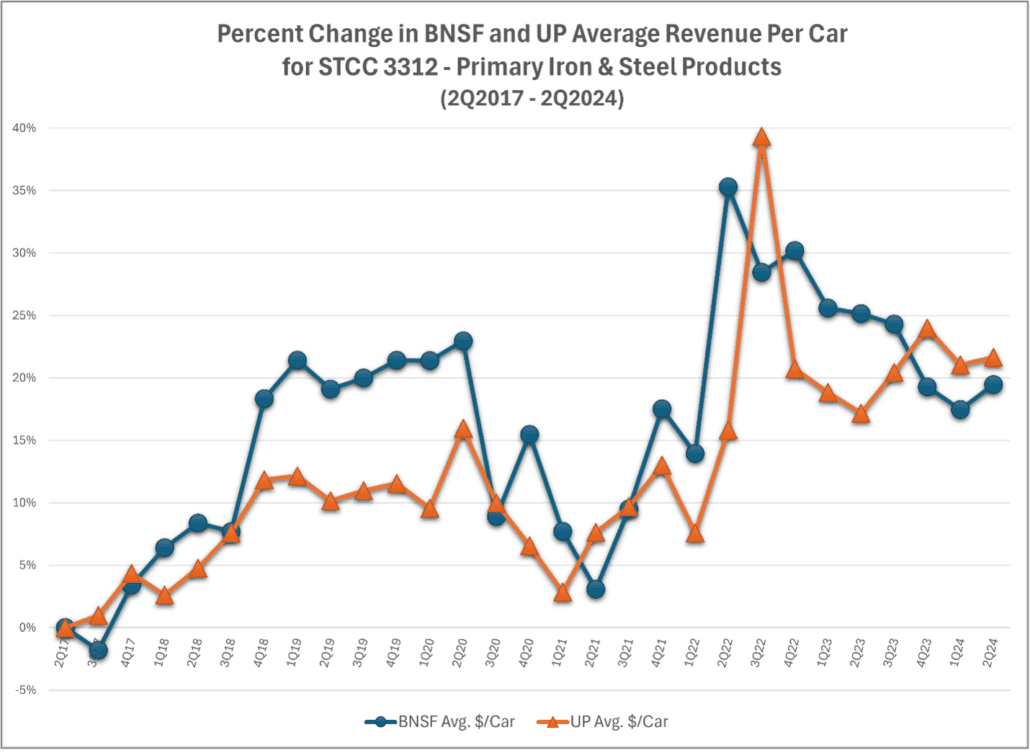
A comparison of railroad’s historical rate changes indicates that railroads are very active with rate benchmarking. The graph below provides an example of the results from railroad benchmarking. It shows the percentage change in average rate per car for all Primary Iron & Steel Products (STCC 3312) BNSF movements, versus UP.

% Change in BNSF & UP Avg Revenue per Car

Source of data: Railroad’s Freight Commodity Statistics as contained in Rail Cost Control

The illustration shows that over the last seven years the percentage change in the average rate per car for all Primary Iron and Steel product moves on BNSF are similar to those of UP. The percentage change in the average rate per car for BNSF and UP frequently separate, but they normally tend to come back to the same type of rate change. The overall average rate change is similar for both railroads during most periods with the railroads exchanging places as to who has the highest rate increases from time to time.

Rail shippers should learn from the practices of railroads and use the data available to them to benchmark their rates against the rates of their competitors.

This is valuable information that will show whether a shipper is being put at a competitive disadvantage in its markets. This market intelligence helps shippers improve their competitive position in markets.

Benchmarking is just common sense. It is always important to find out how well you are doing in the market compared to other companies. To demonstrate, the chart below tracks Grain Mill Products (STCC 204) rates, for movements into the Dallas TX market from major origin locations. Rates are organized on the vertical axis and distance shipped on the horizontal axis.

Waybill Rates for Grain Mill Products

Source of data: Public Use Waybill as contained in Rail Cost Control

The first thing to notice in this illustration is, that the miles for a movement do not necessarily determine the level of the rate for a movement.

For example, movements from Wichita, KS go the shortest distance to Dallas, TX (370 miles) and movements from Des Moines, IA go the longest distance to Dallas, TX (950 miles). However, many of the rates for both of these origins are similar even though Des Moines, IA moves go almost three times the distance. A similar relationship happens with moves from Kansas City, MO. Many of the rates from Kansas City, MO are similar to rates from Des Moines, IA even though Kansas City, MO moves go half the distance to Dallas, TX. This shows that just because you have a geographic advantage in a market does not mean you have a competitive advantage in a market. This is important information for shippers’ marketing and sales departments to know.

When looking at this graph, assume you are a supplier located in Davenport, IA with shipments that travel 950 miles at a rate of $6,701 per car, which is the average rate for all shippers from Davenport, IA into Dallas, TX. Some may say this shipper is getting the average rate from Davenport, IA and has nothing to complain about. But, from the Davenport Shipper’s point of view:

  • Many competitors ship into Dallas, TX with considerably lower rates;
  • Most shippers from Des Moines, IA have significantly lower rates, while shipping a similar distance; and,
  • The average rate into the Dallas, TX market for all movements is $4,589 which is $2,112 less than the average rate from Davenport to Dallas.

If you are a Davenport, IA shipper with a $6,701 rate you would have important issues to discuss with your railroad as you are being put at a competitive disadvantage to shippers from other market areas.

If you are an Omaha NE shipper with a $6,000 rate into Dallas, then the $3000 and $4000 rates of other Omaha shippers are important to discuss with railroads as they are likely hurting your business. Rate benchmarking yields significant savings as it increases your negotiation leverage to obtain better rates for your rail traffic.

Once you know how your rates stack up against competitors in a market, you have a different negotiation with railroads. Your preparation for negotiations will also be different, especially in your important high-volume markets. There are several questions the benchmarking exercise raises:

  1. Are there opportunities to reduce transportation costs through a forward storage site, or transload?

  2. Can a commodity swap or buy/sell agreement with another supplier be negotiated to reduce freight expenses for both companies? (Note- these agreements tend to be short term until a railroad gets the message that you have options)

  3. Can your competitive carloads be bundled with captive carloads in negotiations to obtain better rates from railroads on your captive traffic?

  4. What is the impact on a railroad if you don’t serve specific markets? Will the railroad also lose this business?

Benchmarking rates into a market leads shippers to explore other alternatives for reducing and evaluating rates. The carrier will always say your rate is a market rate; but the carrier’s interpretation of a market rate will include the highest rate any other shipper pays, not necessarily the average rate and certainly not the lowest rate. As long as there is one other shipper with a higher rate, then your carrier’s interpretation will likely be that you have good rates.

Benchmarking helps you educate railroads on:

  • The rates you need;

  • Why you need them; and,

  • The reasons a railroad should give these rates to you.

It is important to benchmark rates with railroads that have monopoly or duopoly power over your traffic. It is important because this is how you determine what rates are reasonable for your traffic. Without the knowledge obtained from benchmarking you will always tend to get rate increases. Companies benchmark to cut costs and improve performance. Railroads do this and so should shippers!

For more information on rail rate benchmarking between specific origins and destinations click the following link to the blog:

Using Competitor Rates to Reduce Your Rates

The process for determining and negotiating more competitive rates for rail movements is an important part of Escalation Consultants’ Rail Negotiation Seminar. This seminar changes how shippers negotiate rates with railroads. The next Rail Negotiation Seminar is in Tampa, FL on March 19th and 20th. Click image below for more information.

Rail Negotiation Seminar

The types of rate benchmarks described in this article are automatically calculated for individual moves or on a macro basis in the Rail Cost Control program (RCC). Click here to learn more about the RCC.

https://www.railcostcontrol.com/wp-content/uploads/7-2.png 540 540 Keith Nestman https://www.railcostcontrol.com/wp-content/uploads/RCC-Logo-2026.svg Keith Nestman2024-11-13 16:39:122024-12-04 18:26:47Benchmark to Reduce Rail Expenses
RCC Blog: 8 Ways to Improve Your Captive Rail Rates

8 Ways to Improve Your Captive Rail Rates

November 13, 2024

Many rail shippers believe that if they are captive to a railroad at a location, they have little leverage to negotiate better rates.

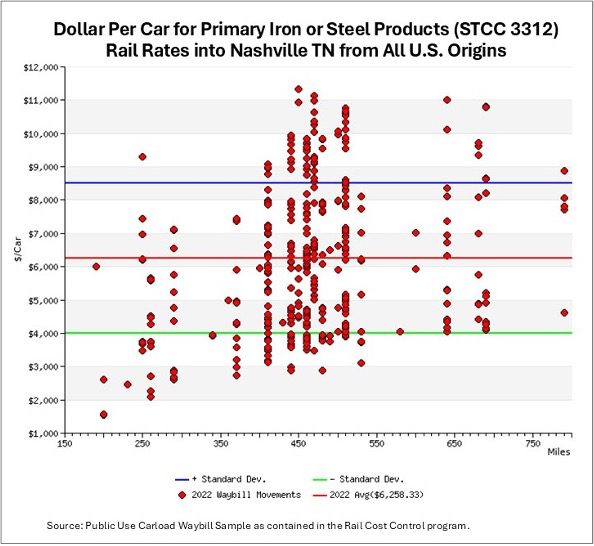
The graph below shows why this isn’t a good way to look at your rail traffic. The graph contains rail rates for Iron or Steel Products (STCC 33123) going into the captive rail market of Nashville, TN.

The question to answer with this graph is:

Why Are Rates So Different at a Destination Market Like Nashville, TN that Is Completely Captive To CSXT?

Dollar Per Car for Primary Iron or Steel Products Rail Rates into Nashville from All US Origins

The graph shows that some rates are below $4,000, while other rates going the same distance, are above $9,000. The question is: If Nashville is a captive market, then why aren’t all rail rates above $9,000?

There are many reasons why rates for specific movements vary, but the big picture answer is very simple, Effective Strategic Planning. Shippers that make railroads look at their traffic differently get better rates from their railroads.

Strategic Planning causes captive moves to have different rate levels. Significant downward pressure on rail rates can be generated when the following issues are addressed by shippers in strategic planning.

Eight Ways to Get Better Rail Rates at Captive Locations:

  1. Railroads need to compete for your business when you have multiple plants that produce the same product.

    • Even when a location is captive to a railroad, a shipper can use geographic competition to obtain lower rates from railroads.
  2. Large shippers that bundle all their rail traffic in an RFP can get better rates at captive locations.

    • In order for a railroad to get more of a shipper’s competitive traffic it must reduce its rates on captive traffic. More traffic is always better than less traffic in rail rate negotiations. RFP’s that take advantage of a shipper’s entire book of potential business increase negotiation leverage.
  3. Forward storage of products at captive locations.

    • To avoid bottle necks at captive destinations, explore forward storage options at sites with rail competition, then truck to captive locations. You don’t have to bypass railroads at captive locations forever. Railroads get the message.
  4. Take freight costs out of the system with commodity swaps or buy/sell agreements

    • Commodity swaps or buy/sell agreements work best when you have a competitor serve your customer when its facility is closer to your customer and you serve a competitor’s customer that is closer to your plant. The higher your rail expenses, the greater the cost savings are for you and your competitor from this type of agreement. Commodity swaps or buy/sell agreements are normally a short-term action as a railroad gets the message pretty quickly that you have competitive options.
  5. High rates create the economic incentive to invest capital to increase your logistics options.

    • The railroad needs to make it uneconomical for a shipper to take traffic off its system. If your rates are too high, then other logistic and capital investment options become more attractive. A railroad must provide rates that discourage a shipper from investing capital to increase its competitive options. Otherwise, a railroads high rate structure could become a big problem for the railroad.
  6. Railroads need to compete against trucking on short and mid distance moves.

    • Large rail rate increases allow trucks to compete with rail for longer distance moves. The cost of trucking needs to become the ceiling price for short and mid distance rail moves.
  7. Political pressure!

    • One of the best and easiest sources of leverage to create is political pressure. Politicians want to talk to you as your company is a great source for tax revenue, political contributions, and you employ many voters. Politicians can be a great benefit because if you have the ear of someone that is important to the railroad, then you become more important to the railroad. There is a right way and a wrong way to address politicians, and all politicians are not equal, which should be considered in your strategic planning.
  8. Foreign Imports: 

    • It doesn’t matter if a railroad’s moves are captive, if imports are reducing your domestic production. The shipper and railroads have the same goal with imports – STOP THE BLEEDING. (Additional information on this topic will be contained in an upcoming Blog Article.)

Rail Negotiation Seminar

If you are interested in ways to effectively reduce the rates for your captive rail movements, you should attend Escalation Consultants Rail Negotiation Seminar. For the last forty years, Escalation Consultants, Inc. has conducted the most highly recommended Rail Negotiation Seminar for shippers. The Rail Negotiation seminar changes how shippers negotiate with their railroads. The next seminar is on March 19th and 20th in Tampa, FL. Click the following link for more information:

Rail Negotiation Seminar

Rail Cost Control Program (RCC)

Escalation Consultants’ Rail Cost Control program and consulting services are used extensively by shippers to help reduce the rate structure for their movements by managing costs and empowering negotiations. For more information about RCC and other related articles on effective methods to reduce rail freight expenses, visit the RCC Blog.

https://www.railcostcontrol.com/wp-content/uploads/8-2.png 540 540 Keith Nestman https://www.railcostcontrol.com/wp-content/uploads/RCC-Logo-2026.svg Keith Nestman2024-11-13 16:23:572024-12-04 18:28:258 Ways to Improve Your Captive Rail Rates
Rail Negotiation Seminar

2025 Rail Negotiation Seminar – Registration Now Open

October 29, 2024

REGISTRATION FOR THE 2025 RAIL NEGOTIATION SEMINAR IS NOW OPEN 

We are happy to announce that registration is now open for the #1 recommended seminar, designed specifically for rail shippers looking to reduce their rail expenses. This highly anticipated event covers proven strategies that increase negotiation leverage with railroads, determining reasonable rates for your rail movements, ways to increase your competitive rail traffic and much more. The Rail Negotiation Seminar changes how shippers negotiate with railroads. The Rail Negotiation Seminar has been the industry standard for shippers looking to reduce rail expenses for more than 25 years. 

Rail Negotiation Seminar

Over the years, this seminar has been attended by thousands of individuals from hundreds of companies that ship by rail.  

We are excited to be able to host this event, once again in Tampa, Florida, and look forward to seeing you all at the Seminar! 

Rail Negotiation Seminar Referrals

https://www.railcostcontrol.com/wp-content/uploads/Rail-Negotiation-Seminar-Survey-Tile-32.png 945 945 Keith Nestman https://www.railcostcontrol.com/wp-content/uploads/RCC-Logo-2026.svg Keith Nestman2024-10-29 17:30:312024-12-05 15:54:112025 Rail Negotiation Seminar – Registration Now Open
Page 2 of 7‹1234›»

Pages

  • About Us
  • AXIS
  • Contact Us
  • Cost Optimizer
  • Costing Dashboard Update
  • Database Management System
  • Evaluation Exercise Calendly
  • Evaluation Exercise Contact Form
  • Home
  • Landing Page – 2025
  • Movement Evaluation Exercise
  • News & Events
  • PopUp Testing 05172021
  • Privacy Policy
  • Rail Cost Control Demo
  • Rail Rate Checker
  • Seminars and Training
  • YT

Categories

  • Uncategorized

Archive

  • August 2026
  • June 2026
  • May 2026
  • March 2026
  • February 2026
  • January 2026
  • December 2025
  • November 2025
  • October 2025
  • September 2025
  • June 2025
  • November 2024
  • October 2024
  • June 2024
  • February 2024
  • September 2023
  • August 2023
  • July 2023
  • June 2023
  • February 2023
  • January 2023
  • June 2022
  • February 2022
  • January 2022
  • December 2021
  • October 2021
  • August 2021
  • July 2021
  • June 2021
  • May 2021
  • April 2021
  • March 2021
  • February 2021
  • January 2021
  • December 2020

Rail Cost Control is a product of Escalation Consultants, Inc.—serving railroad customers since 1979.

Quick Links

  • AXIS
  • Rail Rate Checker
  • Cost Optimizer
  • Database Management System
  • News & Events
  • Seminars & Training
  • About Us
  • Contact Us
  • Login

Contact Info

4 Professional Drive, Suite 129
Gaithersburg, MD 20879

info@railcostcontrol.com
301-977-7459 

linkedinfacebook

© 2025 Rail Cost Control. All Rights Reserved.

Scroll to top

Access FREE Trial to Rail Cost Control and Uncover Savings in Seconds