• RCC Solutions
    • AXIS
    • Rail Rate Checker
    • Cost Optimizer
    • DMS
  • Resources
    • News & Events
    • Seminars & Training
  • Company
    • About Us
    • Contact Us
  • Login
  • Menu Menu

Tag Archive for: Rail Traffic

Posts

Rail Cost Control- Competitive Traffic

6 Ways to Make Railroads Compete for Your Captive Movements 

March 17, 2021

Last week, Escalation Consultants’ blog, “The Cost of Being Captive to a Railroad” showed that traffic railroads view as captive has rates 107% higher than traffic railroads view as competitive. A shipper looking to substantially reduce rates must, therefore, make a railroad compete for more of its traffic. There are a number of ways to do this. The following are six examples to make railroads compete for your captive movements:  

1) Alternate Logistic Options:

The cost of trucking and transloading need to be understood. The higher the rail rate for a move the more viable other logistics options become. It is always good to know the ceiling price for rail movements. The cost of alternate logistics determines this price because once rail costs are higher than other logistic options, a railroad can lose the business. 

2) Create Geographic Competition:

If you produce a product at more than one plant, you can have railroads provide bid rates from each viable plant to customer destinations. This type of geographic competition can make a railroad compete for movements even though a shipper’s plant only has access to one railroad. Geographic competition can significantly reduce the rates for movements as it makes railroads provide competitive rates at captive locations. 

3) Commodity Swap Agreements:

Commodity swaps with competitors are used to reduce logistic cost for both you and your competitors. The framework for a commodity swap: 

      • You have customers closer to your competitors’ plant than your plant,
      • Your competitor has customers closer to your plant than his plant; and, 
      • The competitor serves your customer and you serve your competitors’ customer. 

Companies do not like competitors to serve their customers. However, when cost savings are very large a swap agreement is too good to pass up. The higher a railroad’s cost for a movement, the larger the savings from a commodity swap agreement. This type of agreement does not normally last for multiple years. The railroad gets the message loud and clear. 

4) Perform an Analysis of the Cost of Building a Rail Spur to Another Railroad:

Many rail spur analyses are performed, but few of these build-outs materialize. The reason, if a rail spur is viable, a railroad is under greater pressure to reduce rates. The railroad will need to lower rates to a level that does not provide the economic incentive for you to build the rail spur. Performing an analysis of the viability of building a rail spur to another railroad can be very valuable in captive rate negotiations.

5) Build a Rail Spur to Another Railroad:

If you build a line to another railroad, then you have two railroads competing for your business. This changes your moves from captive to competitive in the railroads’ pricing model. As demonstrated in the blog, “The Cost of Being Captive to a Railroad”, rates for captive moves are on average 107% higher than rates for competitive moves. Building a rail spur represents significant savings as it generates downward pressure on your rates.  

6) Educate Railroads:

A shipper needs to educate railroads on why high rates are bad for both you and your railroads. This means you need to show the overall impact of high rates on your business. The best way to do this is to provide railroad management with information on strategic plans for your company. The information needs to show how railroads can benefit the most and the least from your business, going forward. Railroads have smart people in management. They need to be educated on the benefits of a more competitive rate structure on their business. 

The issues presented to railroads will be different for every company. Developing these issues is an important part of preparation for rail negotiations. Examples will be included in the next blog. 

These types of issues need to be considered in strategic planning designed to drive down rail expenses for captive movements. Every companies’ situation is different, but things that work best to reduce rail expenses do not change.  

To get a better rate structure for your moves, you must make railroads look at your traffic differently! 

This is what strategic planning for rail negotiations needs to accomplish. Escalation Consultants works with companies to reduce rates by accomplishing this objective. The Rail Cost Control (RCC) program facilitates this process. 


Rail Cost Control (“RCC”) is a program developed by Escalation Consultants, Inc. to help shippers reduce rail expenses by managing costs and empowering negotiations. Furthermore, for more information about RCC and other related articles, visit the RCC Blog.
Rail Cost Optimizer

https://www.railcostcontrol.com/wp-content/uploads/rail_cars_in_a_train_yard-1.jpg 1408 1672 Keith Nestman https://www.railcostcontrol.com/wp-content/uploads/new-logo-2.svg Keith Nestman2021-03-17 08:00:552021-06-01 13:51:216 Ways to Make Railroads Compete for Your Captive Movements 
Rail Cost Control Blog Article 11

The Cost of Being Captive to a Railroad

March 10, 2021

Traffic that’s captive to one major railroad is priced significantly higher than traffic where railroads must compete for movements. The difference between Captive Traffic and Competitive Traffic rail rates is very large.

Captive Traffic rates are, on average, 107% greater than Competitive Traffic rates.  

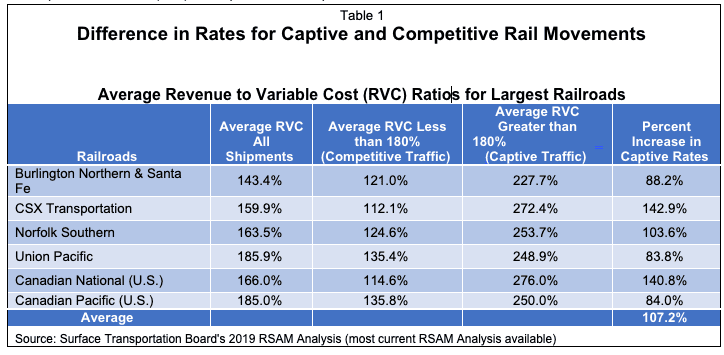
Table 1 demonstrates this rate difference. It illustrates profitability for both captive and competitive movements on the six largest Class I railroads. The table contains the average Revenue to Variable Cost Ratios (RVC) for captive and competitive traffic on each railroad. RVC’s in the table are calculated from the cost and revenue data provided by the Surface Transportation Board (STB) for captive and competitive moves on each railroad. 

Rail Rates for Captive vs Competitive Rail Movements

An RVC measures railroad profitability for movements. It is calculated by dividing the rate for a move by the railroad’s long term Variable Cost (Cost) for the move. Table 1 shows that the 185.9% RVC for Union Pacific (UP) is the highest average RVC. An RVC of 185.9% means that rates are on average 85.9% greater than UP’s Cost for moving its traffic.  

The breakdown of UP RVC’s is 248.9% for Captive Traffic and 135.4% for Competitive Traffic. This makes captive rates for UP 83.8% greater than competitive rates ((2.489 – 1.354) ÷ 1.354). The average increase in captive rates on all six railroads is 107.2%.  

The largest increases in captive rates over competitive rates are on CSXT 142.9%, CN (US) 140.8% and NS 103.6%.   

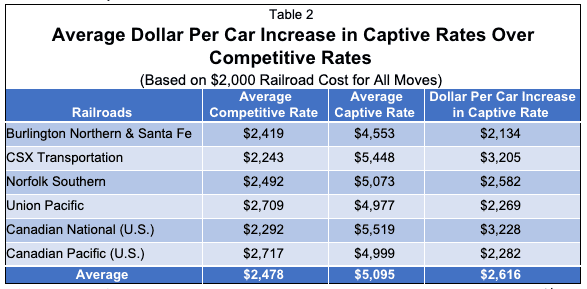
To convert RVC’s in Table 1 to rates, assume that the railroad’s average variable cost of moving captive and competitive carloads is $2,000. Table 2 shows that the average dollar per car increase for all railroads is $2,616.  

The average $2,616 captive rate increase, by itself, is greater than the total rate of $2,478 for railroad’s Competitive Traffic. 

Average Dollar Per Car Increase: Captive vs Competitive Rail Rates

The most significant captive rate increases, as compared to competitive rates, were observed on CSXT ($3,205) and CN (US) ($3,228). These are by far the largest dollar increase in captive rates. 

In order to obtain large rate reductions, shippers must make railroads compete for more of their traffic. There are several ways to accomplish this. With this in mind, Escalation Consultants’ next blog will address: Five Ways to Make Railroads Compete for Your Captive Traffic. 

Note – The US railroad industry is regulated by the STB. An RVC of 180% represents the Jurisdictional Threshold for rail movements. This is because the STB has no authority over rates with RVC’s below 180%. Moves with RVC’s above 180% have high levels of profit and are therefore considered captive by the STB. Rail moves with RVC’s below 180% have lower profit levels, and therefore, considered competitive.  


Rail Cost Control (“RCC”) is a program developed by Escalation Consultants, Inc. to help shippers reduce rail expenses by managing costs and empowering negotiations. Furthermore, for more information about RCC and other related articles, visit the RCC Blog.
Rail Cost Control

https://www.railcostcontrol.com/wp-content/uploads/img_decrease_your_rates_while_increasing_rail_profits.jpg 544 720 Keith Nestman https://www.railcostcontrol.com/wp-content/uploads/new-logo-2.svg Keith Nestman2021-03-10 08:00:272021-04-07 19:37:26The Cost of Being Captive to a Railroad

Pages

  • About Us
  • AXIS
  • Contact Us
  • Cost Optimizer
  • Database Management System
  • Evaluation Exercise Calendly
  • Evaluation Exercise Contact Form
  • Home
  • Landing Page – 2025
  • Movement Evaluation Exercise
  • News & Events
  • PopUp Testing 05172021
  • Privacy Policy
  • Rail Cost Control Demo
  • Rail Rate Checker
  • Seminars and Training
  • YT

Categories

  • Uncategorized

Archive

  • January 2026
  • December 2025
  • November 2025
  • October 2025
  • September 2025
  • June 2025
  • November 2024
  • October 2024
  • June 2024
  • February 2024
  • September 2023
  • August 2023
  • July 2023
  • June 2023
  • February 2023
  • January 2023
  • June 2022
  • February 2022
  • January 2022
  • December 2021
  • October 2021
  • August 2021
  • July 2021
  • June 2021
  • May 2021
  • April 2021
  • March 2021
  • February 2021
  • January 2021
  • December 2020

Escalation Consultants has been serving railroad customers since 1979.

The Rail Cost Control Program is an Escalation Consultants Inc. product. For the last 40 years Escalation Consultants has assisted companies in reducing the delivered cost of their products. We are normally involved with large and small rail shippers in reducing rail expenses on more than a billion dollars in rail spend annually.

Escalation Consultants has spent decades developing tools that automatically seek out and quantify opportunities for reducing rail expenses. The RCC contains these tools and they allow you to look at your movements differently in order to create more cost-effective negotiations with railroads.

To learn about Escalation Consultants Inc, more visit www.EscalationConsultants.com

Quick Links

  • AXIS
  • Rail Rate Checker
  • Cost Optimizer
  • Database Management System
  • News & Events
  • Seminars & Training
  • About Us
  • Contact Us
  • Login

Contact Info

4 Professional Drive, Suite 129
Gaithersburg, MD 20879

info@railcostcontrol.com
301-977-7459 

linkedinfacebook

© 2025 Rail Cost Control. All Rights Reserved.

Scroll to top