• RCC Solutions
    • AXIS
    • Rail Rate Checker
    • Cost Optimizer
    • DMS
  • Resources
    • News & Events
    • Seminars & Training
  • Company
    • About Us
    • Contact Us
  • Login
  • Menu Menu

Archive for category: Uncategorized

RCC Blog - Details on How to Reduce Rail Rates on Captive Moves

Details on How to Reduce Rail Rates on Captive Moves

August 15, 2023

Many rail shippers try to reduce their rail expenses. Those with the most leverage have the most success. The leverage shippers develop with their railroads ultimately determines whose rates increase and whose rates decrease.

From a marketing perspective, leverage with railroads determines whether your company operates at a competitive advantage or disadvantage in its markets. The most important part of any rail negotiation is, therefore, the leverage a rail shipper brings to the table.

Leverage enables a rail shipper to make demands on the railroad. Without leverage, shippers’ rates will tend to increase each year. On the other hand, with leverage, a shipper has much more control over the level of the rate structure for its movements.

To those not directly involved in shipping products by rail (like many in upper management), gaining leverage with a vendor may not seem like that big of a deal. However, once it is recognized that railroads frequently have no competition at the destinations where your products are delivered, the difficulty in obtaining leverage with railroads becomes all too clear. The very nature of the railroad industry makes it more difficult for shippers to obtain negotiating leverage.

However, it needs to be understood that just because you are captive to a railroad does not mean you aren’t able to create negotiating leverage. Many shippers miss out on opportunities to increase negotiation leverage as they don’t fully explore all their opportunities for generating leverage.

To create negotiation leverage with a railroad that believes it has monopoly power over your movements, you must educate that railroad on why it is wrong. To do this a shipper must understand all of its internal options, all of its railroad’s options, and the positive and negative impacts of changes in rates.

As an example, when Escalation Consultants first starts working with a shipper to better control rail expenses the first department we want to talk to, after the transportation department, is marketing and sales. This is because they hold information that can be instrumental in increasing negotiation leverage with railroads. This includes information on:

  1. Business that has been lost

  2. Markets that are not economical for your company to go after

  3. Alternate sourcing options

  4. Your customers ability to use logistic options other than rail

  5. The location of your competitors

In order for shippers to achieve success in controlling expenses on captive rail movements, they need to be creative. To do this effectively, the rail negotiating team will frequently require access to more internal and external information than is normally available in the transportation department.

The issues that work to improve negotiation leverage with railroads tend to be different for every company. However, what works best for every shipper tends to fall in the following areas:

  1. Information from within your own company

  2. Information on your railroads

  3. Intelligence on your primary competitors

  4. Information on potential alternate logistics and sourcing options


Details on each of these options for increasing negotiation leverage will be covered in future blogs. 


Click here for more information on Reducing Rail Rates on Captive Moves or to schedule a discovery call.

https://www.railcostcontrol.com/wp-content/uploads/Rail-Negotiation-Seminar-Survey-Tile-38.png 540 540 Keith Nestman https://www.railcostcontrol.com/wp-content/uploads/RCC-Logo-2026.svg Keith Nestman2023-08-15 15:22:052024-12-05 14:50:45Details on How to Reduce Rail Rates on Captive Moves
RCC Blog - Improving Rail Rates on Captive Movements

A Regulatory Perspective: Improving Rail Rates on Captive Movements

July 11, 2023

Improving Rail Rates on Captive Movements

Large increases in railroad’s profitability are improving shipper’s leverage in rate negotiations on captive movements. This is happening because high levels of railroad profit are factored into the RSAM[1] data that the STB uses to determine the outcome of a 3-Benchmark Rate Challenge. Higher railroad profits result in the RSAM data improving the ability for a shipper to win a 3-Benchmark Rate Challenge. This strengthens negotiation leverage on captive movements. 

As an example, based upon the latest RSAM data, a rail shipper’s captive rates could be similar to competitor. However, they would be considered more than 25% above competitors’ rates in a 3-Benchmark Rate Challenge. This will be a big deal for many rail shippers.  

This blog is not intended to make you an expert on the calculation of the STB RSAM data or on everything that goes into a 3-Benchmark Rate Challenger. The intent of this blog is to provide: 

  1. A general understanding of how the 3-Benchmarks are calculated; 
  1. The impact high railroad profits can have on a shipper’s chance of success in a rate challenge; and, 
  1. The potential change in a shipper’s negotiation leverage on captive rail movements is due to the large increase in railroad profitability.  

Calculating the 3-Benchmarks 

The following benchmarks are used in a 3-Benchmark Rate Challenge. The STB calculates the values for Benchmarks 1 and 2. Shippers and railroads each calculate the 3rd Benchmark. 

Benchmark 1 – RSAM (Revenue Shortfall Allocation Mark-up Ratio) 

  • RSAM represents the average Revenue to Variable Cost Ratio (RVC) a railroad would need to generate from its rates on all captive traffic (traffic with RVC’s above 180%) to be revenue adequate. 

Benchmark 2 – RVC>180% 

  • RVC>180% represents the average RVC a railroad obtains from the rates for all of its captive traffic (traffic with RVC’s above 180%) 

Benchmark 3 – RVC-Comp 

  • RVC-Comp is the average RVC for movement rates that are comparable to the rate for the contested movement.[2]  

Importance of Recent Change in RSAM Values on Shippers Chance of Success in a Rate Challenge  

The latest RSAM data substantially improves a shipper’s ability to win a 3-Benchmark Rate Challenge. This is because the recent increases in railroad profitability put significant downward pressure on railroads’ RSAM values and significant upward pressure on its RVC  > 180% value. Thus, your rates could be comparable to competitors, but be considered 25% above these rates in a 3-Benchmark Rate Challenge. 


To be clear, shippers don’t necessarily need to initiate a 3-Benchmark Rate Challenge at the STB. However, shippers do need to understand that a railroad now has more to lose by not listening to a shipper’s concerns about rates and service on moves where there is a lack of rail competition. 

Schedule a quick discovery call to learn how to best navigate these recent increases in railroad profitability & changes in RSAM Values.


[1] RSAM is Revenue Shortfall Allocation Markup Ratio calculated each year by the STB.

[2] Comparable movement rates must have RVC’s above 180%.

https://www.railcostcontrol.com/wp-content/uploads/Rail-Negotiation-Seminar-Survey-Tile-39.png 540 540 Keith Nestman https://www.railcostcontrol.com/wp-content/uploads/RCC-Logo-2026.svg Keith Nestman2023-07-11 09:00:292024-12-05 14:53:11A Regulatory Perspective: Improving Rail Rates on Captive Movements
RCC Blog - Reasonable RVC's for Captive Rail Movements

Reasonable RVC’s for Captive Rail Movements

June 1, 2023

When looking at what a reasonable margin is for a railroad to make above its cost on captive rail movements you normally get a different answer from a shipper than from a railroad. A shipper logically wants to have a lower rate so it would want the Revenue to Variable Cost Ratio (RVC) for a move to be lower. The railroad benefits from higher rates, so it would normally want a higher RVC. It is therefore interesting to look at how a more neutral party looks at what a reasonable RVC is for captive rail movements.

The Surface Transportation Board (STB) regulates railroads, and it annually puts out two RVC values for captive movements on each Class I Railroad. These RVC values show:

  • RVC>180% 
    • RVC>180% provides the average RVC value each Class 1 railroad is getting from its rates for all of its captive movement (all moves with RVCs above 180%).
  • Revenue Shortfall Allocation Markup Ratio (RSAM)
    • RSAM represents the average RVC a railroad would need on all captive traffic (traffic with RVCs above 180%) to be revenue adequate.

The RVC>180% value provides the average markup above cost a railroad is obtaining on captive movements, while the RSAM value shows the average markup it needs to be revenue adequate.

It is interesting to look at these RVC values for the most current year available (currently 2021), but the historical change in these values is even more interesting.

Historical RSAM and RVC>180% Values for CSXT

The following table shows that between 2018 and 2021 CSXT’s RSAM value decreased 64.5% (243.5% – 179.0%). These yearly RSAM results are quite revealing as to the profitability of railroad movements. The RSAM values show that in order for CSXT to be revenue adequate in 2018, it needed an average RVC of 243.5% on all its captive movements (all moves with RVCs above 180%). The RSAM value decreased each year and by 2021 the average RVC CSXT needed on captive moves to be revenue adequate was only 179%. This 179% RVC RSAM value is less than the 180% Jurisdictional Threshold for captive movements.

The 179% RSAM value in 2021 is a significant indicator of the large increase in railroad profitability that has resulted from the rates and RVCs for CSXT captive movements over the 2018 to 2021 time period. In 2021, approximately 49% of CSX revenue came from movements with RVC’s above 180%.

Reasonable RVC's for Captive Rail Movements

In 2021 there is close to a 100-point difference between the average RVC CSXT is obtaining from its rates on captive movements and the RVC the STB shows that it needs on captive movements to be revenue adequate. It would likely be difficult for a shipper to negotiate rates for captive moves with RVCs below 180%. However, this type of data from a third party like the STB, impacts a shipper’s views on what is reasonable and the rates that are needed for captive movements.

This analysis is not meant to be critical of CSXT. CSXT’s values are simply being referenced for demonstration purposes. The values of other railroads are similar to those of CSXT. As an example, of the four major US railroads, only one has a 2021 RSAM value above the STB’s 180% Jurisdictional Threshold.

Click here to connect with Escalation Consultants’ for a historical summary of RSAM data for all Class I railroads.

https://www.railcostcontrol.com/wp-content/uploads/Rail-Negotiation-Seminar-Survey-Tile-40.png 540 540 Keith Nestman https://www.railcostcontrol.com/wp-content/uploads/RCC-Logo-2026.svg Keith Nestman2023-06-01 21:34:262024-12-05 14:55:23Reasonable RVC’s for Captive Rail Movements
RCC Blog - Improve Negotiating Leverage on Captive Rail Movements

Improve Negotiating Leverage on Captive Rail Movements

February 13, 2023

Shippers Negotiating Leverage Has Just Improved on Captive Rail Movements. 

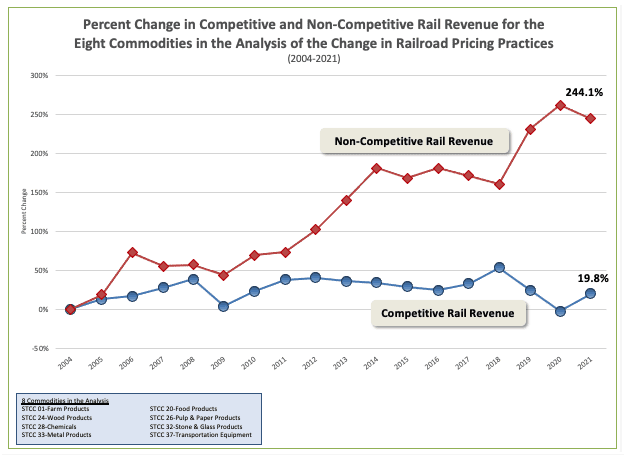
The amount of revenue that railroads receive from rates with Revenue to Variable Cost Ratios (RVC’s) greater than 180% has increased dramatically since 2004.            

Change in Competitive and Non-Competitive Rail Revenue

  1. Non-Competitive Rail Revenue (RVC’s >180%) has increased by 244% since 2004.

  2. This has resulted in a very large increase in railroad profitability.

  3. Shippers need to understand that very large rail profit can increase negotiating leverage with a railroad on captive movements.

To provide context to point 3, the new Revenue Shortfall Allocation Method (RSAM) data just released by the STB has improved shipper’s negotiation leverage on captive rail movements. The high level of railroad profit is factored into the RSAM data, and this improves a shipper’s ability to win a 3-Benchmark Rate Challenge at the STB.

Based upon the new RSAM data a rail shipper’s captive rates could be similar to competitors but be considered more than 25% above these rates in a 3-Benchmark Rate Challenge. This is a big deal!

To be clear, shippers don’t necessarily need to initiate  a 3-Benchmark Rate Challenge at the STB. However, shippers do need to understand that a railroad now has more to lose by not listening to a shipper’s concerns about rates and service on moves where there is a lack of rail competition.

Being smarter about your options improves a shipper’s ability to negotiate better rail rates for its movements. This is what the Rail Negotiation Seminar is about, and it is the reason this seminar is so highly recommended by rail shippers for rail shippers.

The Rail Negotiation Seminar is effective as it provides policies, strategies and negotiation practices that help reduce and better control your rail expenses. In addition, it keeps you current on changes in the marketplace as well as regulatory issues that can have a big impact on your rail expenses.Rail Negotiation Seminar Referrals

For information on the Rail Negotiation Seminar and why this program is so important to shippers in the 2025 rail market, click the link below to obtain a brochure for the seminar.


https://www.railcostcontrol.com/wp-content/uploads/Rail-Negotiation-Seminar-Survey-Tile-41.png 540 540 Keith Nestman https://www.railcostcontrol.com/wp-content/uploads/RCC-Logo-2026.svg Keith Nestman2023-02-13 17:13:062024-12-05 15:21:30Improve Negotiating Leverage on Captive Rail Movements
Percent Change in ALL-LF Index Before and After Error Adjustment

AII-LF: Check Your Index

February 9, 2023


Check the Index You Use to Escalate Multi-Year Rail Contracts


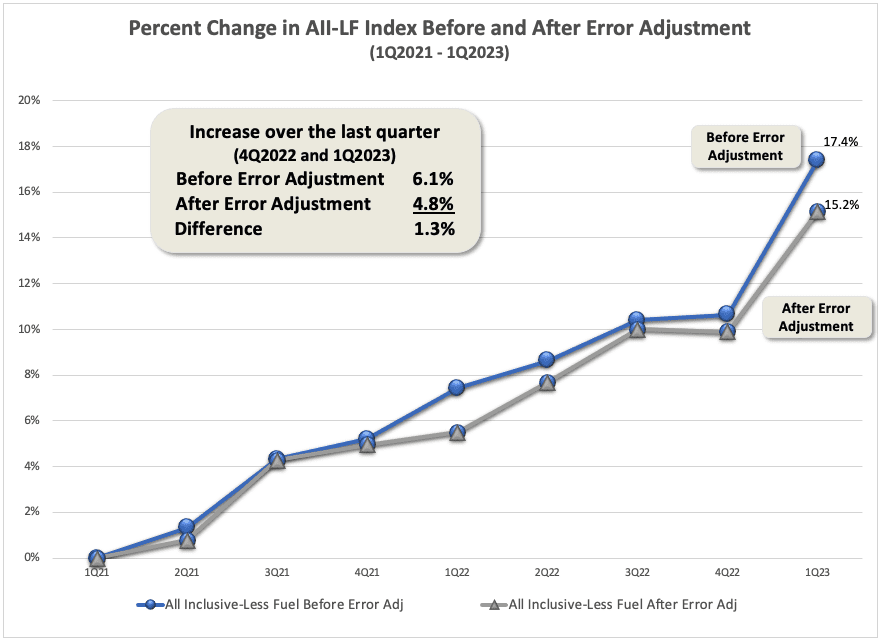
The All-Inclusive Index- Without Fuel (AII-LF) is the primary index used to escalate rail rates in contracts. However, there are two versions of this index that are used to escalate rates and during rapid inflation. One index tends to increase more than the other. The graph shows:

  • Since 1Q2021 the AII-LF index Before Error Adjustment has consistently increased more than the AII-LF index After Error Adjustment.
  • The cumulative difference over the last eight quarters is 2.2% (17.4%-15.2%).
  • The difference over just the last quarter is 1.3% (4Q2022 to 1Q2023)
  • Shippers need to verify which version of the AII-LF index is being used to increase their rates.

All-Inclusive Index- Without Fuel (AII-LF) Changes Over Time

**This graph was generated using the Rail Cost Control program**

The Rail Negotiation Seminar is the most highly recommended program by rail shippers for rail shippers. The seminar is effective as it provides policies, strategies and negotiation practices that help reduce and better control your rail expenses. In addition, it keeps you current on changes in the marketplace that can impact your rail expenses, such as the changes referenced above in the ALL-LF indexes.

Thousands of rail shippers, from every industry that ships by rail, have attended the seminar over the years. Below are some of the observations they have made:

Rail Negotiation Seminar Referrals


Click Link for more information on the Rail Negotiation Seminar. 


https://www.railcostcontrol.com/wp-content/uploads/Screen-Shot-2023-02-09-at-8.12.16-AM.png 644 885 Keith Nestman https://www.railcostcontrol.com/wp-content/uploads/RCC-Logo-2026.svg Keith Nestman2023-02-09 15:53:202024-12-05 15:56:26AII-LF: Check Your Index
Change in RR's Inflation Premium Above Expenses

302% Increase In Rail Premiums Above Expenses

January 24, 2023

2023 Rail Negotiation Seminar Early Bird Pricing

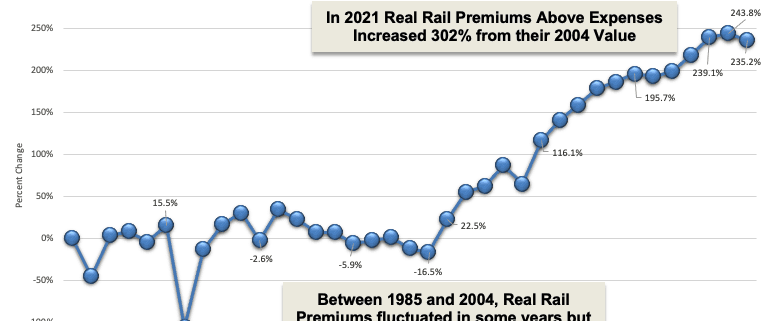
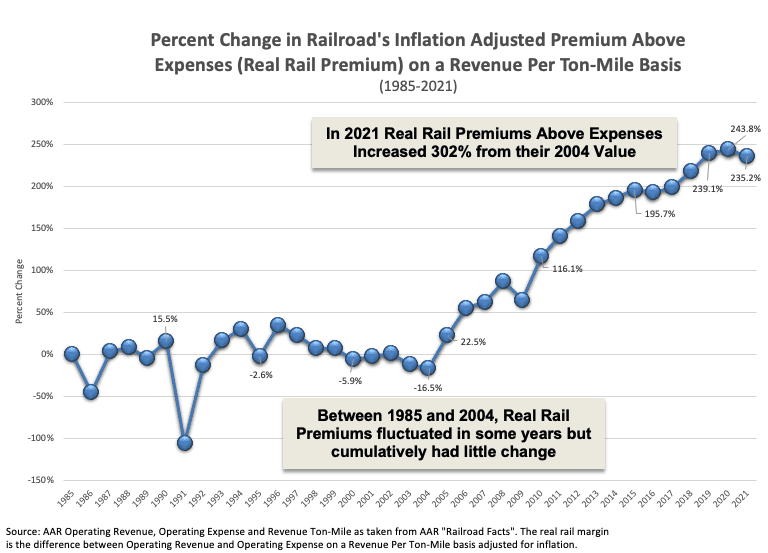
The premium railroads make above their operating expenses, in inflation adjusted terms (Real Terms), has dramatically increased in recent years, but not in the more distant past.

Change in RR's Inflation Premium Above Expenses

The chart shows:

  1. Railroad profit, as measured by the difference between railroad’s Real operating revenue and expenses, increased 302% since 2004.
  2. Over the prior 19 years (1985 – 2004) Real rail profits fluctuated in some years, but cumulatively did not change.
  3. In Real Terms railroad profits simply kept up with inflation between 1985 and 2004.

The goal of effective rail negotiations is for a shipper to minimize rates that generate the type of results obtained by railroads in recent years by developing leverage to maximize the type of results obtained by shippers in prior years.

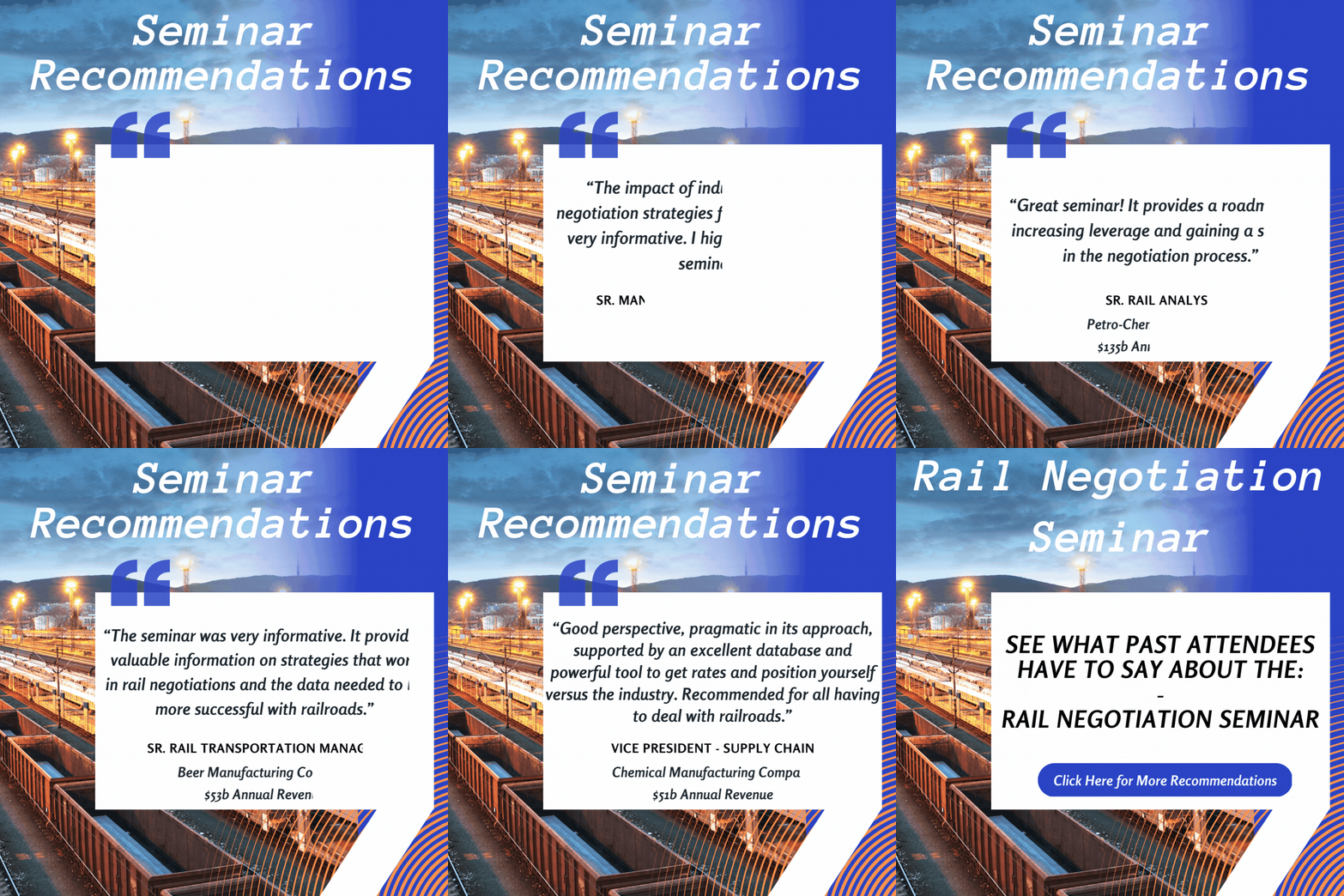
How shippers structure their rail negotiations has a big impact on their ability to control the cost of rail freight. The Rail Negotiation Seminar is a program that is structured to improve rail negotiations and stop shippers’ cost of rail freight from always increasing.  Don’t just take our word, check out the recommendations of past attendees to this program.  

Rail Negotiation Seminar Recommendations

Some important topics covered in the seminar that increase negotiation leverage:

  • Negotiation leverage not related to the competition for a movement
  • The benefits of being proactive and not reactive with railroads
  • Structuring the RFP to reduce cost by creating more pricing options
  • Optimizing your rail spend to increase negotiation leverage with railroads

Don’t wait to register – Early Bird pricing is available through January 31st! For more information about the Rail Negotiation Seminar, click banner below to download the brochure. 

2023 Rail Negotiation Seminar Brochure

https://www.railcostcontrol.com/wp-content/uploads/Screen-Shot-2023-01-24-at-9.05.57-AM.png 553 768 Keith Nestman https://www.railcostcontrol.com/wp-content/uploads/RCC-Logo-2026.svg Keith Nestman2023-01-24 17:49:132023-07-07 15:42:02302% Increase In Rail Premiums Above Expenses
STB’s Annual Rail Rate Index Study: A Deeper Dive

STB’s Annual Rail Rate Index Study: A Deeper Dive

January 23, 2023

As of January 27, 2022, the newly released STB Annual Rail Rate Index Study (Study) summarizes trends in freight rail rates between 1985 and 2019. The Study shows that inflation-adjusted Real Rail Rates have decreased 27% over the past 34 years. Because Real rail rates are lower now than in 1985, the STB Study may be read by some to imply that current rail rates are reasonable in relation to what they have been historically. Unfortunately, this is not an accurate conclusion, because the historical trend in rates provides an incomplete picture of the change in cost of shipping freight by rail.


To read the full article, click below:

STB’s Annual Rail Rate Index Study: A Deeper Dive

https://www.railcostcontrol.com/wp-content/uploads/Screen-Shot-2023-01-24-at-11.40.29-AM.png 1256 1574 Keith Nestman https://www.railcostcontrol.com/wp-content/uploads/RCC-Logo-2026.svg Keith Nestman2023-01-23 18:45:202023-01-24 19:15:52STB’s Annual Rail Rate Index Study: A Deeper Dive
Rail Rate Increases by Commodity

Staggering Rail Rate Increases Across Commodities

January 19, 2023

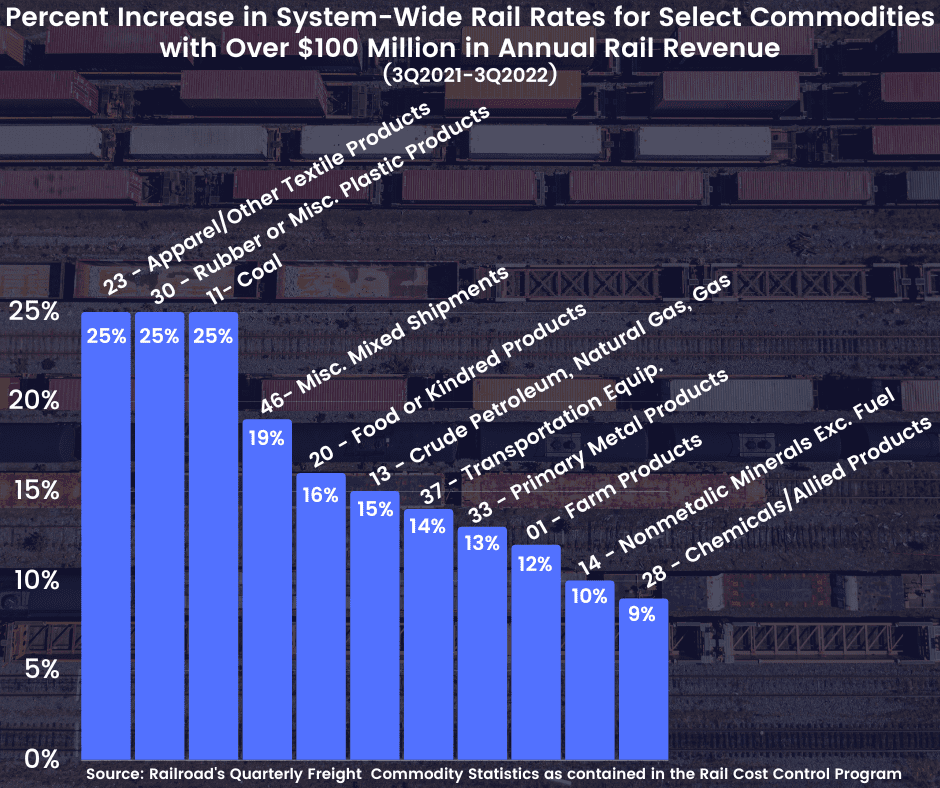
Rail Negotiation Seminar Early Bird PricingThe cost of shipping by rail has increased more in 2022 than any year in the working life of most transportation people!


Rail Rate Increases by Commodity

[Percent Increase Measures the Average Revenue Per Car Including Fuel Surcharge Revenue]


Results from analysis of 2022 rail rates:

  • Double digit rate increases, including fuel surcharge revenue, have become the norm and are no longer the exception.

  • Of the 36 two-digit Standard Transportation Commodity Codes, 69% have had double digit rate increases in 2022.

  • The rate increases railroads are obtaining from different commodities varies dramatically.

Understanding railroads revenue goals for your moves and how you can impact those goals can have a significant impact on your cost of moving rail freight.

The 2023 Rail Negotiation Seminar contains essential information and strategies you need to control rail freight expenses in the current rail market.

Rail rates have increased to the point where the cost of not exploring all your best avenues for better controlling rail expenses is just too costly.

The Rail Negotiation Seminar is an annual event that has changed how many shippers interact with their railroads and this is the most highly recommended program for helping shippers reduce expenses. View the seminar recommendations to find out why.

For information on the Rail Negotiation Seminar and why this program is so important to shippers in the 2023 rail market, click the link below to obtain a brochure for the seminar.

2023 Rail Negotiation Seminar Brochure

https://www.railcostcontrol.com/wp-content/uploads/8-1.png 788 940 Keith Nestman https://www.railcostcontrol.com/wp-content/uploads/RCC-Logo-2026.svg Keith Nestman2023-01-19 19:44:562023-01-19 20:48:51Staggering Rail Rate Increases Across Commodities
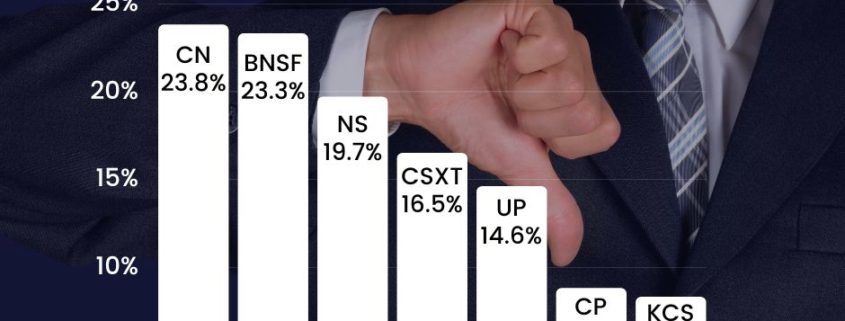
Major Railroad Rate Increases

Big Changes in Cost of Rail Freight

January 13, 2023
Read more
https://www.railcostcontrol.com/wp-content/uploads/2023-Rail-Rate-Percent-Increases-.jpg 788 940 Keith Nestman https://www.railcostcontrol.com/wp-content/uploads/RCC-Logo-2026.svg Keith Nestman2023-01-13 22:02:082023-01-17 18:16:54Big Changes in Cost of Rail Freight
RCC Blog: Acknowledging Railroad Service Issues

Are Railroads Turning the Corner on Bad Service?

June 1, 2022

Much has been written about current problems with the United States supply chain. The problems are far ranging, but the primary focus has been on:

  • The backlog of ships at ports;

  • The breakdown of rail service at major ports, which is making it more difficult to clear docks; and,

  • Poor rail service for important Agricultural commodities like Grain and Fertilizer

To assess the current situation with service, this article takes a closer look at railroad’s overall performance of Intermodal, Unit Train, and Manifest traffic. Railroad operating results indicate that service problems are stabilizing on a large segment of rail traffic and the hope is that this is the start of an overall improvement in rail service.

Change in Carloads

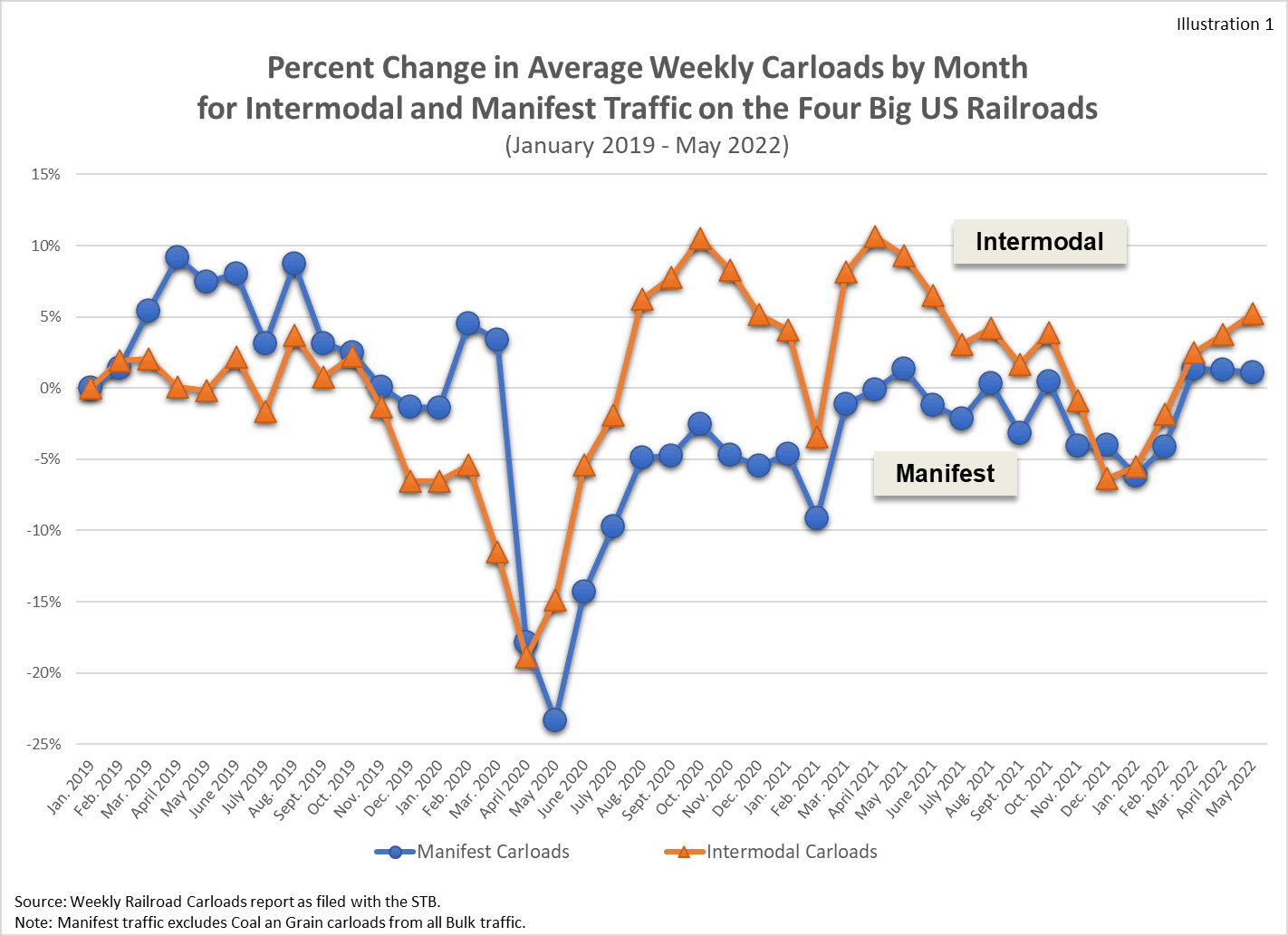
Illustration 1 tracks the percent change in monthly Intermodal carloads versus Manifest carloads on the four major U.S. railroads between January 2019 (beginning of pandemic) and May 2022.

Service Issues Blog 1

Illustration 1 shows that Intermodal carloads recovered more quickly than Manifest carloads from the height of the Covid pandemic in May 2020. Unlike Manifest traffic, Intermodal carloads exceeded pre-Covid levels in much of 2020 and 2021. However, by March 2022 Intermodal and Manifest carloads were both above pre-Covid levels.

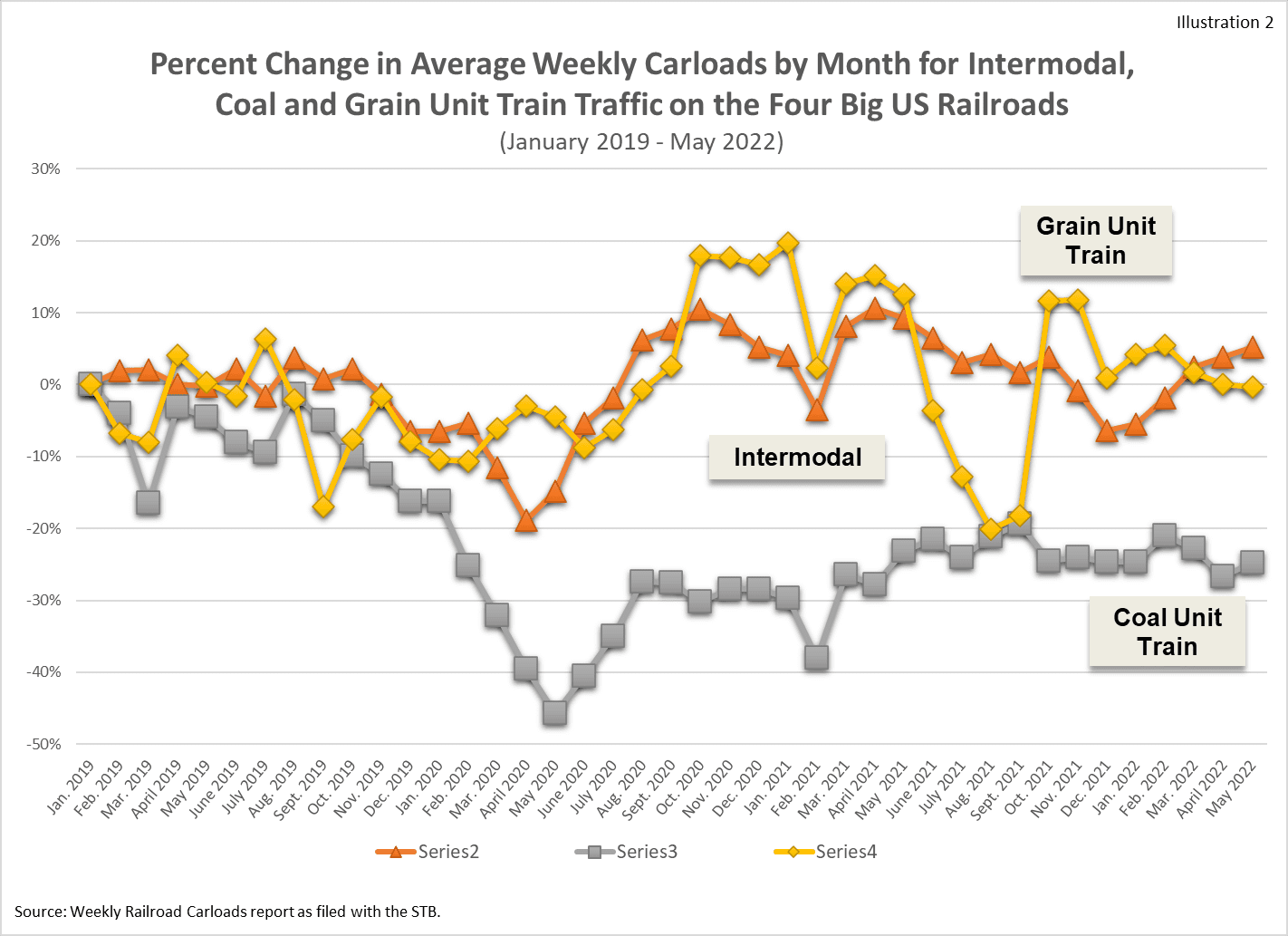
The percent change in carloads for Coal and Grain unit train movements are tracked against Intermodal carloads in Illustration 2. This shows that Grain carloads fluctuate more than Intermodal, but the cumulative percent change is approximately the same as carloads for Grain and Intermodal are both at pre-Covid levels. Coal carloads are down 20% to 30% for reasons that are not related to the Covid pandemic.

Service Issues Blog 2

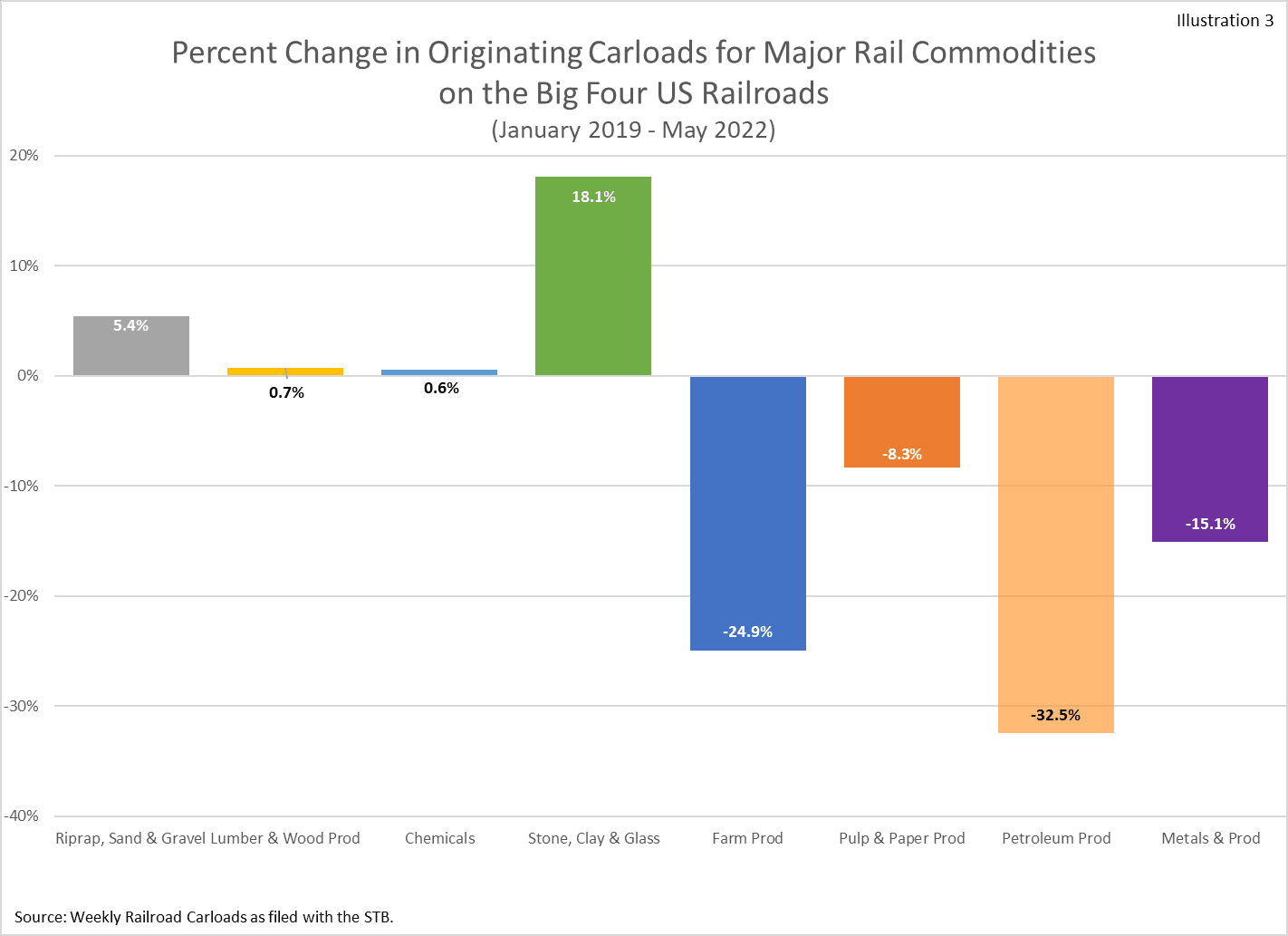
The cumulative change in carloads for other major rail commodities between January 2019 and May 2022 are in Illustration 3. The carload data indicates that service problems are unrelated to an increase in carloads on the rail system, as carloads currently reflect levels similar or below pre-Covid volumes.

Service Issues Blog 3

Change in Train Speed and Dwell Time

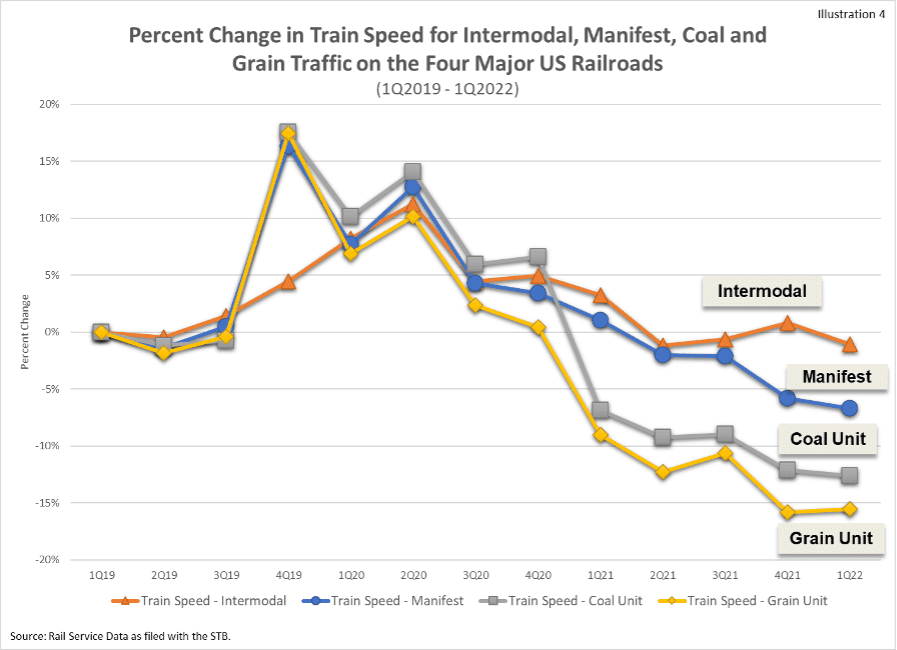
Most rail traffic is moving slower now than before Covid had an impact on the U.S. economy. Intermodal traffic is doing significantly better than Manifest traffic as well as Coal and Grain Unit Train traffic as it is only slightly down from where it was in January 2019.

Illustration 4 shows that the average speed of all types of traffic, other than Intermodal, on the four major U.S. railroads has been in a steady decline since the second quarter of 2020.

Service Issues Blog Illustration 4

Intermodal Train Speed stopped decreasing in the second quarter of 2021, while the speed of Manifest traffic continued to decline.

Overall, the speed of Intermodal traffic is only down 1% since the first quarter of 2019, while the speed of Manifest traffic is down 7% due to a consistent drop in 2021 and 2022. Illustration 4 shows that the decrease in Train Speed is a more significant problem with Coal and Grain Unit Train movements.

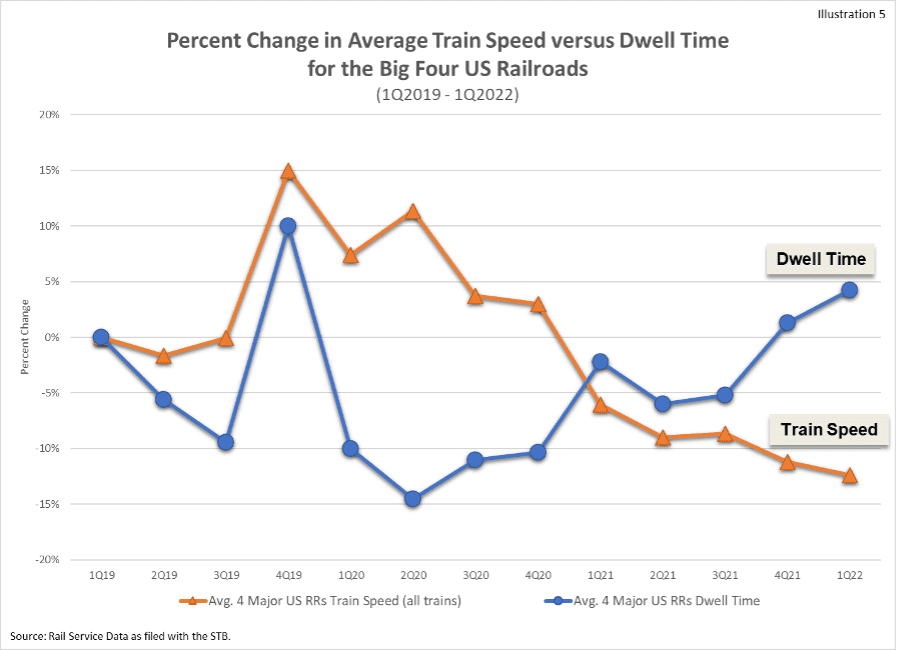
Illustration 5 shows that as Manifest traffic Train Speed started to continually decrease in the second quarter of 2020, the Dwell Time of rail trains at rail terminals continued to increase. This is bad news for rail shippers as trains are spending more time delayed at rail terminals and when leaving the terminal, trains are moving at a slower speed. Illustration 5 shows that this problem has gotten continually worse since the second quarter of 2020. This problem is causing big delays in rail shipper’s deliveries to customers, and it is a significant contributor to the slowdown in the U.S. supply chain.

Service Issues Blog Illustration 5

The one bright spot from this data is that service for Intermodal movements appears to be improving. The Train Speed for Intermodal has been relatively stable since the second quarter of 2021, while Intermodal carloads have had big up and down fluctuations. Intermodal represents a very large percent of all rail traffic, and the hope is that improvements in this area will have a ripple effect on the entire rail system.

Railroad submittals to the Surface Transportation Board (STB) are the source for the data in this report. Current and historical data on rail service, rates, and volumes by commodity and market area are available in the Rail Cost Control program.

https://www.railcostcontrol.com/wp-content/uploads/RCC-Blog-7.png 1080 1080 Keith Nestman https://www.railcostcontrol.com/wp-content/uploads/RCC-Logo-2026.svg Keith Nestman2022-06-01 18:47:052022-06-07 16:07:27Are Railroads Turning the Corner on Bad Service?
Page 3 of 6‹12345›»

Pages

  • About Us
  • AXIS
  • Contact Us
  • Cost Optimizer
  • Costing Dashboard Update
  • Database Management System
  • Evaluation Exercise Calendly
  • Evaluation Exercise Contact Form
  • Home
  • Landing Page – 2025
  • Movement Evaluation Exercise
  • News & Events
  • PopUp Testing 05172021
  • Privacy Policy
  • Rail Cost Control Demo
  • Rail Rate Checker
  • Seminars and Training
  • YT

Categories

  • Uncategorized

Archive

  • March 2026
  • February 2026
  • January 2026
  • December 2025
  • November 2025
  • October 2025
  • September 2025
  • June 2025
  • November 2024
  • October 2024
  • June 2024
  • February 2024
  • September 2023
  • August 2023
  • July 2023
  • June 2023
  • February 2023
  • January 2023
  • June 2022
  • February 2022
  • January 2022
  • December 2021
  • October 2021
  • August 2021
  • July 2021
  • June 2021
  • May 2021
  • April 2021
  • March 2021
  • February 2021
  • January 2021
  • December 2020

Rail Cost Control is a product of Escalation Consultants, Inc.—serving railroad customers since 1979.

Quick Links

  • AXIS
  • Rail Rate Checker
  • Cost Optimizer
  • Database Management System
  • News & Events
  • Seminars & Training
  • About Us
  • Contact Us
  • Login

Contact Info

4 Professional Drive, Suite 129
Gaithersburg, MD 20879

info@railcostcontrol.com
301-977-7459 

linkedinfacebook

© 2025 Rail Cost Control. All Rights Reserved.

Scroll to top

2026 Rail Negotiation Seminar 1